Association LMS for Continuing Education: What It Must Track
What an association LMS needs for continuing education: credit rules, multiple accrediting bodies, expiry, audit reports and AMS write-back.
On this page 7 sections
Short answer
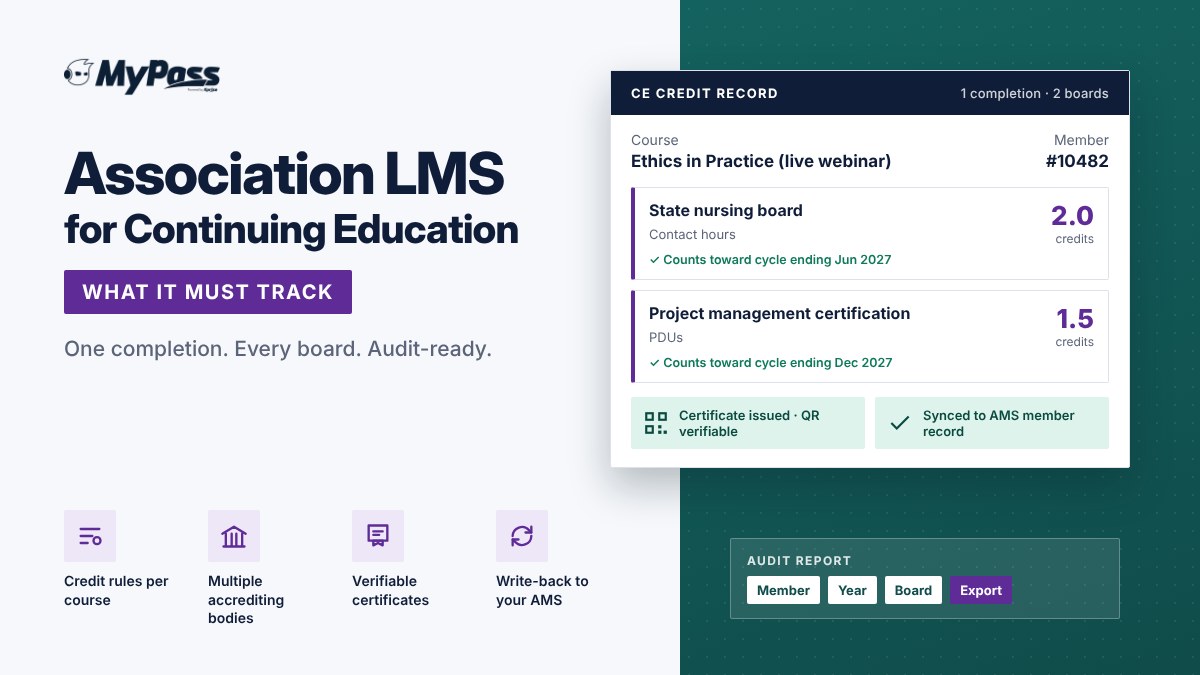
An association LMS for continuing education has one job a generic LMS does not: turn every completion into a credit record that a member, a licensing board and an auditor will all accept. That means credit rules per course, more than one accrediting body, expiry dates, audit-ready reports and a record that lands back in your AMS. If a platform cannot show you those five things on your own course, it is a course player, not a CE system.
Delivering a course is solved. Most platforms play video, run a quiz and mark a learner complete. The difficulty for associations starts after completion. This guide covers what the LMS has to record, which credit types you will be asked to track, where the AMS ends and the LMS begins, and a live test to run on every vendor. If you are still defining the category, start with what an association LMS is and how it differs from a corporate one.
Why continuing education is the hard part
A single webinar can count for different credit types with different boards. A nurse, an accountant and a project manager can attend the same session and each need a different number of credits, under a different body's rules, on a different certificate. Those credits expire on each member's own renewal cycle. Two or three years later, a board may ask for proof.
Associations that track this in spreadsheets usually find out at audit time that the spreadsheet and the certificates disagree. The LMS should be the system of record for credits so that question never comes up.
The eight capabilities to check
Use this table in vendor demos. The right-hand column is what to ask the vendor to show, not tell.
| Capability | Why it matters | Ask the vendor to show |
|---|---|---|
| Credit rules per course | Hours, credit type and accrediting body differ course by course. | One course configured for 1.5 hours with one body and 1.0 with another. |
| Multiple accrediting bodies and jurisdictions | Members hold licenses in more than one state or profession. | One completion issuing two different credit records. |
| Automatic credit issuance | Manual credit entry is where errors and delays start. | A completion producing the credit record with no staff step. |
| Certificates with verification | Boards and employers need to confirm a certificate is real. | A certificate a third party can verify without logging in. |
| Member transcript | Members should answer "how many credits do I have?" themselves. | The member's own view of credits by body and period. |
| Expiry and renewal cycles | Credits only matter inside a member's renewal window. | Reminders sent before a member's credits or certification lapse. |
| Audit-ready reporting | Audits ask for one member, one year or one board, fast. | A report filtered by member, year and accrediting body, exported in one step. |
| AMS write-back | The member record should show credits without double entry. | A completion appearing on the member record in your AMS. |
Tip
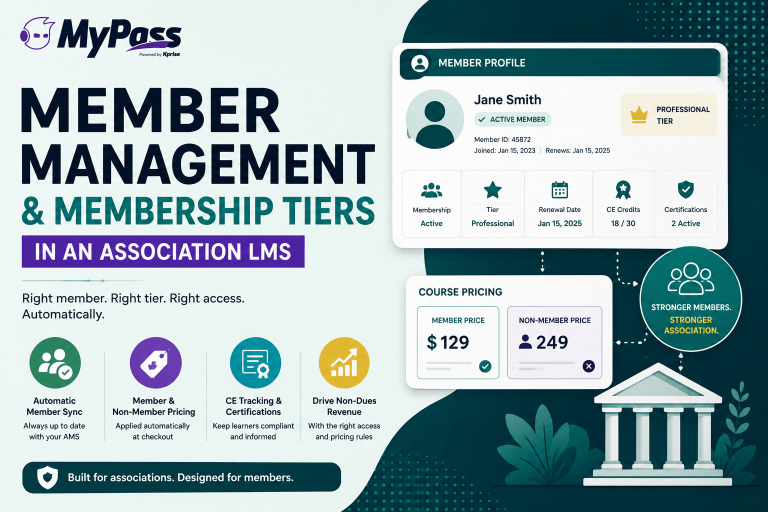
If you sell education to non-members, add a ninth row: member and non-member pricing on the same course, with revenue reported back to the AMS. Our guide to membership tiers in an association LMS covers how to set that up.
Credit types you will be asked to track
"CE credit" is not one unit. These are the ones associations meet most often. Always confirm the current rules with the accrediting body itself.
- CEU (Continuing Education Unit). Commonly 10 contact hours of qualified instruction per CEU, the definition used by IACET.
- Contact hours. Hours of instruction, often used directly by nursing and allied health boards.
- PDUs (Professional Development Units). Used by PMI for project management certifications, generally one PDU per hour.
- CPE (Continuing Professional Education). Used for accountants. Under NASBA standards a credit is based on a 50-minute hour.
- CLE (Continuing Legal Education). Set state by state for lawyers, with different hour definitions and category requirements.
The practical consequence: your LMS has to store the credit type and the accrediting body on each credit record, not just a number of hours. For the basics of the unit itself, see what CEUs are and how they are counted.
What the AMS owns and what the LMS owns
Most CE problems are ownership problems: two systems both think they hold the truth.
| Record | System of record |
|---|---|
| Member identity, dues, membership tier | AMS |
| Course access based on tier | LMS, driven by the AMS tier |
| Completions, scores, time spent | LMS |
| Credits earned and certificates issued | LMS, written back to the AMS member record |
| Event registration and billing | AMS |
The longer version is in AMS vs LMS: which system should own what.
The 20-minute audit test for every vendor
Before you sign, give every finalist the same exercise in a live demo, on a sandbox loaded with one of your own courses:
- Set up one course worth 2.0 credits with one accrediting body and 1.5 with a second.
- Complete it as a test member who holds both credentials.
- Show the two credit records and the certificate the member receives.
- Show that record on the member in your AMS, without an export or import.
- Run the report an auditor would ask for: this member, last year, the second body.
- Show what the member sees 60 days before their renewal window closes.
Key point
A vendor that needs a spreadsheet, a support ticket or "we will follow up" for any step has told you where your staff time will go.
How MyPass LMS handles continuing education
In MyPass LMS
MyPass LMS configures CE rules on each course (hours, accrediting body, expiry and audit fields) and supports multiple accrediting bodies and jurisdictions. Credits are issued automatically on completion, learners get reminders before credits expire, and audit packs can be pulled by member, year or board. Certificates are issued as PDFs with QR-code verification. Completions write credit hours, accrediting body and certificate URL back to the member record, with native sync for iMIS, Nimble AMS, MemberClicks, Fonteva, NetForum, YourMembership, GrowthZone and Personify. See how it works on the MyPass LMS for associations page, or run the audit test above on your own course.
Frequently asked questions
What is an association LMS for continuing education?
It is a learning management system that records each completion as a credit under the right accrediting body, issues certificates, tracks expiry and renewal, and produces audit reports. It usually connects to the association's AMS so credits appear on the member record.
Can a generic corporate LMS track CE credits?
Some can store a number of hours. Few handle multiple accrediting bodies per course, member-specific renewal windows and audit reports by board without add-ons or manual work. Run the audit test above to find out.
Should CE credits live in the AMS or the LMS?
The LMS should calculate and issue credits, because that is where completions happen. The AMS should receive a copy on the member record. Keeping one system of record for credits avoids the two disagreeing at audit time.
How long should we keep CE records?
Follow the longest retention rule among the boards your members report to, and keep the certificate with the credit record. Many associations keep several years of history so members can answer audits after their renewal cycle ends.
Keep reading
Associations & CE
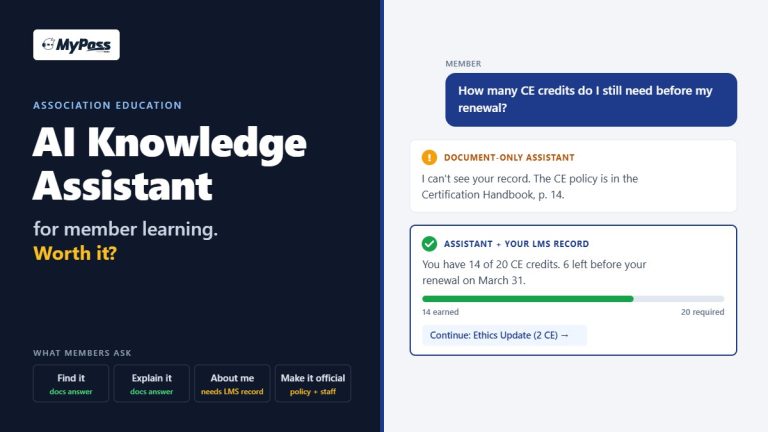
AI Knowledge Assistant for Association Education: Worth It?
Associations & CE
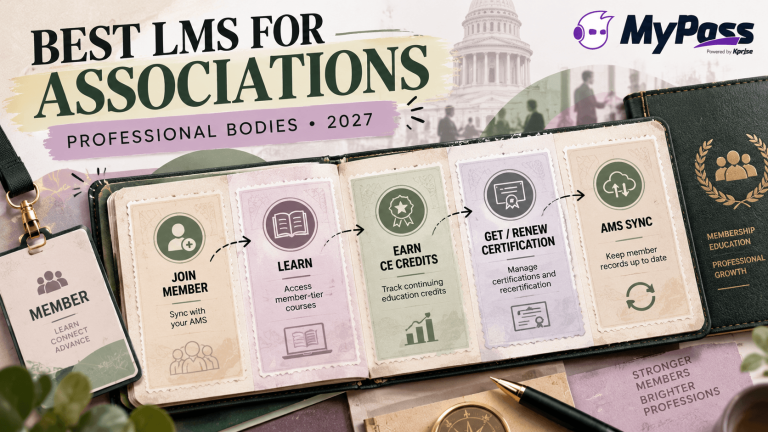
Best LMS for Associations in 2026 (8 Platforms Compared)
Associations & CE