An association LMS has to know who is a member, at what tier, and whether their membership is current, because that determines course pricing, access and continuing education entitlements. Generic learning platforms have no concept of membership, which is why associations end up maintaining access lists by hand or building fragile integrations.
Tier-driven enrolment is the part most platforms cannot do. If you want to see it working against a live AMS, MyPass Association LMS shows the object-by-object sync boundary — what moves, which direction, and what deliberately stays in your AMS.
The question generic platforms cannot answer
A corporate LMS answers one question about a learner: are they an employee. An association LMS has to answer a harder one: are they a current member, at which tier, and what does that entitle them to today.
That distinction sounds administrative. In practice it decides pricing on every course, access to member-only content, continuing education entitlements, and whether someone who lapsed last month can still register at the member rate. Get it wrong in one direction and you give away non-dues revenue. Get it wrong in the other and you charge a paying member full price, which generates a complaint and a refund.
Generic platforms have no concept of membership at all. Associations using one typically end up exporting lists from the association management system, uploading them periodically, and living with the gap in between.
What member management actually has to do
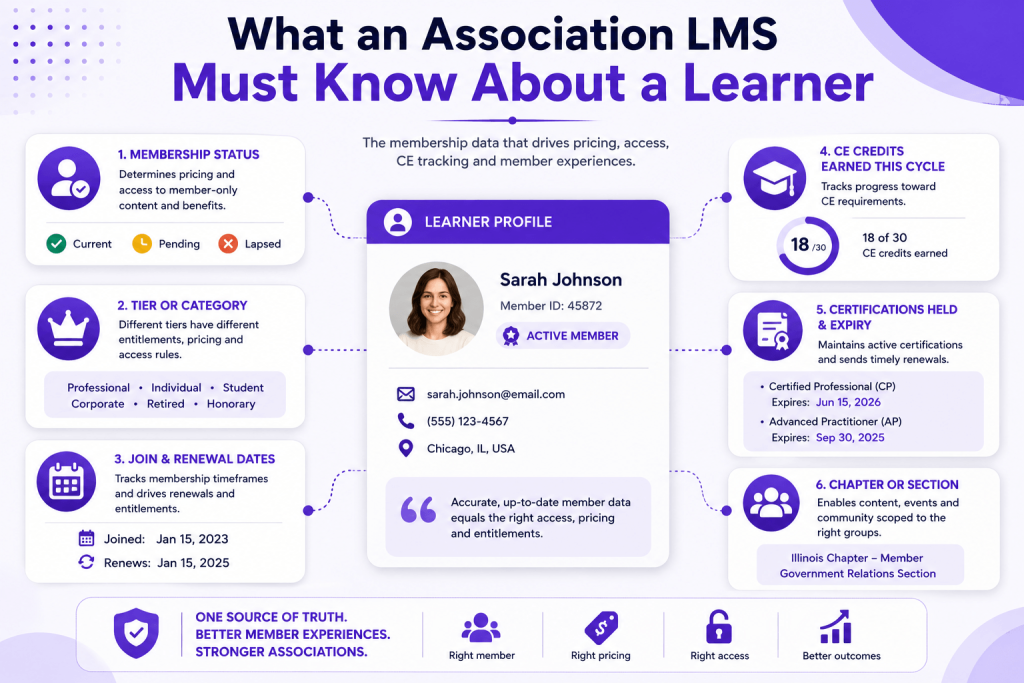
- Membership status, and what happens when it changes. Someone who lapses should lose member pricing and member-only access without anyone remembering to remove them.
- Tier or category. Student, individual, professional, corporate, retired and honorary members frequently carry different entitlements and different course pricing.
- Member and non-member pricing on the same course, applied automatically at checkout rather than through separate catalogues.
- Continuing education credits earned against the member's requirement cycle, with transcripts they can pull themselves.
- Certifications held, including issue and expiry dates, so renewal reminders fire before a credential lapses.
- Chapter, section or special interest group, where content or events are scoped to a subset of the membership.
Why the AMS connection is the whole game
Your association management system is the authoritative record of who is a member. The LMS should not maintain a second, competing version of that truth, because two systems disagreeing about membership status is exactly how the pricing and access errors above happen.
MyPass LMS integrates natively with eight AMS platforms: iMIS, Nimble AMS, MemberClicks, Fonteva, NetForum, YourMembership, GrowthZone and Personify. The integration is included at every paid tier with no separate connector licence, which is worth checking against any quote you receive elsewhere, because connector licensing is where association LMS pricing frequently hides its real cost.
| A question worth asking every vendor: is AMS integration included, or licensed separately per connector, and what happens to that price at renewal? The answer often changes the total cost more than the platform subscription does. |
Why unlimited registered users matters more for associations
Associations carry large rosters relative to how many people are learning at any given moment. A body with eight thousand members might have a few hundred taking a course this month and a few dozen online at once.
Under per-seat pricing, that roster is a liability: you either pay for thousands of accounts that are dormant most of the year, or you restrict enrolment and undermine the member benefit you are trying to deliver. MyPass LMS makes registered users unlimited on every plan, including the free self-hosted Community Edition, and prices hosted plans on simultaneous logged-in capacity instead. Shared Hosting supports up to 50 simultaneous logins and Private Hosting up to 1,000, while registered accounts stay uncapped.
For an association that is the natural shape: put every member in the system, and pay for the infrastructure that serves the ones actually online.
Turning membership into non-dues revenue
Once membership status, pricing and continuing education tracking work together, education becomes a genuine revenue line rather than a member service that costs money to run.
- Sell courses at member and non-member prices from one catalogue, with the correct price applied automatically.
- Use non-member pricing as a membership conversion tool, since the price difference is a visible, recurring argument for joining.
- Attach continuing education credits to purchases, which is what many members are actually buying.
- Bundle education into higher membership tiers as an upgrade incentive.
This works because purchase and enrolment happen in the same system that already knows the buyer's membership status. Bolt a generic store onto a generic LMS and that connection is exactly what breaks.
The bottom line
An association LMS earns its keep by knowing things a corporate platform never needs to know: whether a learner is a current member, at what tier, what that entitles them to, and how many continuing education credits they have earned this cycle. Keep the association management system as the source of truth, connect it natively rather than through periodic exports, and price the platform on capacity rather than on how many members you are allowed to register.
See how AMS integration works, browse the course library, or start a 15-day free trial with no credit card.
Frequently asked questions
What is member management in an association LMS?
It is the platform's ability to know each learner's membership status, tier, renewal dates, continuing education credits and certifications, and to apply pricing and access rules based on them automatically rather than through manually maintained lists.
Which AMS platforms does MyPass LMS integrate with?
Eight: iMIS, Nimble AMS, MemberClicks, Fonteva, NetForum, YourMembership, GrowthZone and Personify. Native AMS integration is included at every paid tier with no separate connector licence.
Can an association LMS offer member and non-member pricing?
Yes, and it should. The same course should carry different prices applied automatically based on the learner's membership status, rather than requiring separate catalogues or manual discount codes, which is where revenue leakage and member complaints originate.
Why does unlimited registered users matter for associations?
Because associations have large rosters relative to concurrent usage. Per-seat pricing forces you either to pay for thousands of mostly dormant accounts or to restrict enrolment. Unlimited registered users lets every member have an account while you pay for infrastructure capacity instead.
How does an association LMS support non-dues revenue?
By selling courses at member and non-member rates from one catalogue, attaching continuing education credits to purchases, using the price difference as a membership conversion argument, and bundling education into higher tiers, all while enrolment and payment happen in the same system.
Still scoping the category rather than the vendor? What an association LMS actually does covers CE credits, certification and the AMS boundary without a pitch.