An AMS (association management system) is your system of record for members — it owns member profiles, dues, tiers and renewals. An LMS (learning management system) is your system of record for education — courses, completions, CE credits and certifications. Associations need both, integrated so member data lives in the AMS while learning happens in the LMS, with credits and certifications syncing back to the member profile.
New to the distinction? Start with our plain-English explainer on what an association LMS actually is, which covers the AMS boundary, CE credits and certification in detail.
The question is usually a symptom of something else
When an association asks 'AMS vs LMS,' they're rarely choosing between the two. Usually one of two things has happened. Either someone is trying to run an education program out of an AMS that was never designed to deliver courses — and it's straining. Or someone is trying to manage membership inside an LMS that has no concept of dues, tiers or renewals — and it's failing quietly.
Both systems touch members. Both track activity of some kind. So the overlap feels larger than it is. The clean mental model is this: the AMS owns *who your members are*. The LMS owns *what they've learned*. Draw that line properly and the two systems make each other more valuable. Blur it and you end up maintaining member data in two places, neither of them fully correct, with no way to tell which one is lying.
What the AMS should own
Your association management system is authoritative for everything about membership itself:
- Member profiles and contact records — the single source of truth for who belongs.
- Membership status, tier and renewal dates — the data that determines what a member may access.
- Dues, billing and membership payments.
- Chapters, committees, and engagement history.
- The official member record that CE credits and certifications ultimately attach to.
iMIS, Nimble AMS, MemberClicks, Fonteva, NetForum, YourMembership, GrowthZone and Personify are all AMS platforms, and they're very good at this. What they are not is learning platforms. Pushing serious course delivery, credit calculation and proctoring into an AMS creates more problems than it solves — and usually produces a learner experience your members quietly avoid.
What the LMS should own
Your learning management system is authoritative for education:
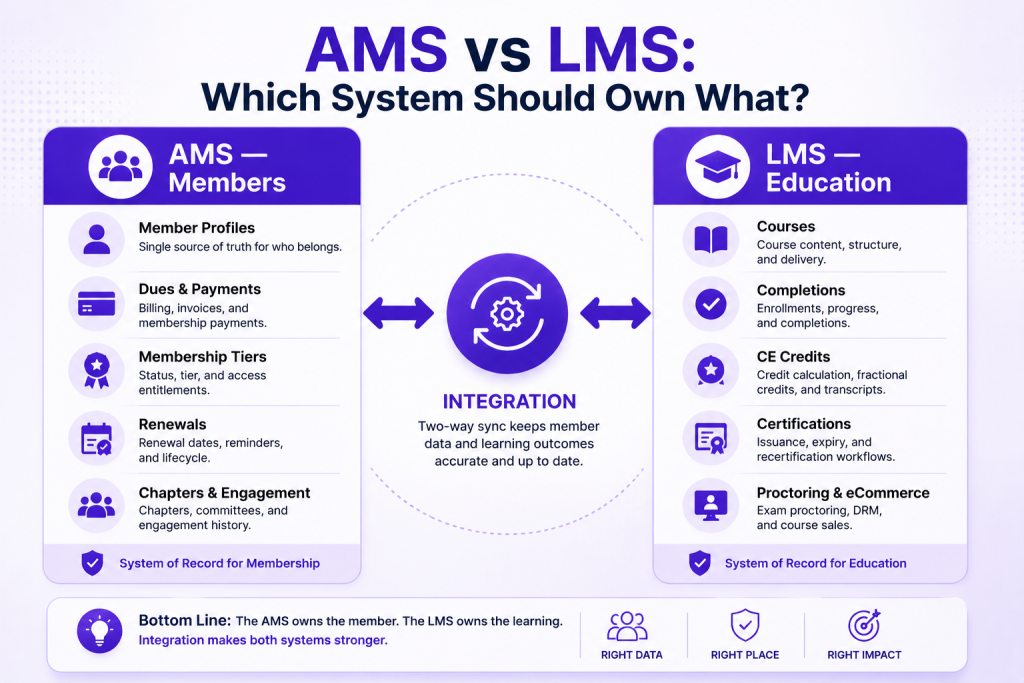
- Course content, delivery and the learner experience.
- Enrollments, progress and completions.
- CE credit calculation, fractional increments and transcripts.
- Certification issuance, expiry and recertification workflows.
- Exam proctoring, content protection (DRM), and course ecommerce.
The LMS holds the detailed record of learning. But the *summary outcomes* — credits earned, certifications currently held — have to flow back to the AMS so the member's official profile stays complete. That's the crossing point, and it's the part associations most often leave manual.
The four things that must cross the line
The boundary isn't a wall, it's a bridge. Four things need to cross it, and this is precisely the job of a real AMS-LMS integration :
- Member identity flows AMS → LMS, so learners never need a second account and single sign-on works.
- Membership tier and status flow AMS → LMS, so course access matches standing automatically as members join, renew or lapse.
- CE credits and certifications flow LMS → AMS, keeping the official member record current and audit-ready.
- Course purchases and revenue data can flow both ways, so non-dues revenue reporting stays intact.
| → The failure mode to watch for: member data drifting between the two systems. The AMS owns the member. The LMS owns the learning. Integration keeps them honest. If your team is maintaining member records in both places, something is misconfigured — and it will surface at audit time. |
So do you need both? Almost always, yes
For any association running education or certification, the answer is both — an AMS to manage membership, an LMS to deliver and record learning, connected by a two-way integration. The alternative, forcing one system to do both jobs, is how associations end up with dated learner experiences, manual CE entry, and audit trails that take days to assemble from exports.
The one decision that determines whether this works: choose an LMS with a named, native, two-way integration to your specific AMS. Not 'API available.' Named. That's what turns two separate systems into one coherent member experience — and it's worth confirming before anything else, as covered in what to look for in a platform built for member organizations .
The bottom line
AMS vs LMS is the wrong framing. It's AMS *and* LMS, each owning its half of the member relationship, connected well enough that neither has to guess. The AMS is your system of record for members; the LMS is your system of record for education; integration keeps identity, access, credits and certifications in step. Draw that boundary cleanly and both systems get more valuable — not less.
MyPass LMS is built to sit alongside your AMS rather than replace it, with native two-way integration to iMIS, Nimble AMS, MemberClicks, Fonteva and four more — so members stay in your AMS while their learning, CE credits and certifications sync automatically. See how MyPass LMS works for associations , or self-host the free Community Edition and test the integration against your own member data.
Frequently Asked Questions
What's the difference between an AMS and an LMS?
An AMS (association management system) manages membership — profiles, dues, tiers and renewals. An LMS (learning management system) manages education — courses, completions, CE credits and certifications. They serve different functions and work best integrated.
Do associations need both an AMS and an LMS?
Almost always. Any association running education or certification programs needs an AMS for membership and an LMS to deliver and record learning, connected by a two-way integration so data stays in sync.
Can an AMS replace an LMS?
Not effectively. An AMS isn't built to deliver courses, calculate CE credits, or run certification and proctoring workflows. Forcing education delivery into an AMS creates manual work and a poor learner experience.
Which system should own member data — the AMS or the LMS?
The AMS should own member data as the single source of truth. The LMS receives member identity via integration and sends learning outcomes — CE credits and certifications — back to the AMS profile.
How do an AMS and LMS work together?
Through a two-way integration: member identity, tier and status flow from the AMS to the LMS, enabling single sign-on and automatic enrollment, while CE credits and certifications flow from the LMS back to the AMS member profile.
If you have settled the boundary question and now need a platform that holds up on the learning side of it, MyPass Association LMS is built for associations specifically — native AMS integration, CE credit tracking and certification management.