| Performance management is the ongoing process of setting clear expectations, giving regular feedback, reviewing progress and developing people so they can do their best work. It runs as a continuous cycle rather than an annual appraisal, and the modern version leans on frequent check-ins, clear goals and real development. |
What Performance Management Actually Means
Ask ten people what performance management is and about eight will describe the annual review. That is fair enough, because for most of us the review is the only part we ever see.
But the review is one meeting inside a much bigger process, and on its own it changes very little. Performance management is everything an organisation does to make sure people know what is expected of them, know how they are doing, and get the support to do it better. Expectations, feedback, review, development. That is the whole thing.
This is why the complaint you hear in every company, that performance reviews are useless, is usually not a review problem. It is that the other three parts were never happening, so by the time the review came round there was nothing to summarise and nowhere for it to lead.
There is a number that makes this uncomfortably concrete. Gallup's engagement tracking in May 2026 found that only 49 percent of United States employees say they know what is expected of them at work. Half the workforce is unclear on the basic question performance management exists to answer. No review template fixes that.
Why the Old Version Stopped Working
The annual review model was designed for an organisation that no longer exists. It assumed a manager with six or seven direct reports, who saw their work closely, and could reasonably hold a year of it in their head.
That assumption has broken. Gartner data reported by Quartz in 2025 found that managers in the United States now oversee roughly three times as many people as they did in 2015, after years of companies cutting management layers. Some of the cuts have been dramatic, with Google reported to have removed about 35 percent of its small-team manager roles and Intel around half of its management positions.
Run the arithmetic. A manager with eighteen reports, asked to write one deep annual review each, is being asked to produce eighteen pieces of evidence-based writing about twelve months of work they only partly saw. What comes out is not an assessment. It is a recollection of the last six weeks, written under time pressure, which is exactly what employees feel when they read it.
The second problem is that managers are the main variable here and the least supported. Gallup's long-running finding is that managers account for at least 70 percent of the difference in engagement between teams. Most of them were promoted for being good at the job and have never been taught how to run a difficult conversation.
| If your managers now have double the reports they had five years ago and the review process has not changed, the process is not failing because people are lazy. It is failing because the maths no longer works. |
The Four Stages of the Cycle
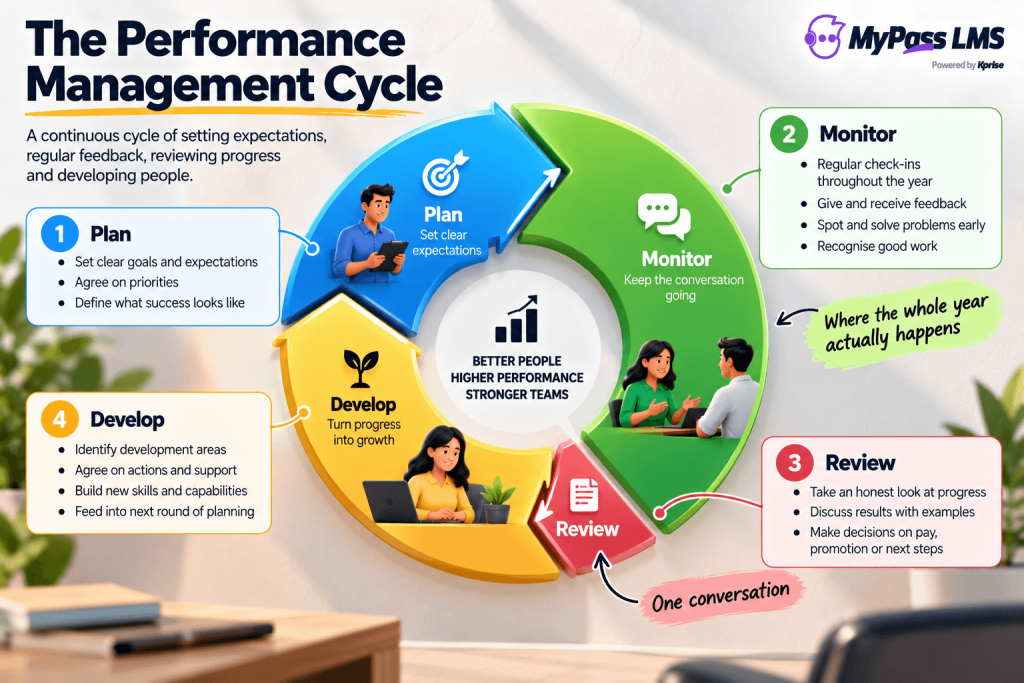
Most frameworks describe four stages, and they loop rather than end.
- Plan. Agree the goals, the standards and how success will be measured. Write it down.
- Monitor. Short, regular check-ins so problems surface early and good work gets noticed while it still counts.
- Review. An honest look back at results against the standards you set, with specific examples.
- Develop. Turn the gaps into concrete actions with dates and support, which then feeds the next round of planning.
The stage organisations skip is almost always monitoring. It is the only one with no deadline, no form and no reminder from HR, so it quietly disappears. And when it does, the review becomes a surprise for everyone in the room.
Annual Reviews or Continuous Check-Ins?
Over the past decade many large employers have dropped the annual rating and moved to frequent, lighter conversations. Not because it was fashionable, but because the annual version has a design flaw. It asks a manager to remember twelve months accurately, and nobody can do that. Recency bias takes over and the last six weeks become the whole year.
That does not mean you should scrap the review. A periodic conversation is genuinely useful. It zooms out, spots patterns and is where decisions about pay, promotion and development get made. What should change is its job. The review should confirm what the person already knew, not reveal it.
| Annual review only | Continuous approach | |
| Feedback timing | Once a year, usually too late to act on | As things happen, while it still matters |
| Accuracy | Skewed by whatever happened recently | Built from examples captured through the year |
| Employee experience | Anxious, and often a surprise | Predictable, very few shocks |
| Manager effort | One heavy burst in review season | Spread out, lighter each time |
| What the review becomes | The entire process | A summary and a planning session |
For most teams the workable middle ground is a fifteen-minute check-in every two to four weeks, a short written note each quarter, and one proper annual conversation that pulls it all together. The check-in does not need an agenda. What are you working on, what is in your way, what do you need from me, is enough.
What Good Performance Management Needs
Three things, and the first is the one organisations work hardest to avoid.
Clear expectations. Vague goals make honest conversations impossible, because there is nothing to compare performance against. "Be more proactive" is not a standard. If you cannot say how you would know the goal had been met, it is not a goal yet. Given that only about half of employees say they know what is expected of them, this is where most of the available improvement sits.
Managers who can hold the conversation. This is the biggest single failure point and the easiest to fix. If you do one thing this year, training your managers to set expectations and give feedback will do more than any new form, template or piece of software.
Development that actually follows the review. A review that identifies a gap and then does nothing about it teaches people the whole exercise is theatre, and they stop preparing for it. The output of a review should be actions with dates, which is what an employee development plan is for.
One way to tell which kind you have: if your reviews produce ratings but no development actions with dates attached, you have an appraisal process rather than a performance management process. The difference shows up a year later, in who is still there.
How to Tell Whether Yours Is Working
Completion rates will not tell you. Ninety-eight percent of forms submitted on time means people are compliant, not that anything improved. Better signals:
- Can your people say what they are being measured on this quarter? Ask it in your engagement survey and compare the answer to the 49 percent national figure.
- Do reviews contain specific examples, or general adjectives like reliable and proactive?
- Did the development actions agreed last cycle actually happen? Most organisations cannot answer this, which is itself the answer.
- Are managers raising problems in month two, or saving them for month eleven?
- Is the share of roles filled internally going up? That means the pipeline is being developed, not just measured.
The third one deserves attention. Plenty of organisations run a decent review conversation and then lose the thread entirely, because the training everyone agreed to lives in a document nobody opens again. Tracking assigned learning against each person's plan is the unglamorous step that turns a conversation into a result, and it belongs alongside your other training metrics and KPIs rather than being measured by course completions alone.
The bottom line
Performance management is not the annual review. It is the continuous loop of agreeing what good looks like, giving feedback while it still matters, reviewing honestly against what you agreed, and turning the gaps into development that actually happens. Skip the monitoring and the review becomes a surprise. Skip the development and the whole thing becomes paperwork. With managers now carrying roughly three times the reports they did a decade ago, and only around half of employees clear on what is expected of them, the fix is not a better form. It is fewer, clearer expectations and more frequent, shorter conversations.
If the development half is where yours falls apart, that is the part MyPass LMS handles. Assign the learning that comes out of a review, then see who finished it. Explore it free.
Frequently asked questions
What is performance management in simple terms?
Performance management is everything an organisation does to make sure people know what is expected of them, know how they are doing, and get the support to do it better. In practice it is a continuous cycle: plan, where you agree goals and standards; monitor, the regular feedback and check-ins through the year; review, an honest look at results against those goals; and develop, concrete actions to close the gaps. The annual review is one part of it, not the whole thing, and on its own it rarely improves anything.
What are the four stages of the performance management cycle?
Planning sets expectations: the goals, the standards and how success will be measured. Monitoring is the ongoing part, short regular check-ins so issues surface early and good work gets noticed. Reviewing compares actual results against those expectations using specific examples. Developing turns the gaps into actions with dates and support attached, which feeds straight into planning the next period. They loop rather than finish. The stage most organisations skip is monitoring, because it is the only one with no deadline or form forcing it to happen.
Are annual performance reviews still worth doing?
Yes, but as a summary rather than the whole process. A periodic conversation is useful for zooming out, spotting patterns and making decisions about pay, promotion and development. The problem with annual-only reviews is accuracy. No manager reliably recalls twelve months of work, so the most recent weeks dominate, and that problem has got worse now that managers carry roughly three times as many reports as they did in 2015. The fix is not to abolish the review but to add frequent lighter check-ins, so the annual conversation confirms what the person already knew.
What is the difference between performance management and performance appraisal?
An appraisal is a backward-looking assessment, usually a rating and a form at a fixed point in time. Performance management is the whole ongoing system the appraisal sits inside: setting expectations, giving feedback through the year, reviewing, and developing people based on what the review found. The quickest way to tell which one you are running is to look at what comes out of it. If your reviews produce ratings but no development actions with dates attached, it is an appraisal process under a different name.