Training Metrics and KPIs That Actually Matter
Training metrics and KPIs that show real impact: completion, time to proficiency, behavior change and business results, with how to measure each one.
On this page 7 sections
The Vanity Metric Problem
For years, training was measured by consumption: how many people completed a course and how many hours they spent. In 2026 those numbers are widely treated as vanity metrics, useful for monitoring delivery but misleading as a measure of success. A 100 percent completion rate tells you people clicked through. It tells you nothing about whether they learned anything or changed how they work.
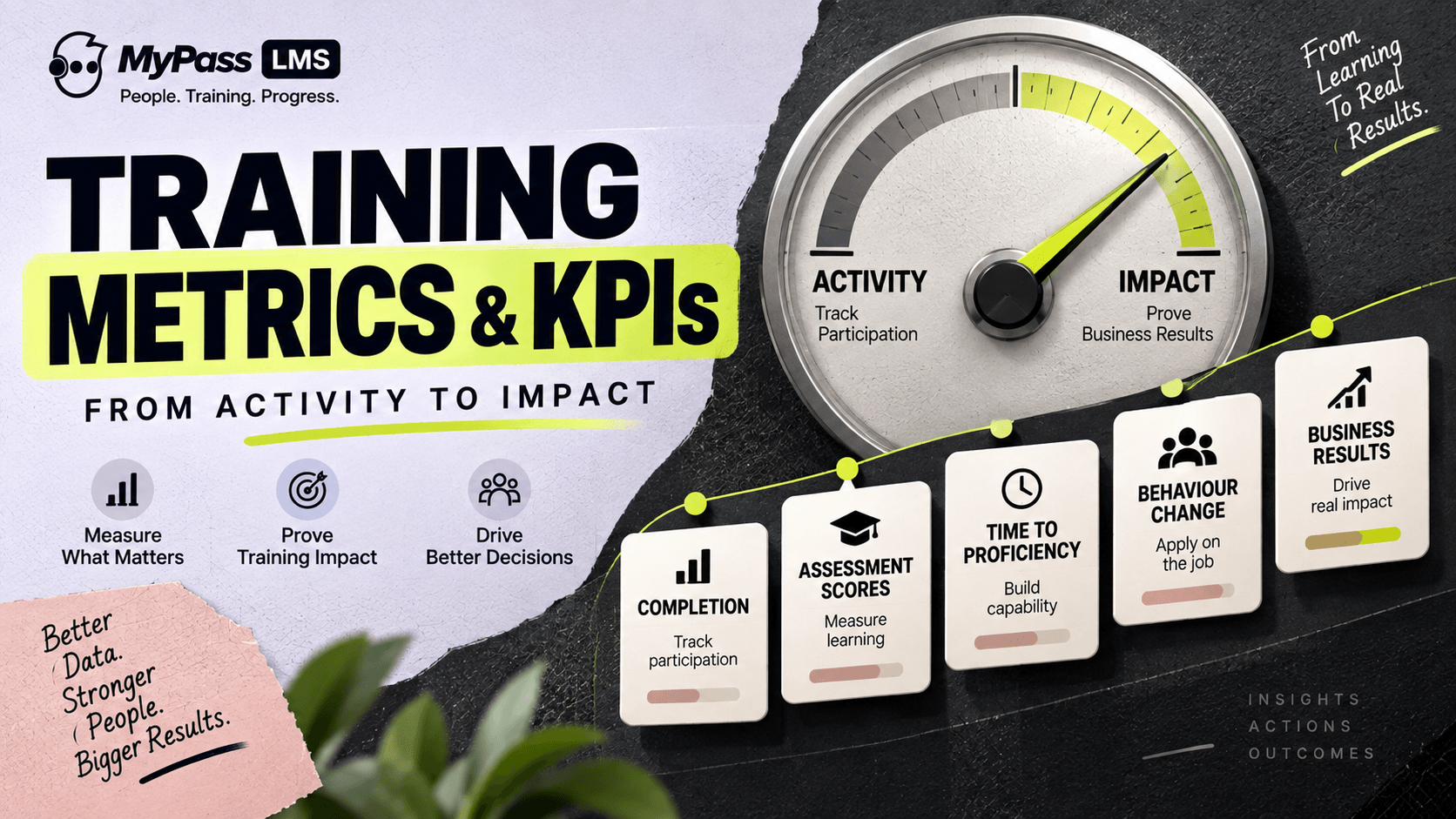
The shift is from measuring activity to measuring impact. Training metrics track what happens during learning; KPIs connect that learning to outcomes the business cares about. You need both, but the second is what proves L&D is worth funding, and it is where most teams are weakest.
Key point
A completion rate is an input. It belongs on your dashboard, but never as the headline. If completion is the only number you report, leadership has no way to know whether training worked.
Metrics vs KPIs
It helps to separate the two clearly, because they answer different questions.
| Training metrics | Training KPIs | |
| Focus | What happens during learning | Whether learning changed outcomes |
| Examples | Completion, seat time, satisfaction | Time to proficiency, behaviour change, ROI |
| Good for | Monitoring delivery and participation | Proving business impact |
| Risk if used alone | Looks busy, proves nothing | Harder to measure, but what matters |
Metrics are the easy, always-available numbers. KPIs take more effort to capture because they require connecting learning data to performance data, but they are the ones that answer the question leadership actually asks: did this make a difference.
The Metrics Worth Tracking
Group your measures so each layer builds toward impact. A useful way to structure them mirrors the classic training evaluation levels: reaction, learning, behaviour and results.
- Reaction: learner satisfaction and engagement. Quick to gather, weakest as proof, but a signal of content quality.
- Learning: assessment scores and knowledge retention, ideally with follow-up checks weeks later, not just at the end.
- Behaviour: whether people actually apply the training on the job, seen through manager observation and performance data.
- Results: the business outcomes, such as time to proficiency, error or incident rates, quality, retention and revenue impact.
Key point
The single most valuable KPI for most teams is time to proficiency: how quickly a new or promoted employee reaches full performance. It is concrete, business-relevant, and directly affected by good training.
Choosing the Right KPIs for Your Goal
Do not track everything. The right KPIs depend on what the training is for, and tracking a focused set beats drowning in a dashboard nobody reads.
| If the training is for | Track above all |
| Onboarding | Time to proficiency, 90-day retention |
| Compliance | Completion by deadline, audit-ready records, incident rates |
| Sales enablement | Ramp time, attach and win rates |
| Upskilling | Skill/assessment gains, internal mobility |
| Customer education | Product adoption, support ticket volume, churn |
Notice completion appears only where it is genuinely the point, compliance, where finishing by a deadline is a legal requirement. Everywhere else, it is a supporting metric, not the KPI.
How Your LMS Makes This Measurable
The reason many teams fall back on vanity metrics is practical: outcome data is harder to collect when it lives in different systems. The closer your assessment, completion and progress data sit to one another, the more measurable the real KPIs become.
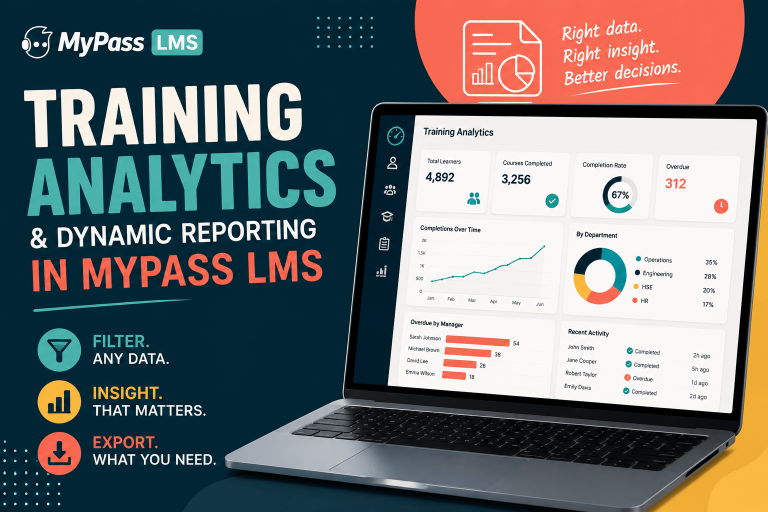
MyPass LMS captures the learner side in one place: completions, assessment scores, time on content and progress across learning paths, all in dynamic reporting and audit-ready records. That gives you the learning-level and behaviour-level data cleanly, and a foundation to connect to the business results you track elsewhere, so you can report impact rather than just activity.
- Assessment scores and pass rates, not just completion.
- Progress across learning paths, so you can see time to proficiency.
- Audit-ready records for compliance KPIs.
- Dynamic reporting you can filter by team, role or program.
The bottom line
The training metrics that matter are the ones that prove impact, not the ones that are easiest to collect. Completion rates and seat time monitor delivery; KPIs like time to proficiency, behaviour change and business results prove worth. Track a focused set tied to each program's goal, and lead with outcomes rather than activity.
Making outcome data measurable starts with clean learning data in one place. See how dynamic reporting and assessment tracking work in MyPass LMS features, read how to measure training effectiveness, or start a free trial.
Frequently asked questions
What are the most important training metrics to track?
The most important are outcome-focused: assessment scores and knowledge retention, time to proficiency, behaviour change on the job, and business results such as error rates, quality, retention and revenue impact. Completion rates and seat time are useful for monitoring delivery but should never be the headline, because they measure activity rather than whether training worked.
Why is course completion rate a vanity metric?
Because it measures whether people clicked through a course, not whether they learned anything or changed how they work. A high completion rate can sit alongside zero performance improvement. It is a useful input for monitoring participation, but as a measure of success it is misleading. The exception is compliance, where completing by a deadline is itself the requirement.
What is the difference between a training metric and a KPI?
A training metric tracks what happens during learning, such as completion, seat time or satisfaction. A KPI connects learning to an outcome the business cares about, such as time to proficiency, behaviour change or ROI. Metrics monitor delivery; KPIs prove impact. Effective measurement uses both but leads with KPIs.
How do you measure training ROI?
Connect the cost of the training to a measurable business outcome it was designed to move, such as reduced errors, faster ramp time, higher sales or lower churn, then compare the gain to the investment. This requires defining the business goal before the training and capturing outcome data afterward, which is why measurement has to be planned from the start, not bolted on later.
Keep reading

Tracking & ROI
How to Reduce Training Costs Without Cutting Quality
Tracking & ROI