Post-Training Survey Questions Worth Asking (With Examples)
Post-training survey questions you can copy, grouped by goal: reaction, learning, confidence and on-the-job use. Plus when to send them and how to act on answers.
On this page 7 sections
Short answer
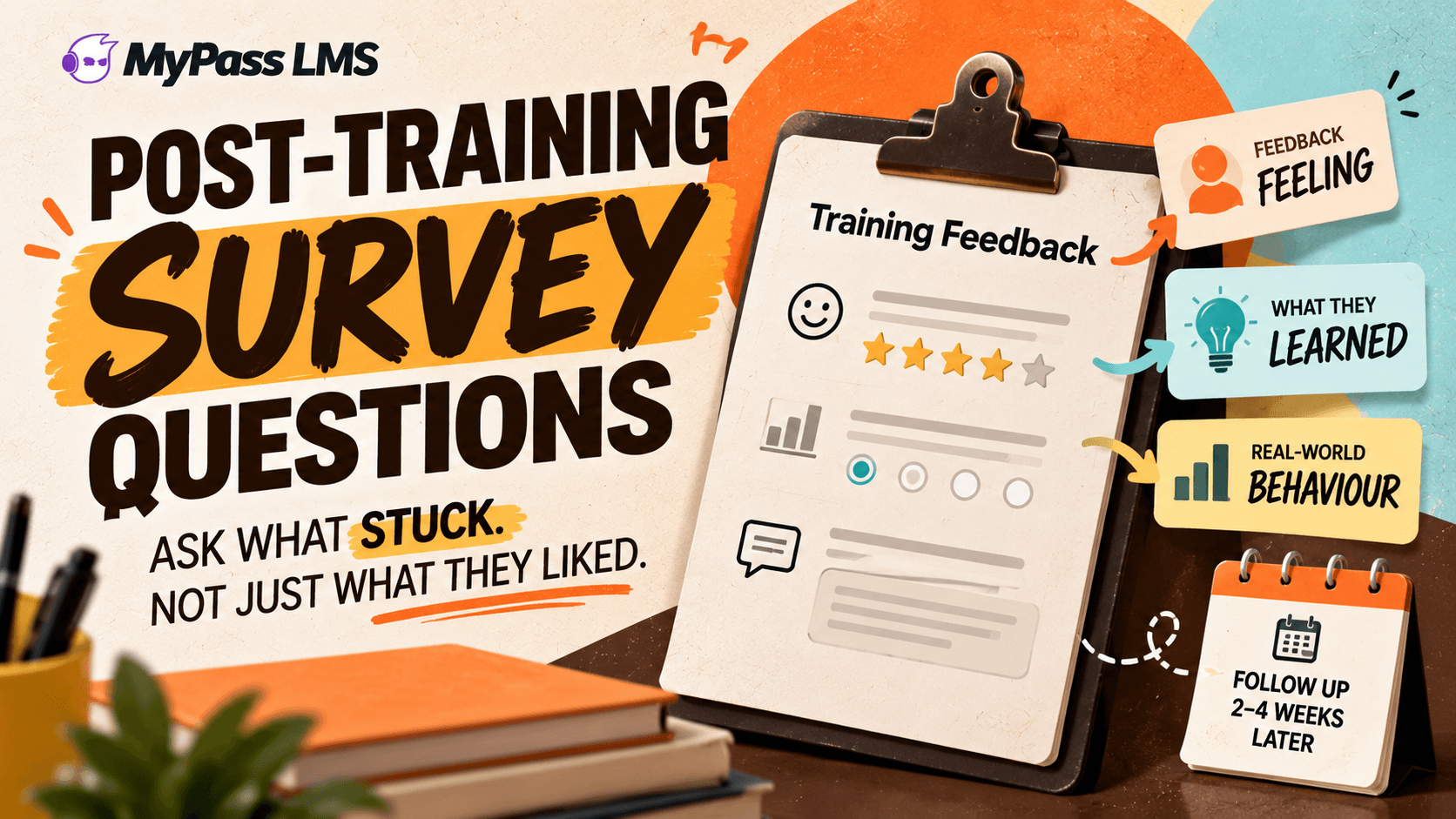
The best post-training survey questions go beyond whether people enjoyed it. Ask what they can now do differently, how confident they feel applying it, what was missing, and whether they'd recommend it. Mix rating scales with one or two open questions, keep it short, and send a follow-up weeks later to see what actually stuck.
First, Why Most Training Surveys Are Useless
Here's the survey almost everyone sends: "Did you enjoy the training? Rate 1 to 5." People tick a 4, you file it away, and you've learned nothing about whether the training worked. Enjoyment is nice, but it doesn't tell you if anyone can do their job better, which is the whole point.
A good survey is the difference between a warm feeling and real information. The questions below are grouped by what they actually measure, so you can pick a handful that answer the question you care about, rather than sending a long form nobody finishes.
Key point
A quick gut check: if every question on your survey could be answered without the person having learned a single thing, your survey is measuring mood, not training. Add at least one question they can only answer if the training landed.
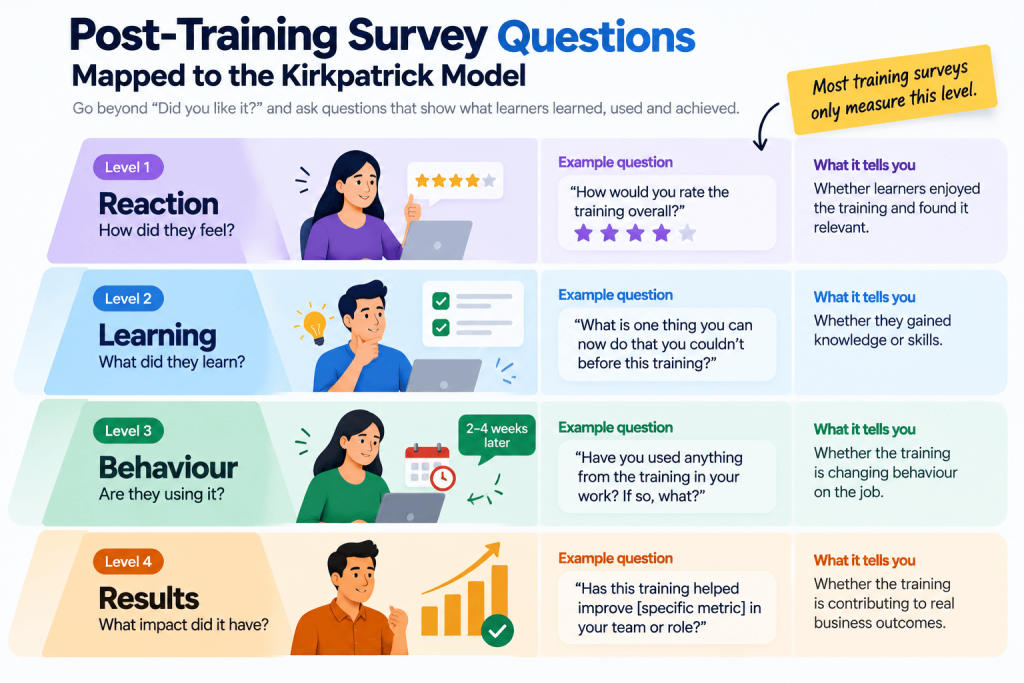
Questions About the Experience
Start with the basics, because a session that was too fast, too long or badly delivered won't teach anyone regardless of the content. Keep this section short; it's the least important part.
- How would you rate the training overall? (1 to 5)
- Was the pace right for you, too slow, about right, or too fast?
- Was the length appropriate for the material?
- How clear was the trainer or the content?
Questions That Actually Measure Learning
This is the section most surveys skip, and it's the one that matters. You want to know whether people took something away and feel ready to use it, not just whether they had a pleasant hour.
- What is one thing you can now do that you couldn't before this training?
- How confident do you feel applying what you learned? (1 to 5)
- Which part of the training will be most useful in your actual job?
- Was anything still unclear by the end?
- What, if anything, was missing that you expected to be covered?
The Follow-Up Question People Forget
The single most revealing question can't be asked on the day, because on the day everyone is optimistic. Send a short follow-up two to four weeks later and ask one thing: "Have you actually used anything from the training in your work? If so, what?"
That one question separates training that changed behaviour from training that felt good and evaporated. If the honest answer is "no, not really," you've learned something far more useful than any same-day rating, and it points you straight at what to fix, usually reinforcement, relevance, or the chance to apply it.
Key point
Two questions, three weeks apart, beat a twenty-question form on the day. Ask "how confident are you?" right after, and "what have you actually used?" a few weeks later. The gap between those two answers is your real result.
How to Run Surveys Without the Admin Headache
Good intentions die on logistics. If sending a survey means exporting a list, building a form, chasing responses and stitching results together by hand, you'll do it once and quietly stop. The trick is to make feedback part of the course itself rather than a separate chore.
In MyPass LMS you can attach surveys and assessments to a course, so learners answer as part of completing it and you're not chasing anyone. Results land alongside completion data, and because reporting is built in, you can see patterns across a whole cohort, which sessions score low on "was anything unclear," where confidence drops, instead of reading responses one by one. That's what makes running surveys sustainable rather than a one-off.
Key point
Start tiny: add just two questions to your next course, one confidence rating and one open "what was missing." You'll get more usable insight from those two than from the long survey you keep meaning to build.
The bottom line
The point of a post-training survey isn't to collect smiley ratings, it's to find out whether the training did anything. Ask what people can now do, how confident they feel, what was missing, and then, weeks later, what they've actually used. Keep it short, mix ratings with a couple of open questions, and you'll get answers you can act on.
And make it easy on yourself, because a survey you can't sustain teaches you nothing. See how attaching surveys and reporting on results works in MyPass LMS features, or read how to measure training effectiveness. Ready to try it? Start a free trial.
Frequently asked questions
What questions should I ask in a post-training survey?
Ask a few about the experience (overall rating, pace, clarity), but spend most of the survey on learning: what can they now do that they couldn't before, how confident do they feel applying it, which part will be most useful, and was anything missing or unclear. Then send a short follow-up a few weeks later asking what they've actually used. Mix rating scales with one or two open questions and keep the whole thing short.
How long should a post-training survey be?
Short, five to eight questions is plenty for most training. Response rates fall fast as surveys get longer, and a survey nobody finishes tells you nothing. It's better to ask a handful of well-chosen questions that reach real learning than a long list that only measures whether people enjoyed the session. If you want deeper insight, split it: a short survey right after, and one or two follow-up questions weeks later.
What is a good post-training survey question to measure impact?
The best one can't be asked on the day: a few weeks later, ask "Have you used anything from the training in your work, and if so, what?" Same-day surveys capture optimism; a follow-up captures reality. If people can name something concrete they've applied, the training changed behaviour. If they can't, you've learned exactly where to improve, usually reinforcement, relevance, or the chance to actually use what was taught.
How do you avoid biased training survey questions?
Avoid leading questions that assume a positive answer ("How great was the trainer?"), and avoid double-barrelled ones that ask two things at once ("Was the content clear and useful?"), since people can't answer both with one rating. Use neutral wording, offer a genuine range on rating scales, and include at least one open question so people can tell you things you didn't think to ask. Anonymous responses also tend to be more honest.
Keep reading

Choosing an LMS
The 15 Questions to Ask Every LMS Vendor Before You Sign


Tracking & ROI
How to Reduce Training Costs Without Cutting Quality

Tracking & ROI