| To measure training effectiveness, use the four-level Kirkpatrick model: reaction, meaning did learners find it useful, learning, meaning did they gain knowledge or skills, behavior, meaning did they apply it on the job, and results, meaning did it impact business outcomes. Add ROI as a fifth level to quantify financial return. The key is deciding what to measure before training starts, by tying each program to a specific, measurable objective. |
Why most training measurement stops too early
Ask most organizations how they measure training and you will hear we track completion rates and we send a survey afterward. Both are fine, and both stop far short of the question that actually matters: did the training change anything? Completion tells you people finished. A happy survey tells you they did not hate it. Neither tells you whether the training improved performance or moved a business metric.
Measuring effectiveness properly means going deeper, and the best known framework for doing so is the Kirkpatrick model. It gives you four levels of evidence, each more meaningful than the last, and it makes clear why stopping at completion leaves the real value of training unproven.
The four levels of the Kirkpatrick model
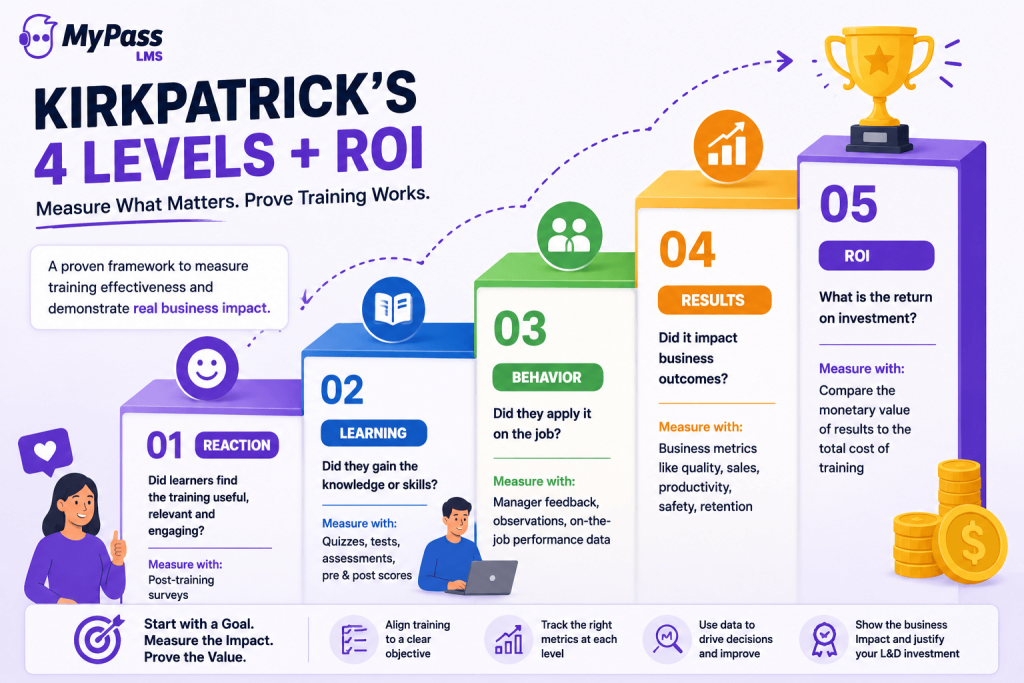
- Level 1, Reaction. Did learners find the training useful, relevant and engaging? Measured with post-training surveys. Easy to capture, least meaningful on its own, but a signal of whether people will apply what they learned.
- Level 2, Learning. Did they actually gain the knowledge or skills? Measured with assessments, quizzes and exams, ideally comparing before and after. This is where you confirm learning happened, not just attendance.
- Level 3, Behavior. Did they apply it on the job? Measured through observation, manager feedback and performance data over the weeks following training. This is the level most organizations skip, and it is where training either proves itself or does not.
- Level 4, Results. Did it move a business outcome? Measured against the metric the training was meant to affect, such as fewer safety incidents, faster resolution times, higher sales, or lower turnover.
| → The levels get harder to measure and more valuable as you climb. Most organizations camp on Levels 1 and 2 because they are easy. The proof of value lives on Levels 3 and 4, which is exactly why they are worth the effort. |
Adding ROI: the fifth level
Beyond the four levels, many organizations add ROI to put a financial figure on training. The calculation is straightforward in principle: compare the monetary value of the training's results, meaning Level 4, against its total cost.
For example, if safety training reduced incidents and those avoided incidents saved a quantifiable amount, you weigh that saving against the cost of the training program. ROI is powerful for justifying L&D budget to finance, but it depends entirely on having measured Level 4 results first. You cannot calculate return on an outcome you never tracked.
How to actually do it: decide before you start
Here is the practical secret to measuring training effectiveness. You decide what to measure before the training runs, not after. This is why defining a measurable objective at the start of a training program matters so much. The objective is your Level 4 metric, chosen in advance.
A workable approach:
- Before training, define the objective and the metric it should move, which is Level 4, and capture a baseline.
- During and immediately after, measure learning with assessments, Level 2, and reaction with a short survey, Level 1.
- Weeks later, measure behavior change, Level 3, using manager feedback and performance data.
- At the cycle's end, measure results against the baseline, Level 4, and, if needed, calculate ROI.
A good LMS makes the first three levels almost automatic, since assessment scores, completion data and pass rates are captured as people learn, giving you Levels 1 and 2 without extra work and a clean baseline for the rest.
The bottom line
Measuring training effectiveness means climbing past completion rates to the levels that actually prove value: reaction, learning, behavior and results, with ROI on top. The four-level Kirkpatrick model gives you the structure, but the real trick is deciding what to measure before training begins, tying each program to a specific business metric and capturing a baseline. Measure that way and you can finally answer the only question that matters: did it work?
MyPass LMS captures the measurement data automatically, including assessment scores, completion and pass rates, giving you Levels 1 and 2 out of the box and a clean baseline for behavior and results. See the reporting features, or start a free trial.
Frequently Asked Questions
How do you measure training effectiveness?
Use the four-level Kirkpatrick model: reaction, meaning did learners find it useful, learning, meaning did they gain knowledge, behavior, meaning did they apply it, and results, meaning did it impact business outcomes. Add ROI to quantify financial return. Decide what to measure before training starts.
What is the Kirkpatrick model?
The Kirkpatrick model is a four-level framework for evaluating training: Level 1 reaction, Level 2 learning, Level 3 behavior, and Level 4 results. Each level provides more meaningful evidence of value than the last, with ROI often added as a fifth level.
How do you calculate training ROI?
Compare the monetary value of the training's results, meaning Level 4 outcomes such as reduced incidents or increased sales, against the total cost of the training program. It requires having measured business results first, so define and track that metric from the start.
What metrics measure training effectiveness?
Post-training survey scores for reaction, assessment and quiz results for learning, on-the-job behavior change via manager feedback and performance data for behavior, and the business metric the training targeted for results. Completion rate alone does not measure effectiveness.
Why is measuring training effectiveness important?
It proves whether training changed anything, improving performance or moving a business metric, rather than just confirming people finished. It also justifies L&D budget and shows where to improve future programs.