
| You win training budget by framing it as a solution to a business problem leadership already cares about, not as a cost. Start from a real problem like turnover or slow ramp, quantify what it costs today, show how the training solves it, estimate the return against that cost, and commit to measuring the result. |
Why Training Budget Requests Get Rejected
If you have ever asked for training budget and been turned down or trimmed, the problem is usually not that leadership hates training. It is that the request was framed as a cost with a vague benefit. 'We'd like budget to train the team' invites the question 'why, and what do we get?', and if the answer is soft, training loses to requests that promise a clear return.
The teams that consistently win budget do something different. They do not ask for money for training; they present training as the solution to a problem the business already wants solved. That reframing, from expense to investment against a known problem, is the single biggest lever you have on whether your request gets funded.
| Leadership does not buy training; it buys solutions to problems it already cares about. If your request starts with 'we want training' instead of 'here's a costly problem and how training fixes it,' you are starting from the weakest possible position. |
Start From a Problem, Not a Program
The foundation of a winning business case is a business problem leadership already recognizes and wants gone. Training is your proposed solution, but the case is built on the problem. So before you cost out a single course, identify the pain: high turnover in a critical role, costly errors, new hires taking too long to become productive, a compliance gap that risks fines, customers churning because they cannot use the product.
Pick a problem that is real, that leadership feels, and that training can plausibly move. Starting here does two things: it makes your request relevant to people who control budget, and it gives you something concrete to measure success against later. A program in search of a justification loses; a solution to a felt problem wins.
Put a Number on It
Vague problems get vague budgets. To make your case compelling, quantify what the problem costs today. You do not need perfect precision, a credible, defensible estimate is enough, and it transforms the conversation.
- Turnover: cost to replace someone (recruiting, lost productivity, ramp) times the number leaving.
- Slow ramp: weeks of reduced productivity per new hire, times new hires per year.
- Errors or rework: time and money spent fixing mistakes that better training would prevent.
- Compliance gaps: potential fines and the cost of an incident or failed audit.
- Churn: revenue lost from customers who leave because they could not succeed with the product.
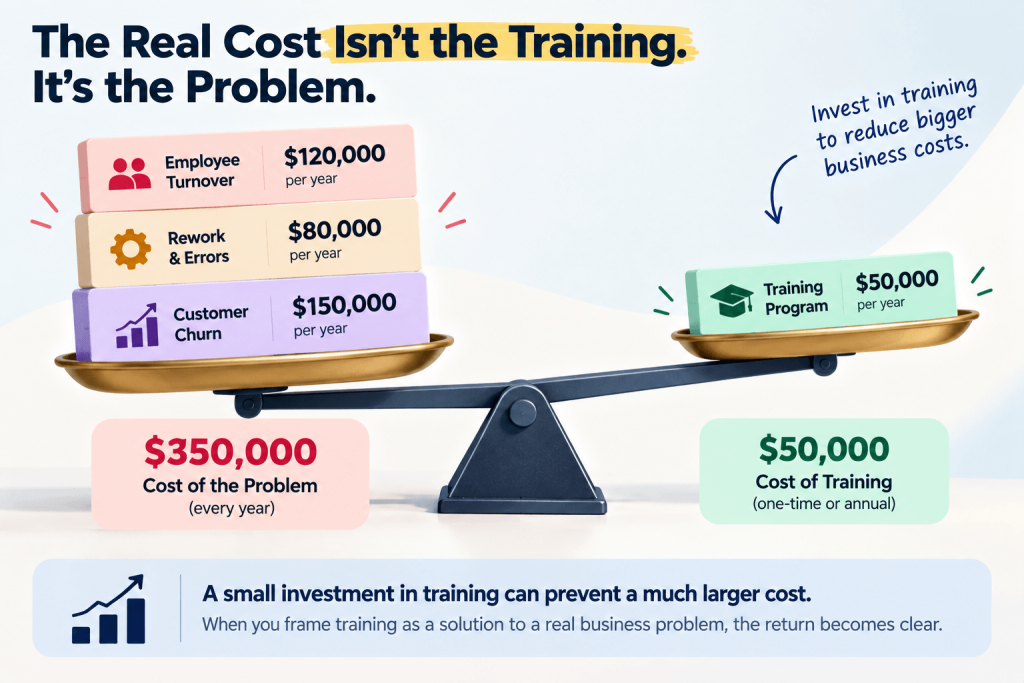
Show the Return, Then Promise to Prove It
With the problem quantified, the return almost makes itself: if turnover in a role costs a large sum a year and a training program that costs a fraction of that can meaningfully reduce it, you are no longer asking for an expense, you are proposing an investment with an obvious payback. Present it that way, cost of training versus value of solving the problem, and let the comparison do the persuading.
Then add the move that separates one-time wins from a reliably funded function: commit to measuring the result. Say how you will show the training worked, completion, behaviour change, and ideally impact on the original problem. This builds trust, because you are accountable for the outcome, and it makes every future request easier, because you will have evidence that last time the investment paid off.
| Committing to measure the result is what turns a one-off approval into an ongoing budget. When you can come back and show the last investment paid off, the next request stops being a debate and becomes a formality. |
How MyPass LMS Helps You Make and Prove the Case
A strong business case needs both a credible cost and a way to prove results, and the platform you choose affects both. On cost, MyPass LMS uses flat pricing with unlimited registered users rather than per-seat fees, which makes your numbers predictable and often lowers the training cost side of your case, strengthening the return.
On proof, reporting tracks completion, assessment results and where learners struggle, giving you the evidence to show the training happened and worked, the exact follow-through you promised leadership. That closes the loop: you propose training against a costed problem, fund it affordably, and come back with data, which is what makes the next budget request straightforward.
| Build your case around one costed problem, not a wish list. A focused request, here is a problem costing us a lot, here is how training fixes it for far less, and here is how I'll prove it, wins budget far more reliably than a broad ask to fund training in general. |
The bottom line
Training budget is won by reframing training from a cost into a solution to a problem leadership already wants solved. Start from a real, felt business problem, quantify what it costs today, show specifically how training fixes it, present the return as cost versus value, and commit to measuring the result so future funding gets easier.
A focused case built on a costed problem beats a broad ask every time. See how flat pricing and results reporting help you keep costs low and prove impact in MyPass LMS features, read how to calculate training ROI, or start a free trial.
Frequently asked questions
How do you get budget for a training program?
Frame the training as the solution to a business problem leadership already cares about, rather than asking for money to train. Identify a real, felt problem (turnover, slow ramp, errors, compliance risk, churn), quantify what it costs the business today, show specifically how the training addresses it, present the return as the training's cost versus the value of solving the problem, and commit to measuring the result. A focused case around one costed problem wins far more reliably than a broad request.
How do you build a business case for training?
Start from a business problem leadership recognizes, put a credible number on what that problem costs today, propose the training as a specific solution to it, estimate the return by comparing the training's cost to the value of solving the problem, and say how you will measure whether it worked. The case is built on the problem, training is the proposed fix, so the strength of your case comes from choosing a real, quantifiable problem the business wants gone.
Why do training budget requests get rejected?
Usually because they are framed as a cost with a vague benefit, 'we'd like budget to train the team', which invites the question 'why, and what do we get?' with no strong answer. Requests also fail when the problem is not quantified, so there is nothing concrete to weigh the spend against, or when there is no commitment to measure results, so leadership has no reason to trust the payoff. Reframing training as a costed solution fixes most of this.
How do you prove training was worth the money?
Commit up front to measuring it, then follow through: track completion, look for the behaviour change the training was meant to produce, and, most persuasively, show movement on the original problem you costed (lower turnover, faster ramp, fewer errors). Tying results back to the specific problem you justified the budget with is what proves the investment paid off, and it is exactly what makes your next budget request easy to approve.