| To reduce training costs without hurting quality, cut waste, not learning. The biggest savings come from eliminating duplicate content, consolidating overlapping tools, shifting repeat instructor-led sessions to self-paced or blended formats, and using AI to speed content creation. Cutting programs outright usually just moves the cost elsewhere. |
Cut Waste, Not Training
When budgets tighten, the instinct is to cut training: fewer courses, shorter programs, cheaper generic content. The problem is that this treats cost and quality as a fixed trade-off, when most of the savings actually sit in waste, not in the learning itself. Undertrained employees make more mistakes, and in safety, compliance or customer-facing roles those mistakes often cost more than the training did.
The better approach is to find where the budget leaks and close those leaks, while protecting the training that works. Done well, organizations have held or even increased learning hours while cutting spend per employee, by reallocating rather than slashing.
| The core principle: cutting training feels like a saving on a spreadsheet, but it usually just moves the cost somewhere more expensive and harder to see, such as errors, rework and turnover. Cut the waste instead. |
Where Training Budgets Actually Leak
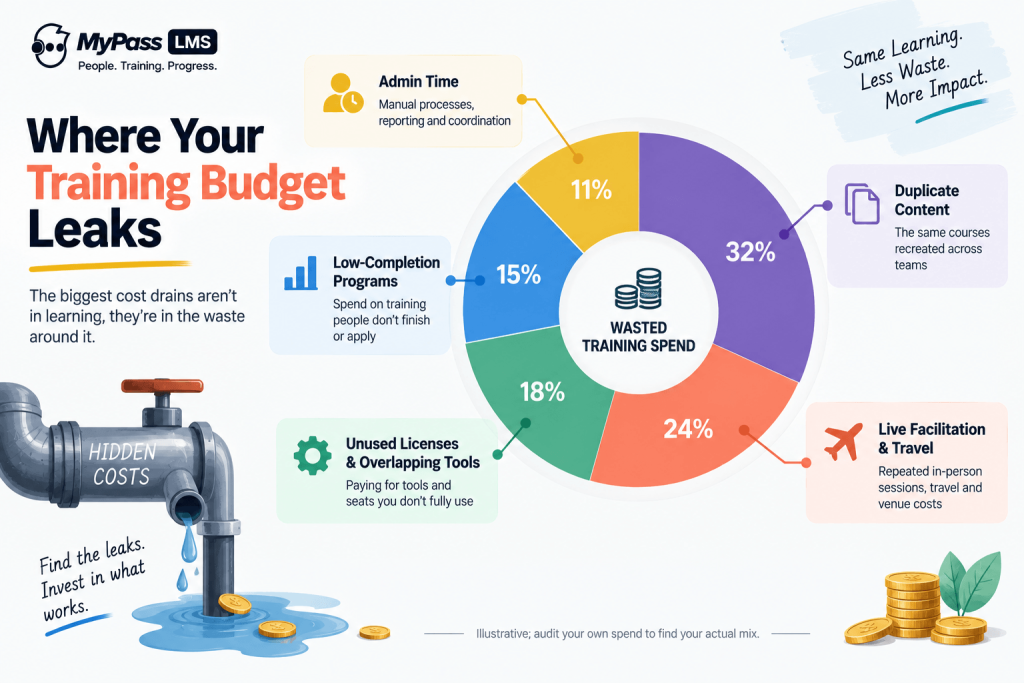
Before cutting anything, find the waste. The same culprits appear in most organizations, and they are usually invisible until someone looks.
- Duplicate content: the same course rebuilt from scratch by different teams or every year.
- Unused software licenses: tools and seats being paid for but not used.
- Overlapping tools: several systems doing jobs one platform could cover.
- Repeated live facilitation: the same instructor-led session run again and again at full cost.
- Travel and venue costs: in-person logistics that a virtual or blended format could reduce.
- Low-completion programs: money spent on training few people finish or apply.
The Highest-Impact Savings
Not all savings are equal. These deliver the most without touching quality, roughly in order of impact for most organizations.
| Lever | How it saves | Quality effect |
| Consolidate tools | One platform replaces several subscriptions and admin | Neutral or better |
| Shift repeat ILT to self-paced | Removes recurring facilitation and travel cost | Neutral if well designed |
| AI-assisted authoring | Cuts content production time and outsourcing | Maintained with human review |
| Reuse and modularise content | Build once, recombine, update in place | Improved consistency |
| Automate admin | Automated enrolment, reminders, reporting | Frees staff for higher-value work |
Tool consolidation deserves special attention. Many organizations pay for a separate LMS, authoring tool, content protection, ecommerce and integrations. Replacing several of those with one platform removes multiple subscriptions and the admin overhead of running them.
Delivery Method Is a Cost Lever
How you deliver training is one of the biggest cost variables, and the most controllable. Instructor-led training is the most expensive per session because of facilitator time, travel and venue. Self-paced online is cheap to repeat once built. Blended sits in between and often gives the best value.
- Move repeatable knowledge to self-paced online, and reserve live time for practice and discussion.
- Convert recurring in-person sessions to virtual to cut travel and venue costs.
- Use microlearning to reduce production and time-off-the-job cost while improving retention.
- Keep instructor-led delivery for the complex, high-stakes topics that genuinely need it.
| A practical rule: if a session is delivered live more than a few times a year and the content is stable, it is probably cheaper as a self-paced or blended offering, with live time saved for the parts that need a human. |
How MyPass LMS Reduces Cost
MyPass LMS attacks training cost from several of these angles at once. Its all-in-one design consolidates the LMS, content authoring, DRM, ecommerce and AMS integration into one platform, removing several separate subscriptions. Its AI course builder cuts content production time and outsourcing, and automation of enrolment, reminders and reporting reduces admin overhead.
The pricing model itself is a cost lever. Flat pricing by simultaneous logins with unlimited registered users means training more people does not increase the bill, which removes the per-seat penalty that makes many platforms expensive to scale. Training the whole workforce costs the same as training a fraction of it.
- One platform replaces several tools and subscriptions.
- AI course builder cuts content creation cost.
- Automation reduces administrative time.
- Flat, unlimited-user pricing removes per-seat cost growth.
The bottom line
Reducing training costs does not have to mean reducing training. The savings that protect quality come from cutting waste: duplicate content, unused licenses, overlapping tools, needless travel and low-value programs. Shift delivery to cheaper-to-repeat formats where it fits, use AI to speed content creation, and consolidate tools. Cutting programs outright usually just relocates the cost.
Start by auditing where your budget actually leaks, then close those leaks. See how an all-in-one platform and flat pricing reduce cost in MyPass LMS features, read how MyPass LMS pricing works, or start a free trial.
Frequently asked questions
How can I reduce training costs without lowering quality?
Cut waste rather than learning. The highest-impact moves are eliminating duplicate content, consolidating overlapping tools, shifting repeatable instructor-led sessions to self-paced or blended formats, using AI to speed content creation, and automating administration. Cutting programs, hours or expert review outright usually lowers quality and moves the cost into errors, rework and turnover instead.
Where do training budgets waste the most money?
Common leaks include duplicate content rebuilt by different teams or every year, unused software licenses, several overlapping tools doing one job, repeated live facilitation at full cost, travel and venue expenses, and programs with low completion or application. These are usually invisible until you audit spend, and closing them saves money without touching the training that works.
Does moving to online training actually save money?
It can, significantly, for the right content. Self-paced online training is cheap to repeat once built, removing recurring facilitator, travel and venue costs that make instructor-led delivery expensive. Blended delivery keeps live time for practice while moving knowledge online. The saving is largest for stable content delivered repeatedly; complex, high-stakes topics may still justify live delivery.
How does an all-in-one LMS reduce training costs?
By replacing several separate subscriptions, such as an LMS, authoring tool, content protection, ecommerce and integrations, with one platform, which cuts both licensing and the admin overhead of running multiple tools. Flat, unlimited-user pricing further reduces cost by removing the per-seat charge that makes scaling training to more people expensive on many platforms.