| Training reduces employee turnover by giving people a reason to stay: a visible path to grow, competent managers, and a confident start through strong onboarding. Since most departures are preventable and lack of development is a top reason people quit, investing in learning is one of the most cost-effective retention strategies available. |
Why Turnover Is a Training Problem
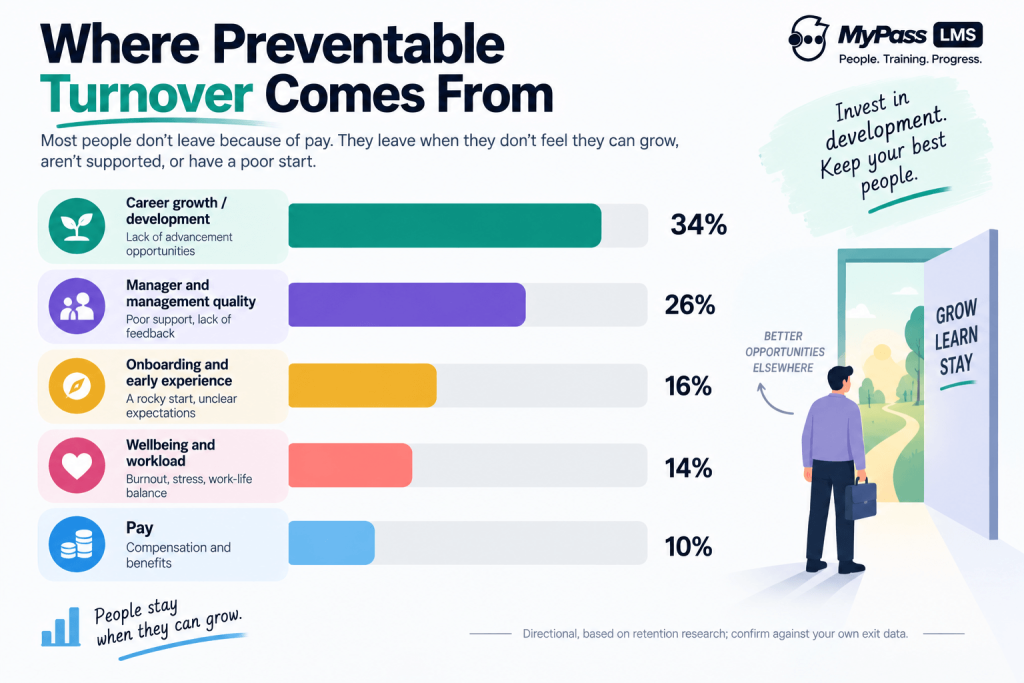
When people quit, the instinct is to look at pay. Pay matters, but exit-interview research tells a more useful story: a large majority of departures are preventable, and the reasons people give are dominated by things training directly influences. Lack of career growth, feeling unsupported by a manager, and a rocky start all show up far more often than salary alone.
That reframes retention. Turnover is expensive, replacing someone can cost from half to twice their annual salary once you count hiring, lost productivity and ramp time, and much of it is fixable through development rather than compensation. Training is not the only lever, but it is one of the few that addresses the actual reasons people leave.
| The uncomfortable finding from retention research: most turnover is preventable, and it is usually a management and development problem, not a pay problem. That is good news, because development is something you control. |
The Three Ways Training Keeps People
Training reduces turnover through three distinct mechanisms. Each targets a different reason people leave, and the strongest retention programs use all three.
- Career development: people who see a path to grow stay. When learning maps to advancement, leaving to grow elsewhere becomes less attractive.
- Manager capability: employees leave managers, not companies. Training managers to coach, give feedback and support their teams is one of the highest-leverage retention moves.
- Strong onboarding: a confident, well-supported start sharply reduces early exits in the first 90 days, when a lot of preventable turnover happens.
Career Development: The Strongest Lever
The single most consistent finding across retention studies is that people stay where they can grow. When employees cannot see a future, they look for one elsewhere, and a significant share of workers report leaving specifically because a job offered no progression.
The practical fix is to make development visible and structured, not vague. Clear learning paths tied to roles, upskilling toward the next position, and internal mobility all signal that growth is possible here. An internal talent marketplace, where people can reskill into open roles, turns would-be leavers into internal moves.
| Retention tip: the goal is not just to offer training, but to connect it visibly to advancement. 'Complete this path and you are ready for the next role' retains far better than a library of optional courses nobody maps to their future. |
Manager Training: The Multiplier
Managers have an outsized effect on whether people stay, driving a large majority of team engagement. Yet many are promoted for individual performance and never taught to lead, then struggle with exactly the things that make people quit: feedback, support, workload and difficult conversations.
Training managers is therefore training retention. A single well-supported manager can lift retention across an entire team, which makes manager development one of the highest-return investments in the whole people budget.
| Untrained manager | Trained manager |
| Avoids or fumbles feedback | Gives clear, regular feedback |
| Reacts to problems late | Runs consistent one-on-ones |
| Team disengages, then leaves | Team feels supported, stays |
Making Retention-Focused Training Work
Turning this into results means running development as a system, not a set of one-off courses, and measuring it against retention rather than completion.
- Map learning to roles and progression, so growth is visible.
- Prioritise onboarding and manager training, the two highest-leverage areas.
- Track the right outcome: retention and internal mobility, not just course completions.
- Make development easy to reach, so busy employees actually use it.
This is where the platform matters. MyPass LMS supports role-based learning paths that connect training to advancement, manager and onboarding programs delivered and tracked in one place, and analytics that let you connect training activity to retention rather than guessing. Because pricing is flat with unlimited registered users, extending development to the whole workforce does not add per-seat cost, which matters when retention is an organization-wide goal.
The bottom line
Turnover is largely preventable, and training addresses the reasons people actually leave: no path to grow, weak management, and a poor start. Career development gives people a future, manager training fixes the relationship most responsible for engagement, and strong onboarding prevents early exits. Together they make development one of the most cost-effective retention strategies there is.
The key is to run it as a system tied to real outcomes. See how learning paths, manager programs and analytics work in MyPass LMS features, read our employee onboarding checklist, or start a free trial.
Frequently asked questions
Does training actually reduce employee turnover?
Yes. Retention research consistently finds that lack of career development is a leading reason people quit, and that most turnover is preventable. Training reduces turnover through three mechanisms: giving people a visible path to grow, equipping managers to lead well, and providing strong onboarding that prevents early exits. It addresses the actual reasons people leave, which pay alone does not.
What type of training has the biggest impact on retention?
Manager training and onboarding have the highest leverage. Managers drive a large share of team engagement, so training them to coach, give feedback and support their teams lifts retention across whole teams. Strong onboarding prevents avoidable exits in the first 90 days. Career-development training that visibly maps to advancement is the strongest ongoing lever.
How much does employee turnover cost?
Estimates vary, but replacing an employee commonly costs from half to twice their annual salary once hiring, lost productivity, onboarding and ramp time are included. Because much of this turnover is preventable through development, investing in training is often far cheaper than absorbing the repeated cost of replacing people who leave for reasons training could have addressed.
How do you measure whether training is improving retention?
Track retention and internal mobility rather than course completions. Compare turnover and tenure between employees who engage with development and those who do not, watch early-exit rates after onboarding changes, and monitor internal moves into open roles. The aim is to connect training activity to whether people stay, which requires learning and people data you can view together.