| An employee development plan is a structured roadmap for how a person will grow, closing the gap between their current skills and where they want to be. Create one by defining the goal, identifying the skill gaps, choosing development actions like training and stretch assignments, setting a timeline with milestones, and reviewing it regularly. |
What an Employee Development Plan Is
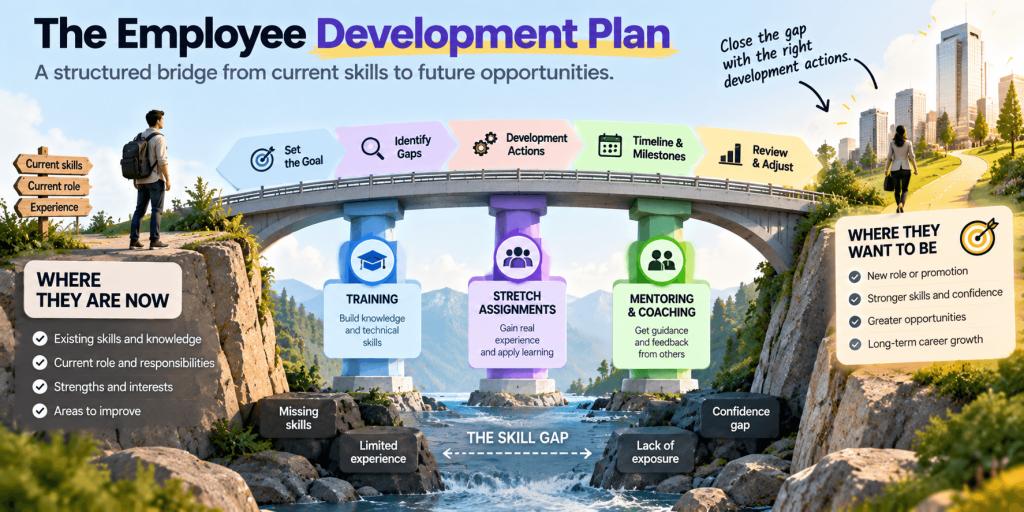
An employee development plan, sometimes called an individual development plan or IDP, is a structured roadmap for how a person will grow in their role or toward a new one. It turns vague conversations about 'developing' someone into a concrete plan: a clear goal, the gaps between where they are and where they want to be, and the specific actions that will close them.
The plan matters for two reasons. For the employee, it makes growth real and visible instead of a nice idea that never happens. For the organization, it is one of the strongest retention tools there is, because people stay where they can see a future. A development plan is where 'we care about your growth' becomes something you can actually point to.
| A development plan is the difference between telling someone they have potential and showing them a path to realise it. The first is a compliment; the second is a reason to stay. |
What a Good Plan Includes
A useful development plan has a few essential parts. Missing any of them tends to leave it vague and unactioned.
| Element | What it captures |
| Goal | Where the employee is growing toward: promotion, skill, or better performance |
| Current state | An honest view of their current skills and level |
| Gaps | The specific skills or experience the goal requires that they do not yet have |
| Actions | Concrete steps to close each gap: training, stretch work, mentoring |
| Timeline | Dates and milestones so progress is trackable |
| The part most plans skip is honest gap analysis. Jumping from 'wants to be a manager' straight to 'send them on a leadership course' misses the step that makes the plan work: what specifically does this person need that they do not have yet? |
How to Create One
Building a development plan is a short, collaborative process, best done with the employee rather than for them.
- Define the goal together: a promotion, a specific skill, or stronger performance in the current role.
- Identify the gaps: compare current skills honestly against what the goal requires.
- Choose actions for each gap: training, stretch assignments, mentoring, coaching, or a mix.
- Set a timeline with milestones: so progress is visible and the plan does not drift.
- Review and adjust regularly: development plans are living documents, not one-time forms.
Development Actions That Work
The strongest development plans use more than training courses. A well-rounded plan mixes several types of action, because people develop through doing, not just studying.
- Training: structured courses and learning paths for the knowledge and skills a goal requires.
- Stretch assignments: real work slightly beyond the current level, where much growth actually happens.
- Mentoring and coaching: guidance from someone further along the path.
- On-the-job practice: applying new skills in the real role with feedback.
Training is the backbone, especially for defined skills, but pairing it with stretch work and mentoring is what turns knowledge into capability. A plan that is only 'complete these courses' rarely produces the growth people are looking for.
How MyPass LMS Supports Development Plans
MyPass LMS supports the learning backbone of development plans and makes progress visible. Role-based learning paths map training to a specific goal, so 'develop toward team lead' becomes a concrete sequence of courses and assessments, and analytics show how far along each person is, turning the plan from a document into something trackable.
Because completion and assessment are recorded, a development plan's progress is measurable rather than a subjective judgement at review time, and because pricing is flat with unlimited registered users, offering development to everyone, not just a select few, does not add per-seat cost. That matters, because development that is visibly available to all is far stronger for retention than a perk reserved for a handful.
| Tip: build a learning path for each common development goal in your organization, such as first-time manager or senior specialist. Then a development plan can point to a concrete, trackable path instead of a vague promise to 'get some training'. |
The bottom line
An employee development plan turns vague growth talk into a concrete roadmap: a clear goal, honest gap analysis, specific actions to close the gaps, and a timeline to track progress. It makes growth real for the employee and is one of the strongest retention tools an organization has, because people stay where they can see a future.
The plan works best when it mixes training with stretch work and mentoring, and when progress is trackable. See how learning paths and analytics support development in MyPass LMS features, read reskilling vs upskilling, or start a free trial.
Frequently asked questions
What is an employee development plan?
An employee development plan, also called an individual development plan or IDP, is a structured roadmap for how a person will grow in their current role or toward a new one. It captures a clear goal, an honest view of their current skills, the gaps between the two, specific actions to close them, and a timeline. It turns vague growth conversations into a concrete, trackable plan.
How do you create an employee development plan?
Define the goal with the employee (a promotion, a skill, or better performance), identify the skill gaps by comparing current ability against what the goal requires, choose development actions for each gap such as training, stretch assignments and mentoring, set a timeline with milestones so progress is trackable, and review and adjust it regularly. Do it with the employee, not for them.
What should an employee development plan include?
It should include a clear goal, an honest view of the employee's current skills, the specific gaps the goal requires closing, concrete actions for each gap (training, stretch work, mentoring), and a timeline with milestones. The most commonly skipped element is honest gap analysis, which is what connects the goal to the right actions rather than defaulting to a generic course.
Why do employee development plans matter?
For the employee, a development plan makes growth real and visible rather than a vague promise. For the organization, it is one of the strongest retention tools available, because people stay where they can see a future. Development opportunities consistently rank among the top reasons employees stay, so a visible, actioned plan directly supports retention and engagement.