L&D Trends for 2027: What's Worth Your Attention (and What Isn't)
On this page 7 sections
Short answer
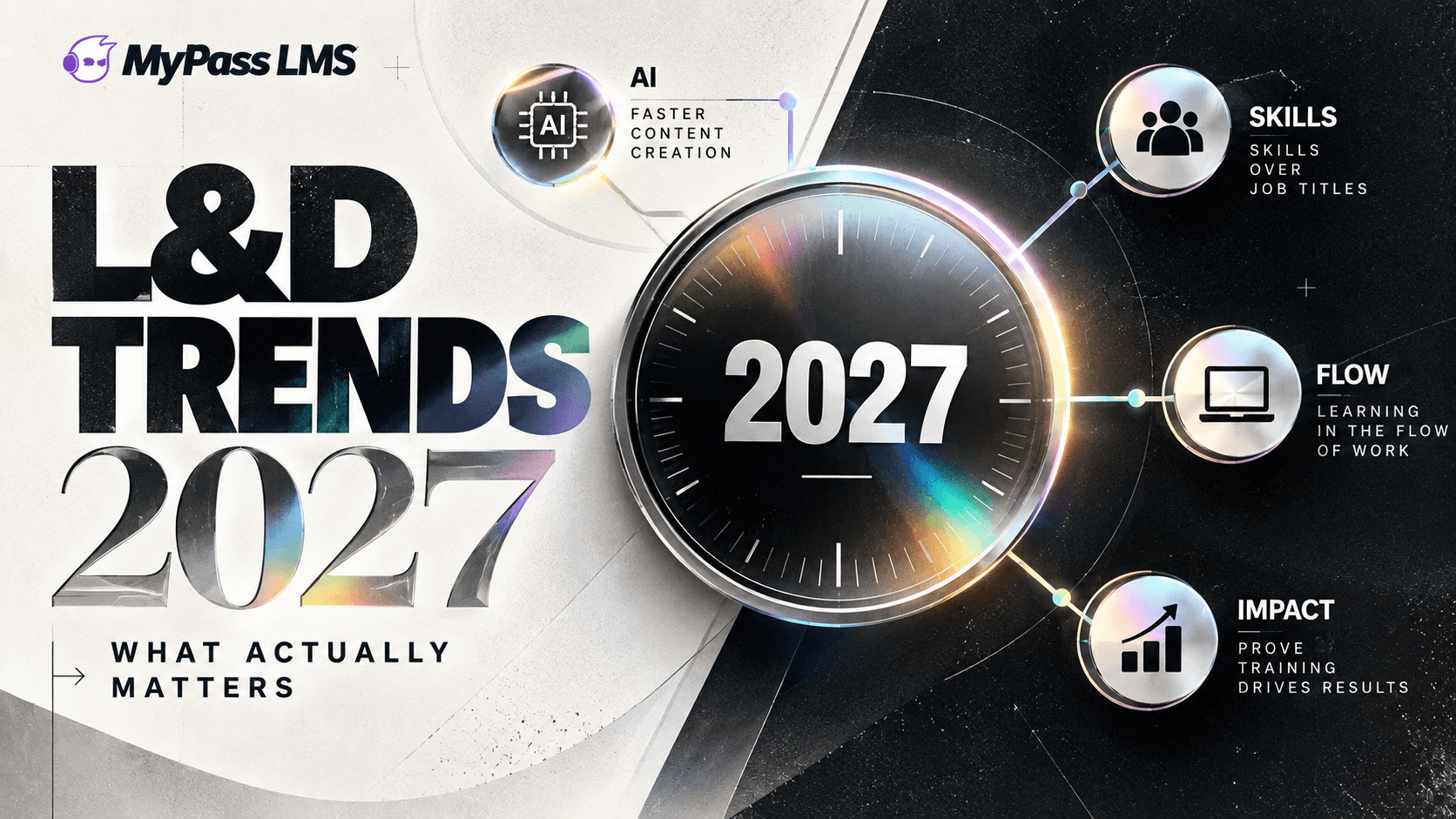
The L&D trends that matter for 2027 are practical, not flashy: AI that genuinely speeds up building and personalizing training, a real shift toward skills over job titles, learning delivered in the flow of work rather than as separate events, and a harder focus on proving impact. The theme is training that sticks and shows results.
Trend Predictions Age Badly, So Here's the Filter
Every year around this time, the internet fills up with L&D trend lists, and most of them are the same buzzwords in a new coat. Half the "trends" never touch how real teams actually train people. So rather than hand you a list of shiny words, this is a look at the shifts that are genuinely changing the work, and an honest note on which ones you can safely ignore for now.
The through-line for 2027 isn't a single new technology. It's a maturing expectation: training is being asked to be more relevant, more efficient to produce, and more provable. If you keep that lens, the useful trends sort themselves from the noise.
Key point
A simple test for any trend: does it change what you'd actually do on Monday? If a 'trend' has no effect on how you build, deliver or measure training, it's a headline, not a trend worth your budget.
AI That Earns Its Keep
AI is the obvious headline, and for once the hype has real substance underneath, though not in the way the flashiest demos suggest. The genuinely useful shift is AI taking the slow, manual parts of L&D off your plate: drafting course content in a fraction of the time, generating quiz questions, translating training into other languages, and surfacing patterns in your data you'd never spot by hand.
What that adds up to is less time spent producing training and more time spent on the parts only a human should do, deciding what to teach, whether it worked, and how to help people who are stuck. The teams getting value from AI in 2027 aren't the ones chasing novelty, they're the ones using it to do the boring work faster so they can focus on the judgment.
Skills Over Job Titles
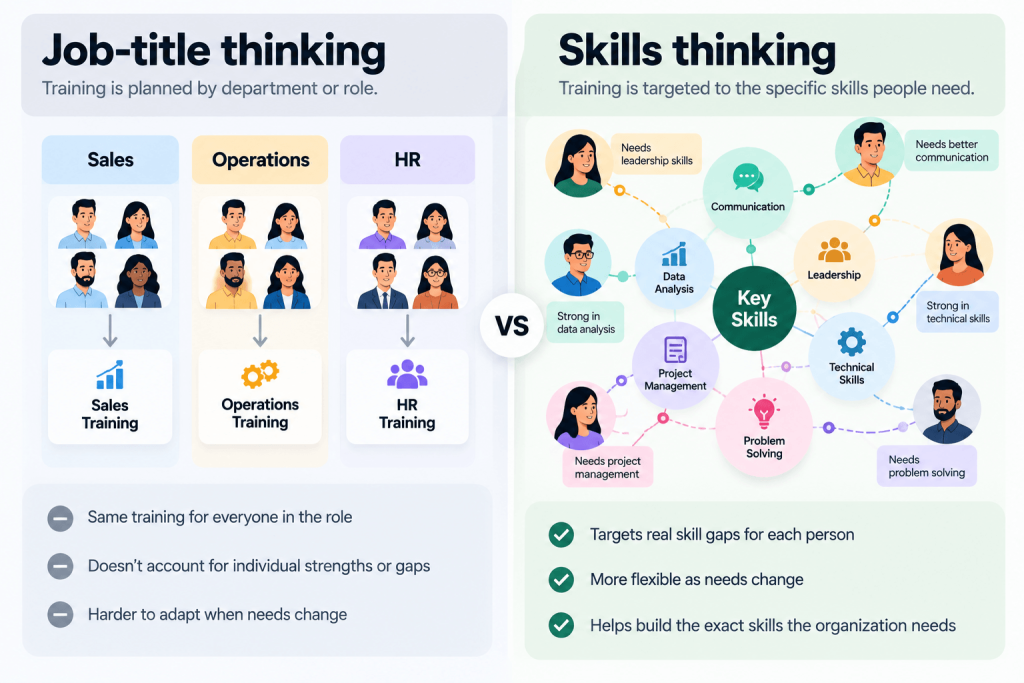
A quieter but bigger shift is the move from thinking in job titles to thinking in skills. Instead of "train the sales team," organizations increasingly ask "who has this specific skill, who needs it, and how do we close the gap?" It sounds subtle, but it changes how you plan development, because people don't fit neatly into boxes and roles keep changing.
- You map what skills the organization actually needs, now and soon.
- You see who has them and who doesn't, at the level of the skill, not the title.
- You target training at real gaps, rather than blanket-training whole departments.
- You adapt faster, because when needs change, you're tracking skills, not reshuffling org charts.
Learning in the Flow, and Proving It Worked
Two more shifts are worth planning around, and they pull in the same direction. The first is learning in the flow of work: instead of pulling people out for separate training events they forget, training increasingly shows up in short, findable pieces right when someone needs it, at the moment of the task, not weeks before or after. It fits how people actually work and it sticks better.
The second is a harder, and healthier, focus on proving impact. For years L&D got away with reporting activity, courses run, hours completed. That's ending. Leadership increasingly wants to know what changed: did behaviour improve, did the business metric move? This isn't a fad, it's L&D being held to the same standard as every other function, and the teams that can answer it are the ones that keep their budgets.
Key point
If you do one thing differently in 2027, make it this: get better at showing what your training changed, not just what you delivered. It's the trend that protects every other thing you want to do.
What This Means for the Tools You Use
You don't need to chase every trend, but these shifts do suggest what to look for in the platform you train on. The direction of travel, AI-assisted creation, skills tracking, in-the-flow delivery, and real measurement, rewards tools that make those things easy rather than fighting you at every step.
MyPass LMS leans into the practical side of these trends: an AI course builder that cuts the time to create training, delivery that reaches people on mobile and in their workflow, and reporting that shows completion, assessment results and where people struggle, so you can actually answer the "did it work?" question. And with flat pricing and unlimited registered users, extending learning to everyone, which most of these trends assume, doesn't punish you with per-seat costs.
Key point
Don't buy tools for trends; buy them for the two or three shifts you're actually going to act on. For most teams in 2027 that's faster content creation and better proof of impact, so weight your choice toward those.
The bottom line
The L&D trends worth your attention in 2027 aren't the flashiest ones. They're practical: AI that genuinely speeds up creating and personalizing training, a shift from job titles to skills, learning delivered in the flow of work, and a real expectation that you prove impact. The common thread is training that's more relevant, cheaper to produce, and provable, not novelty for its own sake.
Pick the two shifts you'll actually act on and build around those. See how AI-assisted creation and impact reporting come together in MyPass LMS features, or read about learning in the flow of work. Planning next year's training? Start a free trial.
Frequently asked questions
What are the biggest L&D trends for 2027?
The practical ones: AI that genuinely speeds up building and personalizing training (drafting content, generating quizzes, translating, surfacing data patterns), a shift from thinking in job titles to thinking in skills, learning delivered in the flow of work rather than as separate events, and a harder focus on proving training's impact rather than just reporting activity. The theme is training that's more relevant, cheaper to produce and provable, not novelty for its own sake.
Is AI really changing L&D or is it hype?
Both, depending on how it's used. The hype is in flashy demos that don't touch real work; the substance is in AI taking slow manual tasks off L&D teams, drafting course content quickly, generating assessments, translating training, and finding patterns in data. That frees people for the parts only humans should do: deciding what to teach and judging whether it worked. The teams getting value aren't chasing novelty, they're using AI to do the boring work faster.
What does 'skills over job titles' mean in L&D?
It's a shift from planning training around roles ("train the sales team") to planning around specific skills ("who has this skill, who needs it, how do we close the gap"). It's more granular and more adaptable, because people don't fit neatly into role boxes and jobs keep changing. You map the skills the organization needs, see who has them, target training at real gaps rather than blanket-training whole departments, and adapt faster when needs shift.
How should L&D prove its impact in 2027?
Move beyond reporting activity (courses run, hours completed) to showing what changed: did the behaviour the training targeted improve, did the business metric move? Tie training to a specific problem, measure before and after where you can, and report the outcome, not just completion. This isn't a passing fad, it's L&D being held to the same standard as other functions, and the teams that can answer "did it work?" are the ones that keep their budgets.
Keep reading
L&D strategy
What Is Learning and Development (L&D)?
L&D strategy