Learning in the Flow of Work, Explained
Learning in the flow of work delivers short, relevant learning at the moment of need, inside the tools and tasks employees already use, instead of pulling them away for scheduled training. The idea, coined by Josh Bersin, matters because knowledge workers average only about 24 minutes a week for formal learning.
On this page 7 sections
Short answer
Learning in the flow of work delivers short, relevant learning at the moment of need, inside the tools and tasks employees already use, instead of pulling them away for scheduled training. The idea, coined by Josh Bersin, matters because knowledge workers average only about 24 minutes a week for formal learning.
What It Means
Learning in the flow of work is an approach that brings learning to the work rather than taking people away from work to learn. Instead of scheduling a training day months before a skill is needed, employees get short, relevant support at the exact moment they need it, embedded in the systems and tasks they already use.
The term was popularised by industry analyst Josh Bersin, and the reason it resonates is a hard constraint on time: research suggests knowledge workers have only around 24 minutes a week to spend on formal learning. Traditional course-based training competes with real work and usually loses. Learning in the flow of work stops competing and starts fitting in.
Key point
This is not a replacement for all structured training. Compliance, certification and deep skill-building still need dedicated time. It is a complement that handles the moment-of-need learning those formats cannot.
Why It Matters Now
Two forces have made this shift urgent in 2026. First, skills are changing faster than scheduled training can keep up: a large share of employers report the pace of work is accelerating the demand for new skills. Second, the classic problem of forgetting: a lot of what people learn in a one-off course evaporates within days if they never apply it.
Learning in the flow of work addresses both. Because the learning arrives at the point of need and is immediately applied, it sticks better, and because it is short and contextual, it keeps pace with change in a way an annual course calendar cannot.
- Time pressure: employees cannot step away for long training sessions as often as skills now change.
- Retention: learning applied immediately is retained far better than learning parked for later.
- Relevance: contextual help beats generic courses for solving the problem in front of someone.
- AI enablement: AI now makes it practical to surface the right microlearning at the right moment.
What It Looks Like in Practice
The concept is only useful if it is concrete. In practice, learning in the flow of work shows up as small, embedded supports rather than courses.
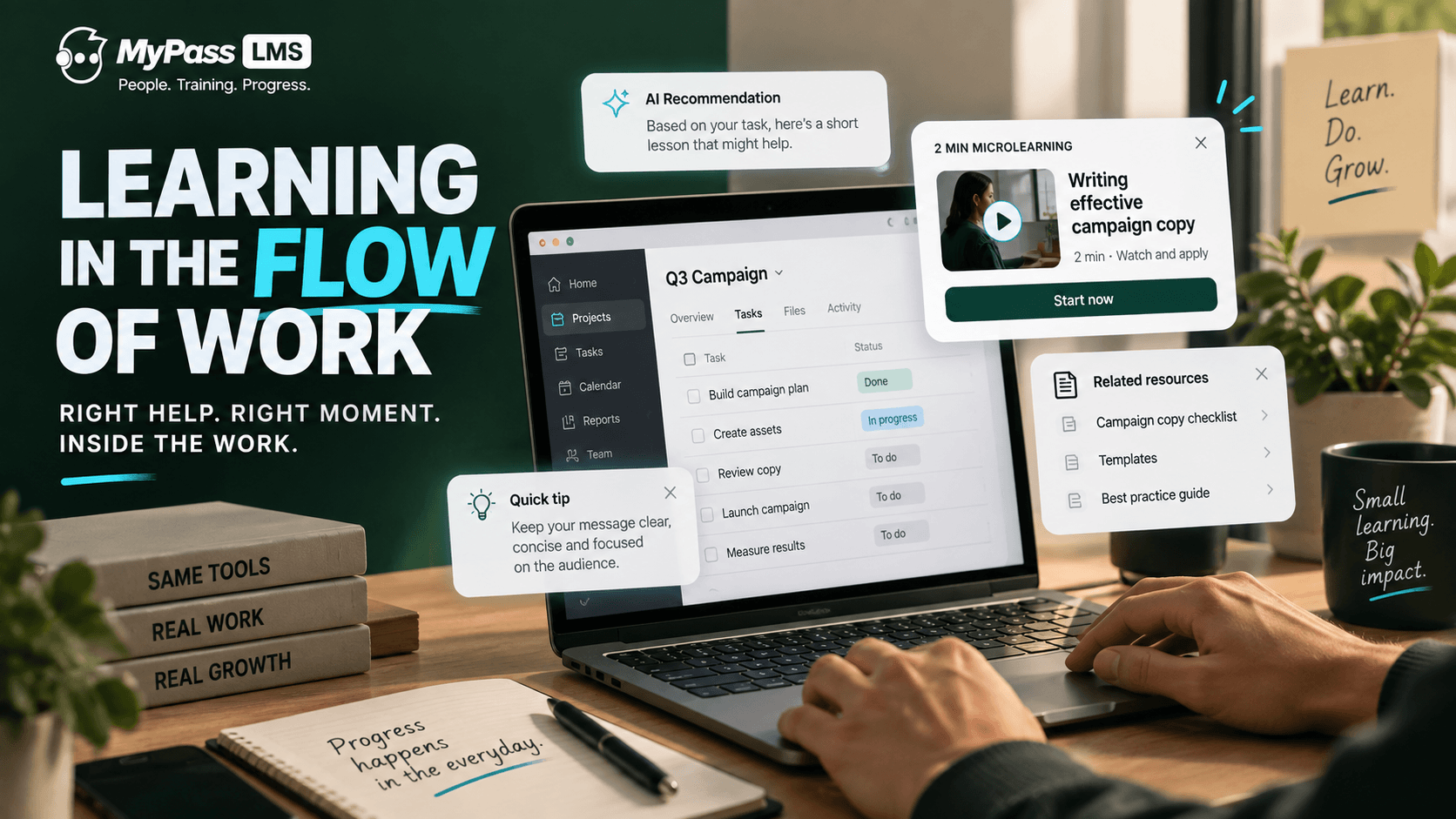
- A short microlearning video surfaced inside the tool where a task is being done.
- In-app guidance or walkthroughs when someone uses a new system, such as a CRM rollout.
- Quick reference resources a learner can find in seconds at the moment of need.
- AI prompts or recommendations that suggest the next relevant piece of learning based on the task.
- Just-in-time refreshers triggered by a process, rather than a fixed annual date.
Key point
A simple test: if learning only happens when someone blocks out calendar time for it, it is not in the flow of work. The goal is help that appears where and when the work happens.
How It Fits With Structured Training
Learning in the flow of work does not replace structured programs; it sits alongside them. Josh Bersin's own framing keeps formal education, such as instructor-led courses with a clear start and end, as one mode among several. The art is knowing which learning belongs where.
| Learning type | Best delivered as |
| Compliance and certification | Structured, tracked courses with records |
| Deep skill-building | Blended programs and learning paths |
| Moment-of-need help | Learning in the flow of work, microlearning |
| System and process changes | In-context guidance plus short refreshers |
The organizations getting this right run both: a structured backbone for the training that must be proven and completed, and flow-of-work learning for the everyday, contextual needs that a course calendar can never keep up with.
Making It Real With Your LMS
Delivering learning in the flow of work depends on content and access. You need short, modular content rather than only long courses, and you need learners to reach it in seconds without a cumbersome login-and-search journey.
MyPass LMS supports the modular side of this: microlearning and short units can be built quickly with the AI course builder, mobile access puts learning within reach during actual work, and learning paths mix short flow-of-work pieces with the structured training that still needs dedicated time. That lets you run both modes from one platform and one learner record, so even moment-of-need learning still counts toward the record.
Key point
Start small: pick one high-friction moment, such as a new system rollout, and deliver a two-minute microlearning at that exact point. Prove it works, then expand.
The bottom line
Learning in the flow of work is the answer to a simple, brutal fact: people do not have time to step away and learn as often as their skills now change. By delivering short, relevant learning at the moment of need, inside the work itself, it fits how people actually work and helps knowledge stick.
It complements rather than replaces structured training, so the strongest approach runs both. See how microlearning, mobile access and learning paths come together in MyPass LMS features, or start a free trial to try it.
Frequently asked questions
What is learning in the flow of work?
Learning in the flow of work is an approach that delivers short, relevant learning at the moment of need, inside the tools and tasks employees already use, rather than pulling them away for scheduled training. Coined by analyst Josh Bersin, it responds to the fact that knowledge workers have very little time, roughly 24 minutes a week, for formal learning.
What are examples of learning in the flow of work?
Examples include a short microlearning video surfaced inside the tool where a task happens, in-app walkthroughs during a new system rollout, quick reference resources findable in seconds, AI prompts that recommend the next relevant learning based on the task, and just-in-time refreshers triggered by a process rather than a fixed date.
Does learning in the flow of work replace traditional training?
No. It complements structured training rather than replacing it. Compliance, certification and deep skill-building still need dedicated, tracked time. Learning in the flow of work handles the moment-of-need, contextual learning that a course calendar cannot keep up with. The strongest organizations run both modes together.
How do you implement learning in the flow of work?
Start with modular, short content rather than only long courses, and make it reachable in seconds. Pick one high-friction moment, such as a system rollout, and deliver a brief microlearning at that exact point. Use mobile access and, where possible, AI recommendations to surface the right content in context, then expand once you have proof it works.
Keep reading

Course design & delivery
What Is eLearning? A Clear, No-Jargon Guide
Course design & delivery
Personalized and Adaptive Learning: Training That Fits the Learner
Course design & delivery
Microlearning for Frontline and Shift Workers: Training That Fits
Course design & delivery