
| A leadership development program grows future leaders instead of only hiring them. You build one by defining the leadership capabilities your strategy needs, identifying and assessing people with potential, designing a mix of formal learning, stretch assignments and mentoring, giving emerging leaders real responsibility with support, and measuring their growth so the program improves over time. |
Why Most Leadership Development Falls Short
Many organizations promote strong individual performers into leadership and hope they figure it out. Some do; many struggle, because leading people is a different job from doing the work well. The cost of that gap is high: disengaged teams, avoidable turnover, and capable people set up to fail in roles they were never prepared for.
A leadership development program exists to close that gap deliberately, growing leaders rather than gambling on them. But programs often fall short because they are treated as a training course: a workshop, a book, a certificate, and back to the day job. Real leadership is not built in a classroom alone, which is why the strongest programs are designed very differently.
| Being great at the work and being great at leading people are different jobs. Promoting your best performer without developing them as a leader is one of the most common and costly mistakes an organization makes. |
Start With the Leadership You Actually Need
Before designing any program, answer a strategic question: what does good leadership look like here, and what capabilities will future leaders need? The answer depends on where your organization is going. A company scaling fast needs leaders who can build teams and handle ambiguity; one in a regulated, stable field may prioritize consistency and judgment. Generic leadership content ignores this and teaches everyone the same abstract traits.
Defining the specific capabilities your strategy requires turns leadership development from a vague good intention into a targeted program. It tells you what to assess people against, what to develop, and how to measure whether the program is working. Skip this step and you end up with activity, workshops attended, that never adds up to the leaders you needed.
Develop Leaders Through Experience, Not Just Courses
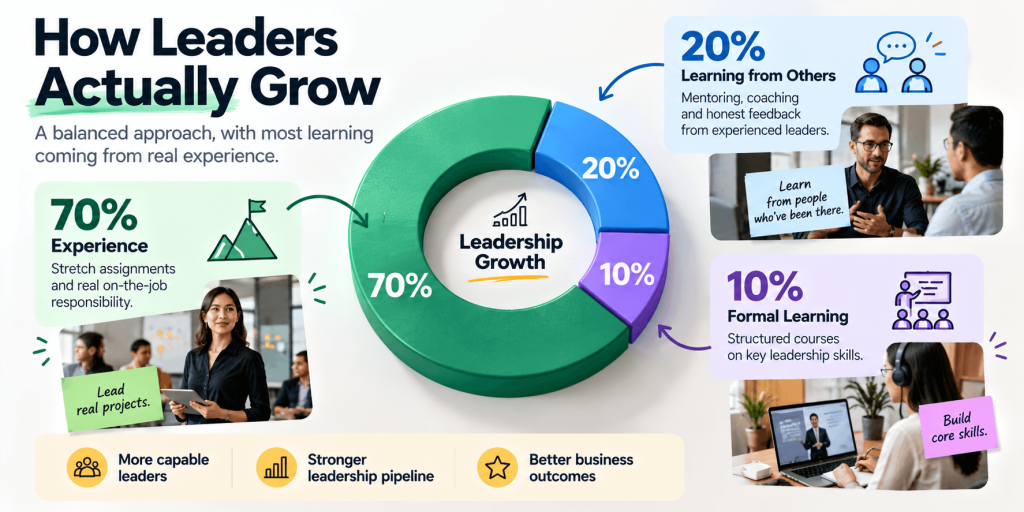
The most important principle in leadership development is that people learn to lead mostly by leading. A widely used rule of thumb, often called 70-20-10, holds that roughly most growth comes from challenging on-the-job experience, some from learning through others such as mentoring and feedback, and a smaller share from formal courses. Programs that invert this, all course, no real experience, consistently disappoint.
- Formal learning: courses on core skills like feedback, delegation, difficult conversations and decision-making.
- Learning from others: mentoring, coaching and honest feedback from experienced leaders.
- Stretch experience: real assignments that require leading, deciding and being accountable.
Give Real Responsibility, With a Safety Net
If experience is where leaders grow, then a program's job is to engineer the right experiences, safely. That means giving emerging leaders something real to lead, a project, a small team, a cross-functional initiative, where they have genuine responsibility and can make decisions, not just shadow someone. The stakes have to be real enough to matter.
But real responsibility without support is just being thrown in the deep end, which teaches some people and sinks others. The support, a mentor, a coach, regular feedback, a manager who debriefs what went well and what did not, is what turns a stretch assignment into learning rather than a trial by fire. Responsibility plus support is the engine of leadership growth.
| Leadership is learned by doing, but doing without support is just sink-or-swim. The program's real value is pairing real responsibility with the coaching and feedback that turn experience into learning. |
How MyPass LMS Supports Leadership Development
Leadership development is mostly experiential, but the formal-learning layer and the tracking still need a home, and that is where MyPass LMS fits. You can deliver the core-skills courses, feedback, delegation, difficult conversations, as structured learning paths, so every emerging leader builds the same foundation before and alongside their stretch assignments.
Because a program runs over months and blends learning with experience, tracking matters: the platform records who has completed which development activities, and reporting shows progress across your leadership cohort so you can see readiness and where people need support. That keeps a long, multi-part program from becoming an untracked good intention.
| Start by defining three to five leadership capabilities your strategy actually needs, then build the program around developing those through a mix of courses, mentoring and real stretch assignments. Capabilities first keeps the program targeted instead of generic. |
The bottom line
A leadership development program grows the leaders your organization needs instead of gambling that strong performers will figure leadership out alone. Build it by defining the leadership capabilities your strategy requires, identifying and assessing people with potential, developing them mostly through real experience with mentoring and courses in support, giving genuine responsibility with a safety net, and measuring growth.
The organizations that grow their own leaders are far less exposed than those that only hire them. See how structured learning paths and cohort reporting support the formal layer in MyPass LMS features, read about succession planning, or start a free trial.
Frequently asked questions
How do you build a leadership development program?
Define what good leadership looks like in your organization and the capabilities your strategy needs, identify and assess people with potential against those capabilities, design a mix of formal learning, mentoring and real stretch assignments (weighted heavily toward experience), give emerging leaders genuine responsibility with coaching and feedback as a safety net, and measure their growth and readiness so you can refine the program. Defining the capabilities first keeps it targeted rather than generic.
What is the 70-20-10 model in leadership development?
It is a widely used rule of thumb that most leadership growth (around 70%) comes from challenging on-the-job experience, some (around 20%) from learning through others such as mentoring and feedback, and a smaller share (around 10%) from formal courses. The exact numbers are approximate, but the principle matters: people learn to lead mostly by leading. Programs that are all course and no real experience consistently underperform this balance.
Why do leadership development programs fail?
Commonly because they are treated as a one-off course, a workshop and a certificate, with no real leadership experience attached, so nothing transfers to the job. They also fail when they teach generic traits instead of the capabilities the organization actually needs, when they give responsibility without support (sink-or-swim), or when there is no measurement to show whether people are becoming ready for bigger roles. The fix is experience-led design tied to defined capabilities.
What is the difference between leadership development and succession planning?
Leadership development is the ongoing work of growing people's leadership capabilities. Succession planning is the specific practice of identifying and preparing people to fill key roles when they become vacant. They are closely linked: a leadership development program is often how you build the bench that succession planning draws from. You develop leaders broadly, and succession planning decides who is being readied for which critical roles.