| Learning and development (L&D) is the practice of helping employees build the skills, knowledge and behaviours an organisation needs, through training, coaching, on-the-job learning and development programmes. It covers everything from onboarding and compliance to leadership and upskilling. Done well, L&D improves performance, keeps people and helps a business adapt. Most of it runs through an LMS. |
L&D, Without the Jargon
You'll hear 'L&D' thrown around in every HR conversation, usually with the assumption that everyone already knows what it means. So here's the plain version: learning and development, or L&D, is simply how an organisation helps its people get better at their jobs and grow. It's both a function (the team or person responsible for it) and a practice (all the ways a company deliberately builds its people's skills and knowledge).
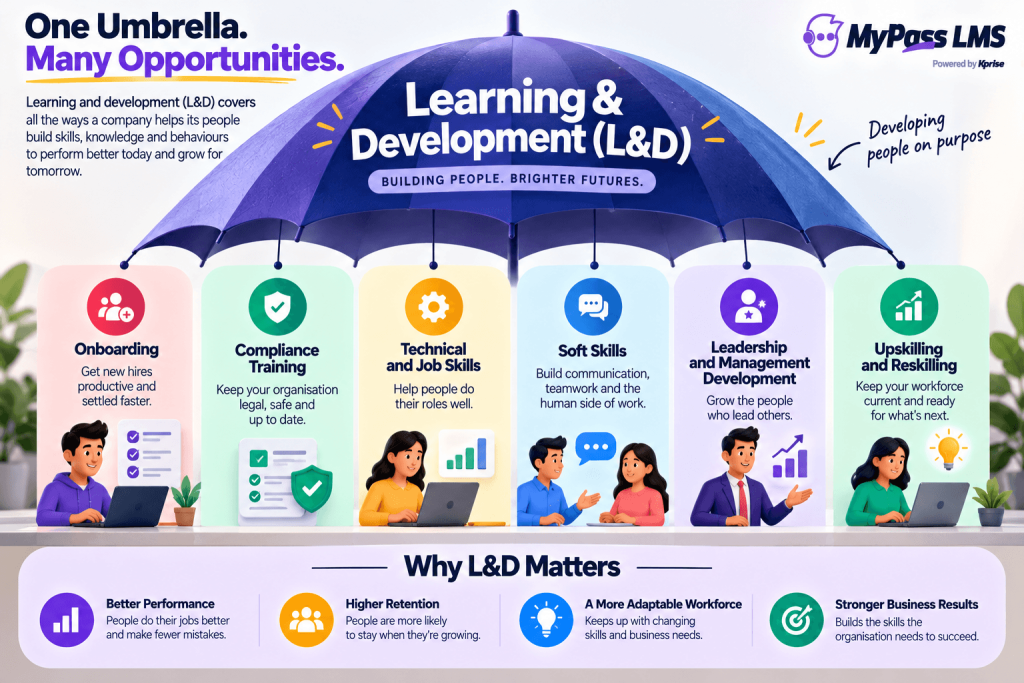
That covers a lot of ground, which is part of why the term feels vague. Onboarding a new hire is L&D. A compliance course is L&D. A leadership programme, a lunch-and-learn, a mentoring scheme, a library of online courses, all L&D. The thread tying it together is intent: the organisation choosing to develop its people on purpose, rather than hoping they figure things out alone. Once you see that, the term stops being fuzzy and starts being useful.
| L&D isn't one specific thing, it's the whole category of how a company deliberately builds its people's skills. Onboarding, compliance, leadership, upskilling, it's all L&D, united by one idea: developing people on purpose. |
What L&D Actually Covers
Because it's a broad function, L&D includes several distinct kinds of work. Most of what an L&D team does falls into these buckets.
- Onboarding: getting new hires productive and settled.
- Compliance training: the mandatory learning that keeps the organisation legal and safe.
- Technical and job skills: helping people do their specific roles well.
- Soft skills: communication, teamwork, leadership and the human side of work.
- Leadership and management development: growing the people who lead others.
- Upskilling and reskilling: keeping the workforce current as needs change.
Why Companies Care So Much About It
L&D costs time and money, so why has it become such a priority? Because, done well, it pays back in ways leaders care about. Trained people perform better and make fewer costly mistakes. Good development is one of the strongest reasons people stay, training genuinely reduces turnover, because people tend to stay where they're growing. And in a world where the skills businesses need keep shifting, L&D is how an organisation keeps up instead of falling behind.
There's a flip side worth naming: L&D has a reputation problem too, because a lot of it has historically been box-ticking, dull courses nobody remembers. That's real, and it's exactly what good L&D sets out to fix. The difference between L&D that's a genuine investment and L&D that's a waste comes down to whether it's relevant, engaging, and actually measured, which is where modern tools and thinking have changed the game.
How L&D Gets Done Today
Modern L&D looks different from the classroom-only era. While in-person training still has its place, most organisations now run a large part of their L&D digitally, through a learning management system (LMS), the software that hosts courses, delivers them to people, and tracks who's done what. If L&D is the practice, the LMS is increasingly where it happens and how it's measured.
That's where a platform like MyPass LMS fits: it gives an L&D team one place to deliver onboarding, compliance, skills and leadership training, assign the right learning to the right people, and actually see whether it's working through reporting. It won't do the strategic thinking, deciding what to develop and why is still human work, but it removes the manual grind so the L&D team can focus on the parts that matter. If you're building or modernising L&D, you can see how it works with a free trial.
| If you're setting up L&D from scratch, the practical first step is usually an LMS to deliver and track it, then start with the training that matters most (often onboarding or compliance) and grow from there. |
The bottom line
Learning and development (L&D) is simply how an organisation helps its people build the skills, knowledge and behaviours it needs, through onboarding, compliance, job and soft skills, leadership and upskilling. Done well it lifts performance, keeps people, and helps a business adapt; done as box-ticking it wastes everyone's time. The difference is relevance, engagement, and whether anyone measures it.
Most L&D today runs, at least partly, through an LMS. See how MyPass LMS helps an L&D team deliver and measure it, explore it free, or read what an LMS actually is if you're starting from the basics.
Frequently asked questions
What is learning and development (L&D)?
Learning and development (L&D) is both a function and a practice: the team responsible for developing employees, and all the ways an organisation deliberately builds its people's skills, knowledge and behaviours. It covers onboarding, compliance training, technical and soft skills, leadership development, and upskilling or reskilling. The common thread is intent, the organisation choosing to develop its people on purpose rather than leaving it to chance. Most L&D today is delivered and tracked through a learning management system (LMS).
What does an L&D team do?
An L&D team identifies what the organisation's people need to learn, then designs, delivers and measures the training to close those gaps. In practice that spans onboarding new hires, running mandatory compliance training, building job-specific and soft skills, developing leaders and managers, and upskilling the workforce as needs change. A good L&D team also measures whether the training actually works, rather than just whether it was completed, and increasingly uses an LMS to deliver and track it all in one place.
Why is learning and development important?
Because, done well, it improves how people perform, reduces costly mistakes, and is one of the strongest drivers of retention, people tend to stay where they're growing. It also keeps a workforce current as the skills businesses need shift, so the organisation adapts instead of falling behind. The caveat is that L&D only delivers these benefits when it's relevant, engaging and measured; box-ticking training that nobody remembers is the version that gives L&D a bad name.
What is the difference between L&D and training?
Training is one part of L&D, not the whole thing. Training usually means structured instruction on a specific topic or skill. Learning and development is the broader function and practice that includes training but also coaching, mentoring, on-the-job learning, leadership development and long-term growth. So you could say training is an activity, while L&D is the wider discipline of deliberately developing people, of which training is one important tool among several.