AI Governance for L&D: Closing the Gap
On this page 7 sections
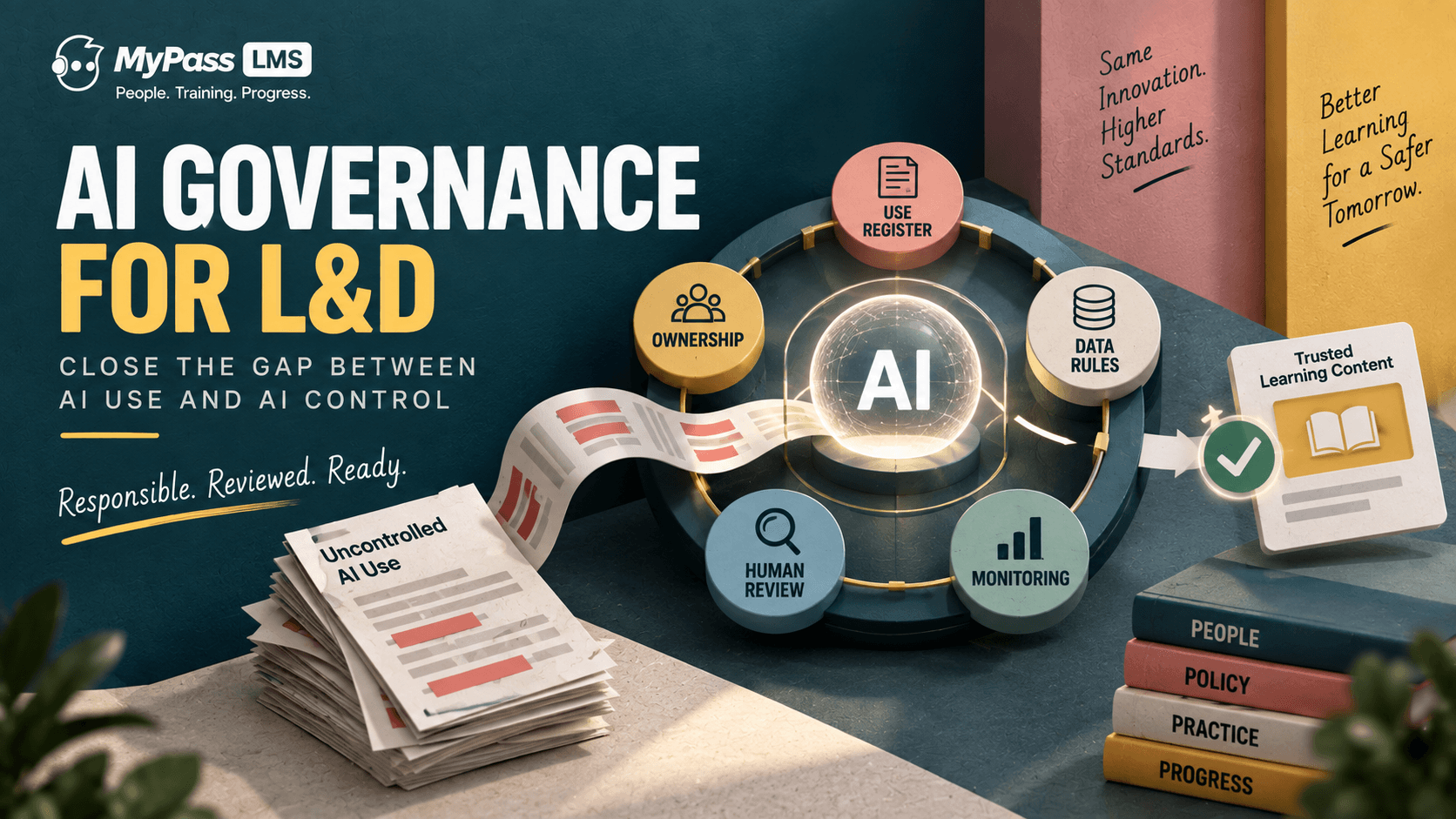
AI governance for L&D is the set of policies and controls that keep AI use in training responsible, accurate and compliant. Most learning teams already use AI to create content, but far fewer have rules for data, quality and oversight. Governance closes that gap with a register of AI uses, clear ownership, quality review, and staff training.
The Governance Gap in L&D
AI has moved from novelty to everyday tool in learning teams. Recent industry research found the overwhelming majority of L&D professionals already use AI, mostly for production tasks like drafting content, generating assessments, creating voice and video, and translation, with faster production cited as the top benefit.
What has not kept pace is governance. Policies, data controls and quality-review workflows have been slow to catch up with how fast teams adopted the tools. The result is a widening gap between AI use and AI control, and that gap is where the risk lives.
Key point
The problem in most L&D teams is not too little AI use. It is lots of AI use with almost no rules around it. Adoption raced ahead; governance did not follow.
Why the Gap Is Risky
Ungoverned AI in training creates concrete, not hypothetical, risks. The point of governance is to head these off before they become incidents.
- Inaccurate content: AI can produce confident, wrong information. Unreviewed, it can teach staff the wrong thing at scale.
- Data exposure: staff pasting sensitive or regulated data into public AI tools can breach privacy obligations.
- Compliance breaches: in regulated fields, AI-generated training that is wrong or unvetted can create legal exposure.
- Bias: AI can embed bias into content or recommendations if nothing checks for it.
- AI slop: the ease of generation leads to a flood of low-quality content produced faster than anyone can evaluate it.
Key point
This is not legal advice, and your obligations vary by industry and jurisdiction. In regulated fields especially, confirm requirements with qualified counsel before relying on AI-generated training.
What AI Governance Actually Involves
Governance sounds heavy, but for an L&D team it comes down to a manageable set of components. You do not need a huge framework to start; you need clarity on a few things.
- An AI use register: a living list of where and how your team uses AI, including which tools.
- Clear ownership: who is accountable for each AI use, and who signs off.
- Data rules: what can and cannot be put into AI tools, especially regulated or personal data.
- Quality review: a human check on AI-generated content before it reaches learners.
- Staff training: making sure the people using AI know the rules and the risks.
- Monitoring and review: revisiting the above as tools and regulations change.
| Component | The question it answers |
| Use register | Where are we actually using AI? |
| Ownership | Who is accountable for each use? |
| Data rules | What data is allowed into AI tools? |
| Quality review | Who checks AI output before learners see it? |
| Staff training | Do our people know the rules? |
A Simple Starting Framework
You do not have to boil the ocean. A lean, practical approach beats an elaborate policy nobody follows.
- Inventory first: list every place AI touches your learning work today. You cannot govern what you cannot see.
- Write a short acceptable-use policy: what tools are approved, what data is off-limits, and who to ask when unsure.
- Require human review: no AI-generated training reaches learners without a named person checking it.
- Train the team: a short internal session on the policy and the risks, so the rules are understood, not just filed.
- Review on a cadence: revisit quarterly, because tools and regulations move fast.
Standards such as ISO/IEC 42001 for AI management systems exist if you need a formal reference point, but most teams should start with the lean version above and formalise later.
Where the LMS Fits
An LMS plays two roles in AI governance. First, it is often where AI is used, through AI course builders and similar features, so how that AI behaves matters. Second, it is how you deliver the AI-literacy and responsible-use training your own staff need, and prove they completed it.
MyPass LMS supports both sides. Its AI course builder is a production tool your governance should cover, and the platform can deliver AI-governance and AI-ethics training to your workforce, assign it by role, and record completion in an audit-ready trail, which is exactly the evidence a governance framework calls for.
Key point
Governance is not only about restricting AI. It is also about training people to use it well. Your LMS is the natural place to deliver and track that AI-literacy training.
The bottom line
AI governance for L&D is about closing the gap between how much AI your team already uses and how little of it is currently controlled. You do not need a giant framework: an inventory, a short acceptable-use policy, mandatory human review, staff training and a regular review cadence cover most of the risk.
Part of governance is training your people to use AI responsibly and proving they did. See how the AI course builder and audit-ready reporting work in MyPass LMS features. This article is general guidance, not legal advice.
Frequently asked questions
What is AI governance for L&D?
AI governance for learning and development is the set of policies, roles and controls that keep AI use in training responsible, accurate and compliant. It covers where AI is used, who is accountable, what data is allowed into AI tools, how AI-generated content is reviewed, and how staff are trained. The aim is to close the gap between rapid AI adoption and slow AI control.
Why does L&D need AI governance now?
Because most L&D teams already use AI heavily for content, assessments and translation, but few have rules around it. Ungoverned use risks inaccurate content taught at scale, sensitive data exposed to public tools, compliance breaches in regulated fields, and a flood of low-quality AI content. Governance heads these off before they become incidents.
What should an AI governance framework for training include?
At minimum: a register of where AI is used, clear ownership for each use, data rules on what can go into AI tools, mandatory human review of AI-generated content before learners see it, staff training on the rules and risks, and a regular review cadence. Standards like ISO/IEC 42001 offer a formal reference, but a lean version is a fine start.
Does an LMS help with AI governance?
Yes, in two ways. If the LMS includes AI features such as a course builder, that AI use falls under your governance. And the LMS is the natural place to deliver AI-literacy and responsible-use training to your own staff, assign it by role, and record completion in an audit-ready trail, which is the evidence a governance framework needs.