A proper iMIS LMS integration creates a secure, two-way connection between iMIS and your learning platform, so member records, single sign-on, course enrollments and continuing education credits sync automatically between both systems. Done right, members log in once, and CE credits earned in the LMS write back to their iMIS profile without anyone re-keying data.
Every vendor says they integrate with iMIS. Here's how to find out who actually does
Ask ten LMS vendors whether they integrate with iMIS and ten will say yes. The word is doing an enormous amount of work in that answer, and the gap between what it can mean is the difference between a system that runs itself and one that generates a weekly data-entry task forever.
So skip the feature list and ask for one thing instead: open the LMS, complete a course as a test member, then open that member's record in iMIS and show me the credit. Live. No overnight batch, no export step, nobody touching a spreadsheet.
That single demo request separates real two-way integration from a data feed with good marketing. Vendors who have built it will do it happily. Vendors who haven't will start explaining their roadmap.
| → The demo test that settles it: 'Complete a course in the LMS and show me the CE credit appear on the iMIS member profile - right now, in front of me.' If that can't be demonstrated live, it isn't a two-way integration. |
Why iMIS integration matters more than any other feature on your list
iMIS sits at the centre of thousands of associations as an engagement management system - member records, dues, event registration, and critically, the member profiles your CE program has to write to. It's the system of record. Your LMS is a guest in that relationship, and its job is to keep the record of truth accurate without human intervention.
When that connection is weak, the failure is predictable. Staff export completions and paste credits into member records by hand. Members log in twice - once to the iMIS-powered site, once to the LMS — and email support when they can't remember the second password. Transcripts drift out of date. Then an audit or an accreditation review arrives and someone spends three days assembling evidence that should have taken three clicks.
None of that is an iMIS problem. It's an integration problem, and it's entirely solvable - which is why choosing an LMS that connects properly to your existing AMS matters more than almost any feature comparison you'll run.
The four things a real iMIS integration handles without you
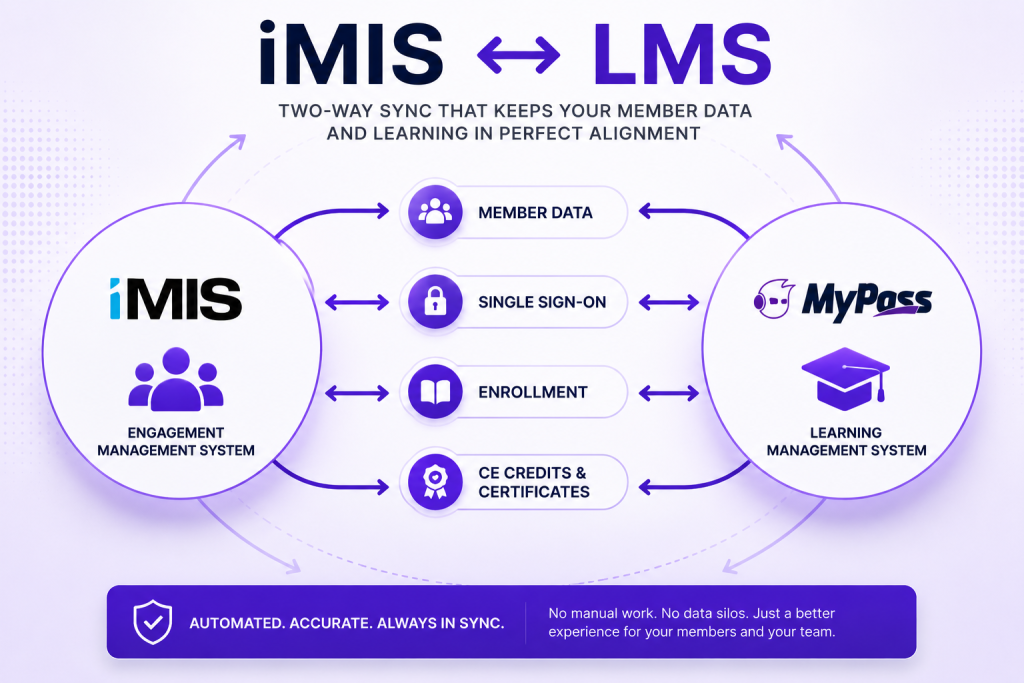
- Member data sync. Create or update a member in iMIS and their record appears in the LMS automatically. No manual account creation, ever. Membership status and tier travel with them, so access always reflects standing.
- Single sign-on. A member already logged into your iMIS-powered site reaches their courses without a second login, because the LMS trusts the identity iMIS has already verified.
- Enrollment automation. Members land in the right courses based on what iMIS already knows - tier, chapter, committee - rather than staff assembling enrollment lists each month.
- CE credit and certificate writeback. The one that matters most. Completions, credits and certifications earned in the LMS post back to the iMIS member profile automatically, so the official record is current and audit-ready by default.
Notice that three of those four move data *into* the LMS. Only the fourth moves data back. That asymmetry is exactly where most integrations quietly fall short - see how AMS and LMS responsibilities should be divided for why the writeback direction is the one that protects your member record.
Two-way vs one-way: the distinction that costs you a staff day a week
Plenty of platforms offer a one-way sync. iMIS pushes member data into the LMS, and that's the end of it. On a feature list it reads as 'iMIS integration' and looks identical to the real thing.
But it leaves the hard half unsolved. If credits and completions don't flow back automatically, someone is still doing manual data entry - just in the other direction. You've automated the easy part, the part that was never really the bottleneck, and kept the part that eats an afternoon every week.
True bidirectional sync closes the loop: member data in, learning outcomes out. That writeback is what makes the iMIS profile the single source of truth for CE and compliance reporting. It's also the thing associations most often forget to verify during a demo, because the vendor demonstrated the inbound direction and it looked impressive.
A fair word about the iMIS-native competition
You should know the landscape before you evaluate. TopClass LMS is owned by Advanced Solutions International (ASI) - the same company that owns iMIS — so it maintains a particularly deep, in-house iMIS bridge with real-time two-way sync including CE writeback. If a tight iMIS connection is your single criterion, that's a genuine strength and it would be dishonest to pretend otherwise.
The trade-off associations consistently report is a dated interface and a steep administrative learning curve, alongside implementations that run longer than expected. So the practical question isn't whether shared ownership produces a good integration - it does. It's whether you have to accept a legacy platform to get one.
You don't. A strong iMIS integration is not exclusive to platforms owned by iMIS's parent company. What you're actually looking for is two-way sync with genuine CE writeback, on a platform your team can run without specialist help, at a price that doesn't scale per member. If you're weighing that trade-off directly, our honest comparison of TopClass LMS and the alternatives lays out both sides.
Five questions to ask before you connect anything
Bring these to any demo. They'll save you months.
- Is the integration two-way, and can you demonstrate CE credit writeback to an iMIS profile live?
- Is single sign-on included, or licensed separately?
- Is this a named, pre-built iMIS connector, or a custom API project scoped after signature?
- When a member lapses or renews in iMIS, does course access adjust automatically — and how quickly?
- Can historical CE and completion data be migrated, so nobody loses their record in the move?
| → A named, pre-built iMIS connector is worth far more than a promise to integrate via API. Custom integration projects are where implementation timelines and budgets quietly go to die. |
The bottom line
The value of an iMIS LMS integration isn't that a connection exists. It's what stops being manual. When member data, SSO, enrollment and CE writeback all sync on their own, staff stop re-keying, members stop logging in twice, and compliance reporting stops being a fire drill. Verify the writeback direction specifically — ask to see it live, on a real member profile, before you sign anything.
MyPass LMS provides native two-way iMIS integration with genuine CE credit and certificate writeback, single sign-on, and tier-based enrollment — on a modern platform with unlimited registered users and no per-seat fees. You can review the full list of MyPass LMS integrations , or start with the free self-hosted Community Edition and test the connection against your own iMIS data first.
Frequently Asked Questions
What is iMIS LMS integration?
iMIS LMS integration is a secure, two-way connection between the iMIS engagement management system and a learning platform. It syncs member data, single sign-on, course enrollments and continuing education credits automatically between both systems.
Is iMIS integration two-way?
It should be. A true iMIS integration is bidirectional: member data flows from iMIS into the LMS, and completions, CE credits and certificates flow back to the iMIS member profile automatically. One-way syncs leave you doing manual data entry.
Can CE credits write back to iMIS automatically?
Yes, with a genuine two-way integration. Credits and certifications earned in the LMS post back to the member's iMIS profile automatically. Always ask to see this demonstrated live rather than described.
Does iMIS LMS integration include single sign-on?
A proper integration includes SSO, so members logged into your iMIS-powered site reach their courses without a second login. Confirm it's included rather than a paid add-on.
Which LMS platforms integrate with iMIS?
Several, including TopClass LMS (owned by iMIS's parent company ASI), MapleLMS, Oasis LMS and MyPass LMS. MyPass offers native two-way iMIS integration with CE writeback plus seven other AMS connectors, with unlimited registered users.
How long does an iMIS LMS integration take to set up?
With a pre-built connector, typically days to a few weeks depending on how much historical data you migrate. Custom API integrations take considerably longer, which is why a named connector matters.