Software companies need an LMS that handles three distinct audiences well: employees, customers and often developers or partners. The best options support unlimited external users, integrate cleanly with product identity systems, and treat customer education as a growth channel rather than a support cost. Per-user pricing quietly caps how much you can enable your ecosystem.
Software companies are a specific LMS buyer
Most LMS marketing addresses either 'employees' or 'customers' as the audience, and treats them as separate purchases. Software companies buy for both, plus often developers, partners and community, which is a genuinely different problem from either alone.
The result is a platform decision that turns on a few questions most LMS vendors do not lead with: can you handle very large external audiences without punishing you for growth, do you integrate with your product's identity system, and can you treat customer certification as a marketable credential rather than a completion record. Get those wrong and you end up buying a second platform for the audience the first one made expensive.
What software companies actually need
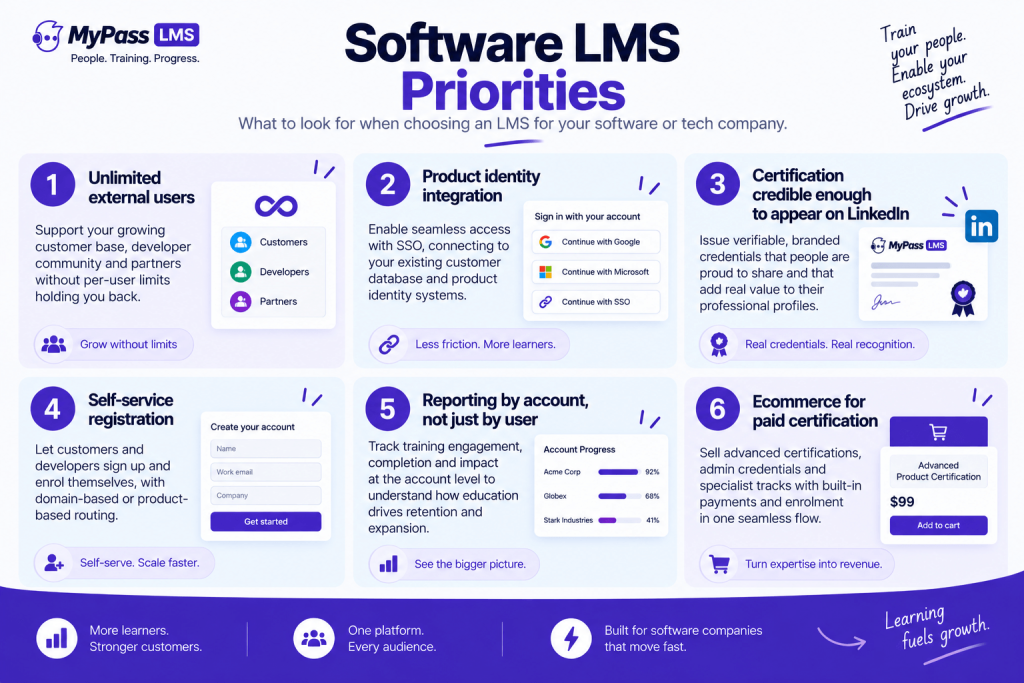
- Unlimited external users. Your employee count is small relative to the size of your customer base, developer community and partner ecosystem. Per-user pricing that made sense internally becomes prohibitive when the same platform reaches all of them.
- Product identity integration. Customers already have an account in your product. Making them create a new one to take a course is friction you can avoid. Look for SSO options that work with your existing customer database, not just internal identity providers.
- Certification credible enough to display. If you invest in a customer or developer certification programme, the credential needs to be something people put on LinkedIn. That means verifiable, visible and clearly branded, not a PDF you email.
- Self-service registration. Customers and developers will not wait for you to enrol them. Registration needs to work without an administrator, ideally with domain-based or product-based routing.
- Reporting by account and cohort, not just by user. Customer education value is measured at the account level, not the individual level. If you cannot see whether the accounts using training retain and expand more than accounts that do not, the whole programme is opaque.
- Ecommerce for paid certification. Advanced developer certifications, admin credentials and specialist tracks are frequently paid, and they should be. That requires selling and enrolment in one flow.
How the options compare
An honest read on the categories. [General 2026 market positioning; confirm current capability and pricing with vendors directly.]
- Dedicated customer education platforms. Several specialist tools do customer-facing training well, with strong integrations to CS platforms and product analytics. They can be less strong on employee training, formal compliance and credentialing where audit-grade records matter.
- TalentLMS. Genuinely usable for small teams, published pricing, active-user brackets that make growing external audiences a budget conversation. Fits small software companies well; the pricing model constrains larger deployments with big external audiences.
- Docebo. Capable platform with strong analytics, well-suited to larger software companies with enablement budget. Per-user pricing and enterprise sales engagement, so scoping external audiences requires planning to control cost.
- MyPass LMS. Unlimited registered users on every plan, so external audiences do not raise the bill. Native ecommerce for paid certifications, certification workflows with expiry, and included AI capabilities.
- Roll-your-own on Moodle or another open-source platform. Some engineering-heavy software companies genuinely do this and it works. Others try it and discover the maintenance and product integration burden outweighs the savings.
The three programmes software companies actually run
- Employee training. Onboarding, sales enablement, compliance and internal skills. Standard LMS territory, and the audience where per-user pricing feels normal.
- Customer education. Onboarding new customers, driving product adoption, reducing support load. Research from Forrester found customer education correlates with meaningful retention and revenue gains, and it works best when the platform treats it as a core use case rather than an afterthought.
- Developer and partner enablement. Technical certifications, integration training, partner tier requirements. This is where credential credibility and self-service registration matter most, and where paid certification often becomes a revenue line.
Software companies frequently start with one of these and discover they need the others. Choosing a platform that does one well and the others badly means either living with the gap or eventually buying a second platform. Choosing one that handles all three is a genuinely different decision.
The pricing trap specific to this sector
Per-user pricing punishes software companies in a specific way: it turns growing your customer education programme, which is a commercial success, into a cost centre. Every additional certified customer, every developer in the community, every partner rep raises the software bill.
The commercial logic pushes the opposite direction. Broad enablement typically drives retention and expansion. Wide developer community adoption drives product stickiness. Extensive partner certification drives channel revenue. So you have a pricing model penalising exactly the behaviour that produces the revenue outcomes the programme is meant to drive.
Unlimited registered users removes that tension entirely. Certify everyone who wants to be certified, enable every developer who wants to learn, and pay for infrastructure capacity instead of headcount.
| The evaluation question specific to software companies: model your platform cost on the assumption your customer or developer community grows tenfold. If that model has your platform cost also growing tenfold, the pricing model is going to shape your commercial decisions in ways you will regret. |
Where MyPass LMS fits, and where it does not
MyPass LMS suits software companies that need one platform covering employees, customers and partners with unlimited user pricing, want to treat certification as a marketable credential, and prefer to pair with rather than replace their existing customer success stack. Native ecommerce means paid certifications work without a separate storefront, and the free Community Edition supports the developer-heavy segment that wants a self-hostable option.
Where it is not the obvious pick: if your primary need is deep integration with a specific customer success platform for behavioural triggers and in-product learning, a specialist customer education platform may fit that narrower job more tightly. If your engineering-led culture strongly prefers open-source at every layer, Moodle self-hosted remains a legitimate answer for teams with the technical capacity.
The bottom line
Software companies buy an LMS for a different problem than most other industries: three distinct audiences, external populations much larger than internal headcount, and certification that matters more as a marketable credential than as an internal record. Prioritise unlimited external users, product identity integration, self-service registration and account-level reporting, and treat customer education as a growth channel rather than a support cost. Then avoid per-user pricing that will shape your commercial decisions in ways your board would not endorse.
MyPass LMS includes unlimited registered users, native ecommerce and certification workflows on every plan. See the software industry solution, start a 15-day free trial, or explore customer education.
Frequently asked questions
What is the best LMS for a software company?
One that handles employees, customers and developers or partners together, with unlimited external users, product identity integration, credible certification, self-service registration and account-level reporting. Per-user pricing is the trap to avoid, since it turns customer and community growth into a rising software bill.
Do software companies need a separate customer education platform?
Not necessarily. A single LMS that treats customer education as a first-class use case, with unlimited external users, self-service registration and certification credibility, can cover employee, customer and partner training in one platform, which avoids the cost and complexity of running two.
Why is per-user pricing a problem for software companies?
Because your customer, developer and partner audiences are typically much larger than your employee headcount. Per-user pricing turns growth in those audiences, which drives retention, expansion and channel revenue, into a rising software cost, which pushes you to ration enablement precisely when it is working.
How do software companies use LMS certification?
As a marketable credential for customers, developers and partners. Certified customers advocate and expand more; certified developers stick to your product; certified partners qualify for tier benefits. This works when the credential is verifiable, displayable on LinkedIn and clearly branded, not a PDF emailed after completion.
Should developer certification be free or paid?
Both models work. Foundational certifications are typically free to maximise reach and drive product adoption. Advanced and specialist certifications are frequently paid, filter for commitment and generate revenue. Native ecommerce inside the LMS makes both models operationally simple.