| Gamification in training applies game mechanics such as points, badges, levels, streaks and leaderboards to learning, so progress feels visible and rewarding. Used well, it lifts engagement and completion for routine or repetitive training. Used badly, it rewards activity instead of learning and quickly wears off. |
What Gamification in Training Actually Means
Gamification in training is the use of game design elements inside non-game learning, so that finishing a module or hitting a milestone produces a small, visible reward. It is not the same as game-based learning, where the training itself is a game. With gamification, the course stays a normal course. What changes is the layer around it: the learner can see progress, earn recognition, and compare where they stand.
The mechanics people mean when they say gamification fall into a few groups. There are progress signals like points, experience levels and completion bars. There are achievements like badges and certificates. There are social elements like leaderboards and team challenges. And there are habit devices like streaks and daily goals.
- Points and experience: a running score for completing lessons, quizzes or tasks.
- Badges and achievements: visual markers for reaching a defined milestone.
- Levels and progress bars: a sense of advancing through a structured path.
- Leaderboards: ranked comparison against peers, a team, or a personal best.
- Streaks and challenges: time-based goals that encourage regular return visits.
| Gamification changes how training feels, not what it teaches. If the underlying content is weak, a leaderboard will not save it. Fix the content first, then add the layer. |
Why It Works, When It Works
The reason gamification helps is straightforward. Most workplace training is not intrinsically motivating. Compliance refreshers, product updates and process training are things people have to do, not things they want to do. Game mechanics supply the missing motivation by making progress visible and giving frequent, low-stakes feedback.
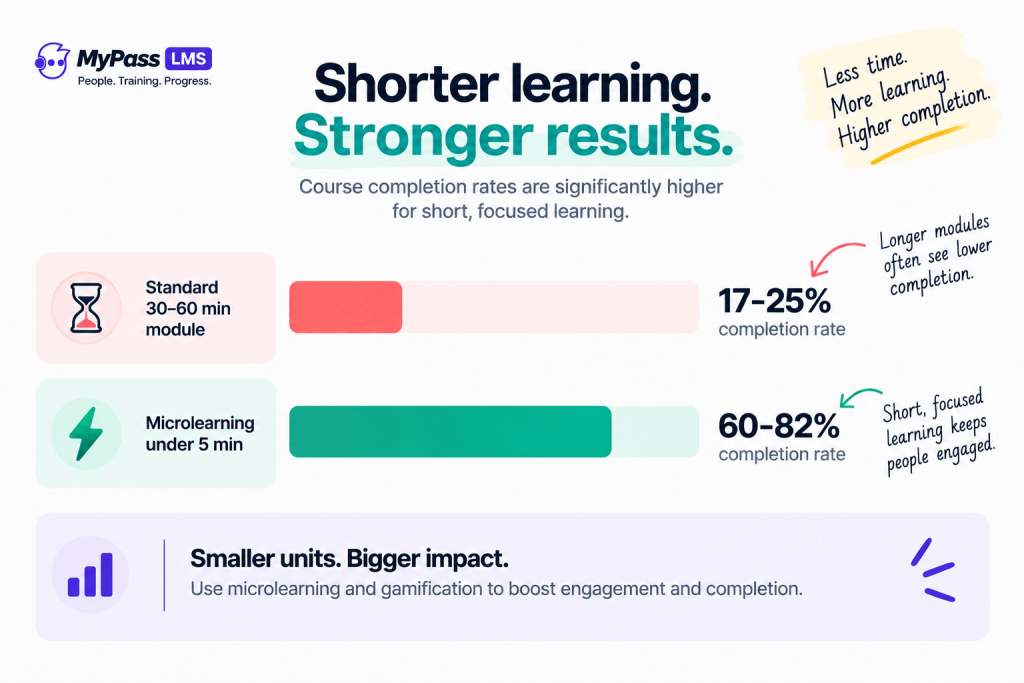
This matters most where completion is the problem. Industry data puts content completion at roughly 17 to 25 percent for standard 30 to 60 minute modules, rising sharply to 60 to 82 percent for microlearning under five minutes. Gamification works with that grain: short units, quick wins, and a visible reward at the end of each one.
It also works because it gives managers a reason to talk about training that is not nagging. A team challenge or a shared goal reframes training as something the group is doing together, rather than a task an individual is behind on.
What Backfires
Gamification fails in predictable ways, and most of them come from rewarding the wrong thing. When points are tied to activity rather than learning, people learn to game the game. They click through faster, skip the reading, and chase the score instead of the skill.
- Rewarding speed over understanding: learners rush to earn points and retain nothing.
- Permanent public leaderboards: the same people win, everyone else disengages, and low performers feel exposed.
- Meaningless badges: rewards that do not map to real competence lose value fast.
- Novelty decay: engagement spikes at launch, then falls once the mechanics stop feeling new.
- One-size targeting: the same challenge for a new hire and a ten-year veteran motivates neither.
| The single most common mistake is a permanent, public, all-time leaderboard. It motivates the top few and demotivates everyone else. Reset it regularly, scope it to teams, or rank people against their own past performance instead. |
How to Set Up Gamification That Lasts
Durable gamification is designed, not switched on. The goal is to reward the behaviour you actually want, keep the rewards meaningful, and refresh the mechanics before novelty wears off.
- Tie rewards to outcomes, not clicks. Award points for passing an assessment, not for opening a page.
- Keep leaderboards fair. Use rolling time windows, team-level ranking, or personal-best comparisons.
- Make badges mean something. Map each one to a real competency or a completed learning path.
- Use streaks for habitual training. They suit recurring or refresher content, not one-off courses.
- Segment by audience. Give new hires onboarding challenges and veterans advanced or optional ones.
- Review the data. If a mechanic is not moving completion or scores, change it or remove it.
| Mechanic | Best used for | Watch out for |
| Points | Rewarding assessment passes and real progress | Tying points to raw activity |
| Badges | Marking completed paths and competencies | Badges with no real meaning |
| Leaderboards | Short team challenges and campaigns | Permanent public all-time ranking |
| Streaks | Recurring and refresher training | Punishing people for one missed day |
Gamification and Your LMS
Gamification is only practical when it is built into the platform that delivers your training. Bolting a separate rewards tool onto a learning management system means two systems to maintain and data that never quite lines up. When points, badges and progress live inside the LMS, they update automatically as learners complete real courses, and the same reporting that tracks completion can show whether the mechanics are working.
MyPass LMS treats gamification as part of the learning experience rather than a separate add-on, so recognition and progress tracking sit alongside course delivery, assessments and reporting. That keeps the reward tied to the actual learning record, which is exactly what stops gamification from drifting into rewarding activity for its own sake.
| If you are evaluating platforms, ask whether gamification is native or a third-party integration. Native mechanics stay in sync with completion data. Integrations often do not. |
The bottom line
Gamification in training is a multiplier, not a fix. It raises engagement and completion when the content is already sound and the mechanics reward real learning. It backfires when it rewards speed, exposes low performers, or relies on novelty that fades.
Start small: pick one high-volume course where completion is weak, add points tied to assessment results and a time-boxed team challenge, and measure the change. If it works, expand it. If it does not, adjust before you scale. You can see how native gamification fits alongside course delivery and reporting in MyPass LMS features, or start a free trial to try it on your own content.
Frequently asked questions
Does gamification actually improve learning outcomes?
It reliably improves engagement and completion, which are prerequisites for learning. Whether it improves retention depends on design: rewards tied to assessment performance help, while rewards tied to raw activity do not. Gamification amplifies the quality of the underlying content rather than replacing it.
What is the difference between gamification and game-based learning?
Gamification adds game mechanics such as points and badges around ordinary training. Game-based learning makes the training itself a game or simulation. Gamification is cheaper and faster to deploy across existing courses. Game-based learning is more immersive but costs far more to build.
Do leaderboards demotivate people?
Permanent public leaderboards often do, because the same people win and everyone else disengages. Leaderboards that reset regularly, rank teams rather than individuals, or compare people against their own past performance avoid most of the downside while keeping the motivation.
Which types of training benefit most from gamification?
High-volume, repetitive or compliance training benefits most, because these are the courses people are least intrinsically motivated to finish. Onboarding and product training also respond well. Complex, high-stakes or deeply technical training benefits less, since motivation there is already high.