
| Employees forget most of what they learn within days because of the forgetting curve: memory decays fast without reinforcement. You fix it by spacing learning over time, prompting people to recall information rather than reread it, reinforcing with short refreshers, and giving them chances to apply the training on the job soon after. |
The Problem: Training That Evaporates
You run a good training session. People engage, they pass the quiz, and everyone feels productive. Then a week later you discover almost none of it stuck. This is one of the most demoralizing patterns in L&D, and it is not a sign of bad learners or bad content. It is a predictable feature of how human memory works.
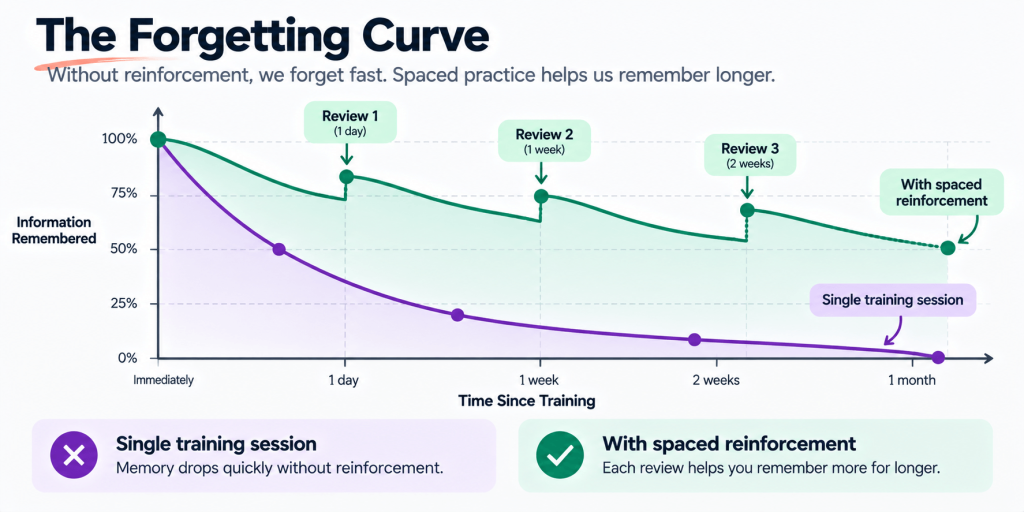
Over a century ago, psychologist Hermann Ebbinghaus mapped what is now called the forgetting curve: without reinforcement, we lose a large share of newly learned information within days. That is the default for all of us. The good news is that the curve is not fixed. Once you understand why forgetting happens, you can design training that fights it.
| Forgetting is the default, not the exception. If your training is a single event with no reinforcement, the forgetting curve guarantees most of it will be gone within a week, no matter how good the session was. |
Why the Forgetting Curve Happens
Memory is not a recording; it is a connection that weakens unless it is used. A single exposure to information creates a fragile memory, and the brain, efficient by design, discards what it does not see as important. Without a reason to keep the information, it fades. Several things make workplace training especially forgettable.
- One-and-done delivery: a single session with no follow-up gives the brain no signal to retain.
- Passive learning: watching or reading creates weaker memories than actively recalling.
- No application: training people cannot use soon is forgotten before they get the chance.
- Overload: cramming too much into one session means most of it never encodes at all.
- No relevance: information the learner does not see as useful is the first to go.
The Fixes That Beat Forgetting
Retention responds to a handful of well-evidenced techniques. You do not need all of them, but the more you use, the flatter your forgetting curve.
- Space it out: revisit key points across days or weeks instead of one long session.
- Make them recall: quiz and retrieval prompts beat rereading, because effortful recall strengthens memory.
- Reinforce with microlearning: short refreshers keep the memory alive without a full re-training.
- Apply it fast: give people a real task using the training soon after they learn it.
- Chunk it: smaller pieces encode better than a firehose of content in one sitting.
| The single most powerful technique is retrieval practice: making people recall information from memory, not just reread it. A short quiz a few days after training does more for retention than repeating the whole session. |
Design Training to Reinforce Itself
Beating the forgetting curve is a design choice, not extra work bolted on afterwards. Instead of thinking of a course as a one-time event, think of it as a sequence: initial learning, then spaced reinforcement, then application. The same content, delivered on a schedule rather than all at once, retains far more.
In practice that means breaking a big course into shorter modules released over time, adding brief recall quizzes days after the main lesson, and pairing each topic with an on-the-job task. None of this requires more content; it requires sequencing what you already have so the brain gets the repeated, spaced signals it needs to keep the information.
How MyPass LMS Helps Training Stick
MyPass LMS is built to deliver training as a reinforced sequence rather than a single forgettable event. You can break courses into short modules and release them on a schedule, so learning is spaced rather than crammed, and add quizzes and assessments that force retrieval instead of passive rereading.
Automated reminders bring people back for spaced refreshers without manual chasing, and reporting shows not just who completed a course but where retention is weak, so you can add reinforcement exactly where the forgetting curve is steepest. Because pricing is flat with unlimited registered users, giving everyone ongoing access to refreshers does not add per-seat cost.
| A simple starting move: take one important course and add a short recall quiz scheduled for three to five days after the main lesson. That one change, retrieval plus spacing, often lifts retention more than any amount of polish on the original content. |
The bottom line
Employees forget training because forgetting is the brain's default, not because the training was bad. The forgetting curve is steep for a single, passive, one-and-done session, but it flattens dramatically when you space learning over time, prompt recall instead of rereading, reinforce with short refreshers, and let people apply what they learned quickly.
Treat every course as a reinforced sequence, not an event. See how scheduled modules, quizzes and reminders support retention in MyPass LMS features, read how microlearning works, or start a free trial.
Frequently asked questions
What is the forgetting curve?
The forgetting curve, first described by Hermann Ebbinghaus, shows how quickly we lose newly learned information when it is not reinforced. A large share of what we learn can be forgotten within days. It is a normal feature of memory, not a failure of the learner, and it applies to everyone. The key insight is that reinforcement, spacing and recall flatten the curve and dramatically improve how much is retained.
Why do employees forget most of their training?
Because most workplace training is a single, passive session with no reinforcement and no immediate chance to apply it, which is exactly the setup the forgetting curve predicts will fade fast. The brain discards information it does not see used or repeated. Spacing the learning, adding recall quizzes, reinforcing with short refreshers and giving people a real task to apply it are what turn forgettable training into training that sticks.
What is spaced repetition in training?
Spaced repetition means revisiting key information at increasing intervals over time rather than all at once. Because each well-timed review interrupts the forgetting curve and strengthens the memory, spaced learning retains far more than a single session of the same length. In workplace training it usually looks like short refreshers or recall quizzes delivered days or weeks after the initial lesson, often through microlearning.
How do you make training stick?
Space the learning across days or weeks, make people actively recall information through quizzes and retrieval prompts rather than rereading, reinforce with short microlearning refreshers, give them a real task to apply the training soon after, and break content into smaller chunks. Retrieval practice and spacing are the two highest-impact techniques. The core shift is treating a course as a reinforced sequence, not a one-time event.