| Low LMS adoption is usually caused by friction, irrelevant content, poor communication and no leadership buy-in, not by lazy employees. You fix it by making the platform easy to reach, assigning content that is clearly relevant, communicating why it matters, involving managers, and measuring real usage rather than just logins. |
Why Your LMS Sits Unused
Buying an LMS is the easy part; getting people to use it is where most implementations struggle. If you are looking at a platform you paid for and a usage report that is nearly flat, you are not alone, and the cause is almost never that your employees are lazy. Low adoption is a design and process failure with identifiable, fixable causes.
The pattern repeats across organizations. The platform is hard to reach, the content does not obviously matter to the person's job, nobody explained why it exists, managers ignore it, and there is no follow-up. Each of those is a lever you control. Understanding which ones are pulling your adoption down is the first step to fixing it.
| Reframe the problem before you solve it. 'Our employees won't use the LMS' usually means 'we made the LMS easy to ignore.' Adoption is something you design for, not something you demand. |
The Real Causes of Low Adoption
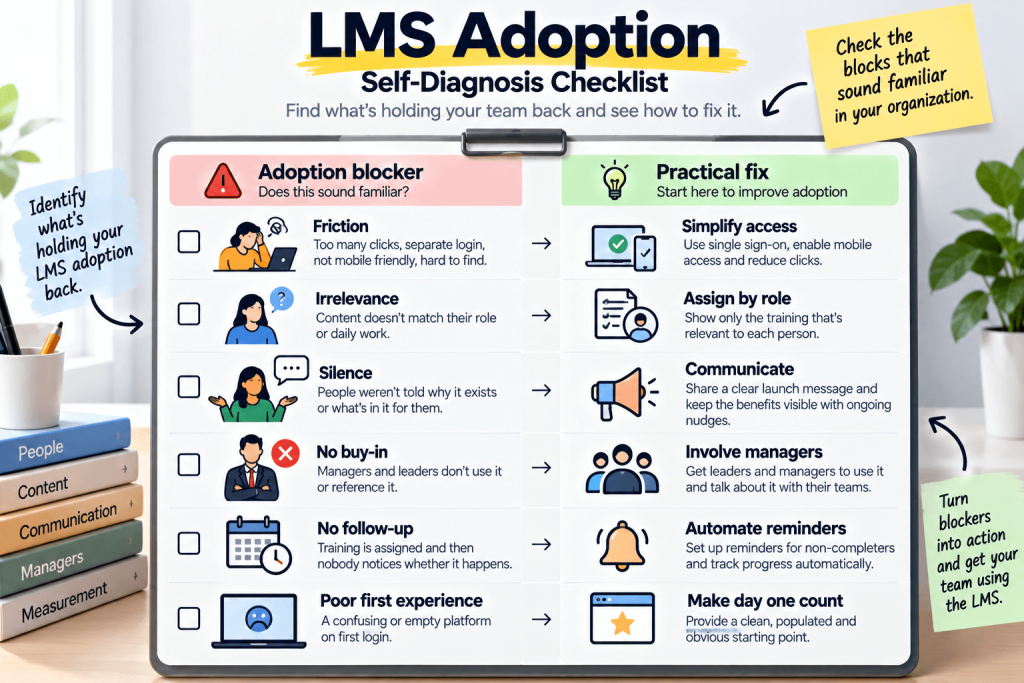
Adoption drops for a handful of predictable reasons. Diagnosing which apply to you tells you exactly what to fix.
- Friction: too many clicks, a separate password, no mobile access, hard to find.
- Irrelevance: content that does not match the person's role or daily work.
- No communication: people were never told why the platform exists or what is in it for them.
- No leadership buy-in: if managers and leaders ignore it, so does everyone else.
- No follow-up: training is assigned and then nobody notices whether it happens.
- Poor first experience: a confusing or empty platform on first login kills momentum.
The Fixes That Actually Move Adoption
The good news is that adoption responds quickly to the right changes, because the causes are practical. Work the highest-leverage fixes first.
- Cut the friction: single sign-on, mobile access, and the fewest possible clicks to start learning.
- Make it relevant: assign content by role so people only see what applies to them, and say why.
- Communicate the why: a clear launch message and ongoing nudges explaining what is in it for them.
- Get leaders involved: when managers use it and reference it, their teams follow.
- Automate follow-up: reminders that chase non-completers without manual nagging.
- Fix the first login: a clean, populated, obvious starting point so day one feels worthwhile.
| The single highest-leverage fix is usually reducing friction. If reaching the LMS means a separate login and three menus, adoption dies there. Single sign-on and mobile access alone often lift usage more than any campaign. |
Measure Adoption Properly
You cannot improve what you measure badly. Many teams track logins and call it adoption, but a login is not use. Real adoption is people actively completing relevant learning and coming back. Measuring the right thing tells you whether your fixes are working and where usage is still stuck.
Look at active users over time, completion of assigned learning, repeat visits, and which content gets used versus ignored. That last one is gold: content nobody touches is either irrelevant or impossible to find, and either way it is dragging your numbers down. Adoption is a metric you manage, not a one-time launch you hope succeeds.
How MyPass LMS Supports Adoption
MyPass LMS is built to remove the friction that kills adoption. Single sign-on and mobile access make the platform easy to reach, role-based assignment keeps content relevant so people only see what applies to them, and automated reminders handle the follow-up that manual chasing never sustains.
Reporting shows active usage and where people drop off, not just logins, so you can see whether adoption is genuinely improving and which content is being ignored. Because pricing is flat with unlimited registered users, extending access to everyone, which adoption depends on, does not add per-seat cost, so there is no reason to ration who gets on the platform.
| A practical starting move: turn on single sign-on, assign one genuinely useful role-based course, and send one clear message about why it matters. Prove the platform is easy and relevant on a small scale, then expand. |
The bottom line
Low LMS adoption is a fixable design and process problem, not a verdict on your employees. The causes, friction, irrelevance, silence, no leadership buy-in, no follow-up, each map to a practical fix. Cut the friction, make content relevant, communicate the why, involve managers, and measure real usage rather than logins.
Adoption is something you design for and manage over time. See how single sign-on, role-based assignment and usage reporting support adoption in MyPass LMS features, read how to improve course completion rates, or start a free trial.
Frequently asked questions
Why is our LMS adoption so low?
Usually because of friction (hard to reach, separate login, no mobile), content that is not relevant to people's roles, no communication about why the platform exists, no leadership buy-in, and no follow-up. Each is a design or process failure you control, not a sign your employees are unwilling. Diagnosing which causes apply tells you exactly what to fix.
How do you increase LMS adoption?
Cut friction with single sign-on and mobile access, assign content by role so it is clearly relevant, communicate why the platform matters, get managers to use and reference it, automate reminders for follow-up, and fix the first-login experience. Reducing friction is usually the highest-leverage change, since a hard-to-reach LMS loses people before they ever engage.
How do you measure LMS adoption?
Measure active use, not just logins. Track active users over time, completion of assigned learning, repeat visits, and which content is used versus ignored. A login is not adoption; someone completing relevant training and returning is. Content nobody touches signals irrelevance or poor findability. Measuring the right metrics shows whether your fixes are working and where usage is still stuck.
What role do managers play in LMS adoption?
A large one. When managers use the platform themselves and reference it with their teams, adoption rises, because the training visibly matters to someone who matters to the employee. When leaders ignore the LMS, everyone else does too. Getting managers involved, and giving them visibility into their team's usage, is one of the most effective and most overlooked adoption levers.