| Talent management is how an organisation attracts, develops, deploys and keeps the people it needs. It covers hiring, onboarding, development, performance, internal moves and succession, treated as one connected cycle rather than separate HR tasks. Done well, it means you can fill important roles from inside instead of always buying talent. |
What Talent Management Actually Covers
Talent management is a big phrase for a simple idea. It is everything an organisation does to make sure it has the people it needs, now and in two years, and that those people want to stay.
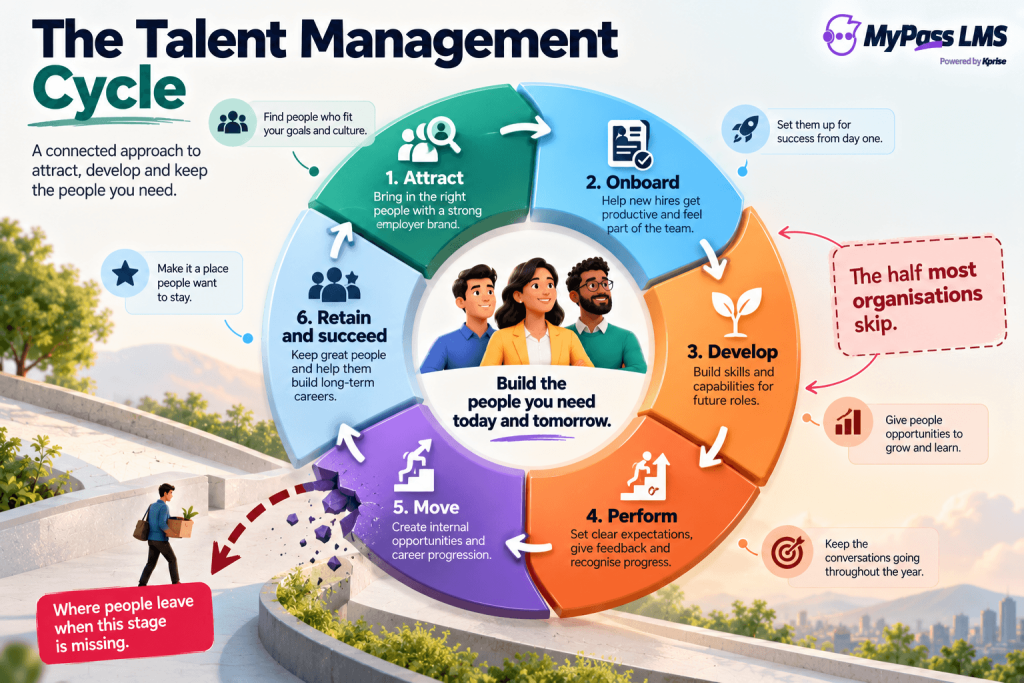
In practice that means six things that are usually owned by different people and rarely joined up. Attracting candidates. Onboarding them. Developing them. Managing their performance. Moving them into new roles. And planning who takes over when someone leaves.
The difference between talent management and ordinary HR admin is that word "cycle". HR admin treats these as separate jobs with separate owners. Talent management treats them as one loop, where what you learn in a performance review changes what you develop, which changes who is ready for the next role, which changes what you need to hire from outside.
When it is not joined up, you get the thing everyone recognises. A manager spends four months recruiting for a role that two people already in the building could have done, if anyone had known they could do it.
Why This Matters More Than It Did Three Years Ago
For a long time talent management was something large companies with a dedicated team worried about. That has changed, for two reasons that are worth being specific about.
The skills you need are moving. The World Economic Forum's Future of Jobs Report 2025 estimates that nearly 40 percent of the skills needed on the job will change by 2030, and that 59 of every 100 workers will need training as a result. More tellingly, 63 percent of employers now name skills gaps as the single biggest barrier to transforming their business. Not funding. Not technology. People.
And buying your way out has got harder. Hiring budgets are tight, headcount approvals are slow, and the specific skills everyone suddenly needs are the ones in shortest supply externally. Which leaves one realistic option: grow the capability from the people you already employ. That is talent management, and it is why it has moved from a nice-to-have to something small organisations are now doing on purpose.
| A useful question for a leadership meeting: of the roles you expect to need filled in the next eighteen months, how many could be filled by someone already working here? If nobody can answer, that gap is the thing to fix first. |
The Six Stages of the Talent Management Cycle
Different models carve this up differently, but they all cover the same ground. Here is the practical version, with the question each stage is actually answering.
| Stage | The question it answers | What it looks like in practice |
| Attract | Why would someone good come here? | Employer brand, job design, honest job adverts, pay that is defensible |
| Onboard | How fast can they become useful? | Structured first 90 days, clear expectations, early wins |
| Develop | How do people get better at this? | Training, coaching, stretch work, development plans |
| Perform | Do people know what good looks like? | Clear goals, regular feedback, honest reviews |
| Move | Where does someone go next? | Internal mobility, career paths, promotion that is visible and fair |
| Retain and succeed | What happens when they leave? | Retention drivers, succession plans, knowledge handover |
Most organisations are decent at two or three of these and quietly ignore the rest. The usual pattern is strong attract and onboard, weak develop and move, and no succession planning at all until someone important resigns.
The Stage Everyone Skips, and What It Costs
If you only fix one part of this, fix internal mobility. The numbers on it are unusually clear.
LinkedIn analysed 32 million member profiles and looked at how long people stayed. Employees who were promoted within three years of joining had a 70 percent chance of still being there. People who made a sideways internal move had a 62 percent chance. People who made no move at all had a 45 percent chance.
Read that again, because the second number is the interesting one. A sideways move with no pay rise and no promotion kept people almost as well as a promotion did. What people are responding to is not the title. It is the evidence that going somewhere is possible here.
This is the cheapest retention lever most organisations own, and it is usually blocked by something mundane. Managers hoard good people. Open roles are filled through someone's network before they are advertised internally. Nobody knows who has what skills, so internal candidates are invisible. None of those are strategy problems. They are plumbing problems, and they can be fixed in a quarter.
The prerequisite is knowing what your people can actually do, which is what a skills gap analysis gives you, and having somewhere that growth gets written down, which is what an employee development plan is for.
How to Start Without Buying a Big System
You do not need a talent management suite to begin. You need four things, and three of them fit in a spreadsheet.
- A list of the roles that would genuinely hurt to lose. Usually five to fifteen, not everyone.
- For each of those, the names of anyone who could do it today, could do it in a year, or could do it in three. If a row is blank, that is your risk.
- A development plan for the people in the one-year column, with actual dates on it.
- A rule that open roles get advertised internally first, for a set number of days, before they go out.
That last one costs nothing and changes behaviour faster than any system. It also surfaces the hoarding problem immediately, because you will find out which managers quietly block their people from applying.
Once that is running and you can see which gaps keep appearing, it is worth connecting the development side properly, so that the training you assign is tracked against the plan rather than sitting in someone's inbox. That is also the point where the link between development and retention stops being a theory and starts showing up in your numbers. And before anyone leaves, the succession half of this deserves its own attention, which is what succession planning covers in detail.
The bottom line
Talent management is the loop that connects hiring, onboarding, development, performance, internal moves and succession, instead of running them as six unrelated jobs. It matters more now because the skills organisations need are changing fast, the gaps are the main thing holding businesses back, and hiring the answer in has become slow and expensive. The stage most organisations skip is the one with the clearest payoff: letting people move internally. A sideways move keeps people almost as well as a promotion, and it costs you nothing but the willingness to advertise the role inside first.
Start with the roles you cannot afford to lose, name who could cover them, and put real dates against the development. When you want that development tracked rather than hoped for, MyPass LMS does that part. Explore it free.
Frequently asked questions
What is talent management in simple terms?
Talent management is everything an organisation does to make sure it has the people it needs and that those people want to stay. It covers six connected stages: attracting candidates, onboarding them, developing their skills, managing performance, moving them into new roles internally, and planning succession for when someone leaves. The word that matters is connected. Running these as six separate HR tasks is admin. Running them as one loop, where what you learn at one stage changes what you do at the next, is talent management.
What is the difference between talent management and human resources?
Human resources is the broader function and includes payroll, contracts, employee relations, compliance and policy. Talent management is the part focused specifically on getting, growing and keeping capable people, and on making sure the organisation has the skills it will need in future. Put simply, HR keeps the employment relationship running properly, while talent management makes sure the right capability exists in the business. In small organisations the same person does both, but they are different jobs with different measures of success.
What are the stages of the talent management cycle?
Six. Attract, which is about why a good candidate would choose you. Onboard, which is about how quickly someone becomes useful. Develop, which is how people get better at the job. Perform, which is making sure people know what good looks like and get honest feedback. Move, which is internal mobility and career paths. And retain and succeed, which covers why people stay and who takes over when they go. Most organisations do attract and onboard well, and quietly neglect develop and move.
Why is internal mobility so important to talent management?
Because it is the cheapest retention lever most organisations have. A LinkedIn analysis of 32 million member profiles found that employees promoted within three years had a 70 percent chance of staying, those who made a lateral internal move had 62 percent, and those who made no move at all had 45 percent. The lateral figure is the striking one: a sideways move with no promotion kept people nearly as well as a promotion did, because what people respond to is evidence that progression is possible where they already work.