| A skills gap analysis compares the skills your organization needs against the skills it has, to reveal exactly where the shortfalls are. You conduct one by defining the skills you need, assessing current skills, comparing the two to find gaps, prioritising which matter most, and closing them with training, hiring or redeployment. It turns workforce planning from guesswork into evidence. |
What a Skills Gap Analysis Is (and Why Bother)
A skills gap analysis is one of those exercises that sounds corporate and dull but quietly fixes a very real problem: not knowing what your people can and can't actually do. At its simplest, it's a comparison, the skills your organization needs on one side, the skills it currently has on the other, with the difference between them being your 'gaps.' Those gaps are exactly where you're exposed and exactly where to focus.
Why bother? Because without it, you're guessing. You train people in whatever seems reasonable, hire based on hunches, and discover skill shortages only when they cause a problem, a project that stalls, a role you can't fill internally, a capability you assumed you had and didn't. A skills gap analysis replaces that guesswork with evidence: a clear picture of where your workforce falls short of what the business needs, so every training, hiring and development decision is aimed at a real gap rather than a guess.
| A skills gap analysis answers a question most organizations can't: what can our people actually do, versus what do we need them to do? The difference is your gap, and it tells you exactly where to aim training and hiring. |
The Steps, One at a Time
Conducting a skills gap analysis follows a clear sequence. You can do it for the whole organization, a team, or a single role, the steps are the same.
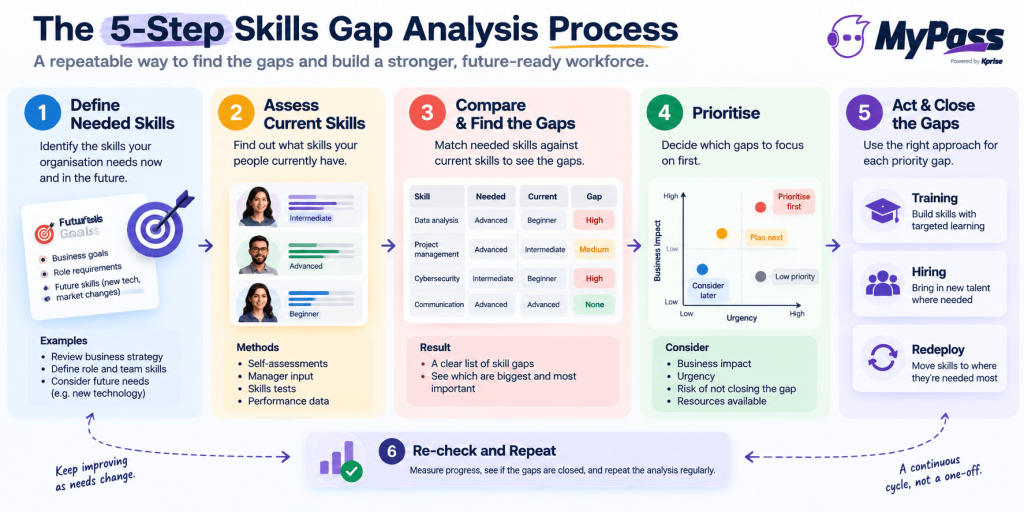
- Define the skills you need: what the organization, team or role requires now and soon, tied to your goals.
- Assess the skills you have: find your people's current levels, by self-assessment, manager input, testing or performance data.
- Compare: line up needed against current to see exactly where the gaps are.
- Prioritise: decide which gaps matter most and are most urgent, you can't close them all at once.
- Act: close the priority gaps with targeted training, hiring or redeployment, then re-check over time.
Defining Needed Skills Is Where to Be Careful
The whole analysis rests on getting the first step right: a clear, honest definition of the skills you actually need. This is harder than it looks and easy to rush. Vague skill definitions ('good communication,' 'tech-savvy') give you a vague, useless analysis. The more specific and observable you make the needed skills, the more precise and actionable your gaps will be.
It's also where you have to think forward, not just backward. Defining the skills you need today is necessary but not enough, the point of a gap analysis is partly to get ahead of future needs. If you're adopting new technology, shifting strategy, or expecting roles to change, those future skill needs belong in your definition. This is what turns a skills gap analysis from a snapshot of current shortfalls into a planning tool that prepares your workforce for where the business is going, not just where it's been.
What to Do With the Results
A skills gap analysis is only worth doing if you act on it, and the results point to three broad responses, usually in combination. The most common is training: upskilling your existing people to close the gaps, which is often the cheapest and most retention-friendly option. The second is hiring: bringing in skills that are faster to buy than to build, or that you need at a level you can't develop in time. The third is redeployment: moving people whose skills fit a need elsewhere, or reshaping roles around the skills you have.
For most gaps, training is the first thing to reach for, because developing your existing people is usually more cost-effective than hiring and better for morale and retention. The analysis tells you precisely who needs to develop what, so training is targeted rather than scattered. And because needs keep shifting, a skills gap analysis isn't a one-off, you re-run it periodically to track whether gaps are closing and to catch new ones emerging. It's a cycle, not a single event.
| A skills gap analysis you don't act on is just an interesting document. The payoff is in the response, usually targeted training first, then hiring or redeployment for what you can't build in time. |
How MyPass LMS Helps You Close the Gaps
A skills gap analysis tells you what to fix; MyPass LMS helps you fix it and prove it's working. Once you know who needs which skills, you build targeted development as structured learning paths aimed precisely at the gaps, assign it to the right people by role, and deliver it in a way they'll actually use, self-paced and mobile, rather than scattering generic training.
Crucially, reporting then lets you track whether the gaps are actually closing, who's progressing, who's stuck, so your analysis becomes a live cycle rather than a one-off document. That closes the loop: find the gap, target the training, measure the result, re-check. An AI course builder also lets you create skill-specific content quickly when the gap is in something you don't already have a course for. And with flat pricing and unlimited registered users, running this across your whole workforce doesn't add per-seat cost.
| Start with one critical role or team rather than the whole company. A focused skills gap analysis you act on beats an organization-wide one that overwhelms you, and it teaches you the process before you scale it up. |
The bottom line
A skills gap analysis compares the skills you need against the skills you have, turning workforce planning from guesswork into evidence. Conduct one by defining needed skills (specifically, and with an eye on the future), assessing current skills, comparing to find gaps, prioritising what matters most, and acting, usually with targeted training first, then hiring or redeployment. Then re-run it, because it's a cycle, not a one-off.
The value is entirely in acting on what you find. See how learning paths and progress tracking help you close the gaps you identify in MyPass LMS features, read about building a skills taxonomy, or start a free trial.
Frequently asked questions
What is a skills gap analysis?
A skills gap analysis is a comparison between the skills your organization needs and the skills it currently has, revealing exactly where the shortfalls, or 'gaps', are. It's done for the whole company, a team or a single role. The point is to replace guesswork with evidence: instead of training people in whatever seems reasonable or discovering skill shortages only when they cause problems, you get a clear picture of where your workforce falls short of what the business needs, so training, hiring and development decisions all target real gaps.
How do you conduct a skills gap analysis?
Follow five steps. Define the skills you need (specifically, tied to your goals, and including near-future needs). Assess the skills you currently have, through self-assessment, manager input, testing or performance data. Compare the two to find exactly where the gaps are. Prioritise, since you can't close every gap at once, focus on the most important and urgent. Then act, closing priority gaps with targeted training, hiring or redeployment, and re-check over time. The analysis is only worth doing if you act on the results.
What is a skills gap analysis template?
A skills gap analysis template is usually a grid or matrix: the skills you need listed across one axis, your people or roles down the other, and a rating in each cell showing the current level versus the required level, so the gaps stand out. It gives you a structured, visual way to capture needed skills, assess current skills, and see the shortfalls at a glance. The template is just the tool, the value comes from defining the right skills, assessing honestly, and acting on the gaps it reveals.
What do you do after a skills gap analysis?
Act on the results, in one of three ways, usually combined. Training: upskill your existing people to close the gaps, often the cheapest and most retention-friendly option, and the first to reach for. Hiring: bring in skills that are faster to buy than build, or needed at a level you can't develop in time. Redeployment: move people whose skills fit a need elsewhere, or reshape roles around the skills you have. Then re-run the analysis periodically, since needs shift, so it becomes a cycle that keeps your workforce aligned with the business.