
| A competency framework is a structured set of the skills, knowledge and behaviours people need to perform well in their roles, usually with defined proficiency levels. Organisations use it as a shared yardstick for hiring, developing, assessing and promoting people. Built well it brings consistency; built badly it becomes a document nobody uses, so practicality is everything. |
What a Competency Framework Is
A competency framework sounds like corporate jargon, and in the wrong hands it becomes exactly that, a dense document nobody reads. But the idea behind it is genuinely useful. A competency framework is a structured map of the competencies, the skills, knowledge and behaviours, that people need to succeed in your organisation, usually broken down by role and with levels showing what 'good' looks like at each stage.
Think of it as a shared yardstick. Instead of every manager having their own private idea of what makes a great salesperson or a good manager, a competency framework writes it down clearly so everyone's working from the same definition. That shared clarity is what makes it powerful: it brings consistency to how you hire, develop, assess and promote people, instead of leaving those decisions to gut feel and whoever's loudest. The catch, as we'll get to, is that it only works if it's practical enough to actually use.
| A competency framework is just a shared, written definition of what good looks like, in skills and behaviours, across roles. Its power is consistency: everyone works from the same yardstick instead of their own private idea of 'great'. |
What Organisations Use It For
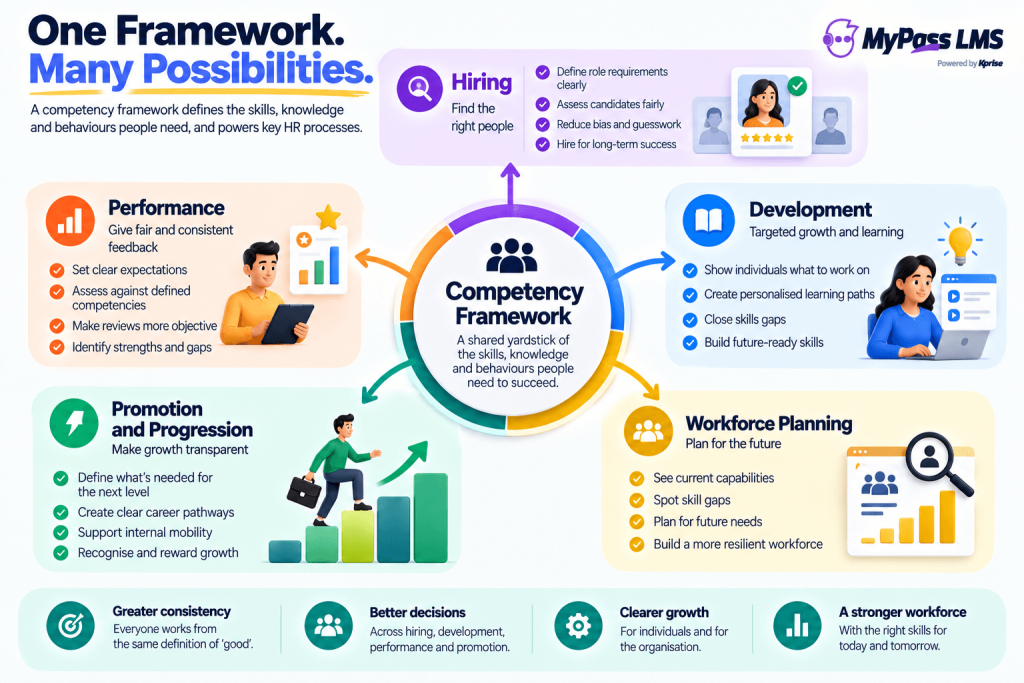
A good competency framework isn't a box-ticking exercise, it's a tool that quietly improves several HR processes at once, because they all rely on knowing what 'good' means.
- Hiring: assess candidates against the competencies a role actually needs, not vague impressions.
- Development: show people exactly what to work on to grow, and target training at real gaps.
- Performance: give reviews a fair, consistent basis instead of personal opinion.
- Promotion and progression: make clear what someone needs to reach the next level.
- Workforce planning: see where the organisation has capability and where it doesn't.
How to Build One (Without Over-Engineering It)
Building a competency framework is straightforward in principle, and the main risk is making it too complicated to use. Start by deciding what it's for, hiring, development, performance, because that shapes everything. Then identify the competencies that genuinely matter: a mix of core competencies everyone needs (like communication or teamwork) and role-specific ones. Define each in specific, observable terms, 'can resolve a customer complaint unaided' beats 'good at customer service', because vague competencies can't be assessed. Add proficiency levels so you can tell a beginner from an expert. Then roll it out across hiring, development and reviews, and keep it current as roles change.
The single biggest mistake is over-engineering it. Frameworks with hundreds of micro-competencies and elaborate scoring look impressive and get abandoned within months, because they're too heavy to use. A smaller, clearer framework that people actually apply beats a sophisticated one that lives in a shared drive. Once you have it, it connects directly to a skills gap analysis and to how you upskill people, because the framework defines what you're measuring against.
| The number-one way competency frameworks fail is over-engineering, hundreds of micro-competencies and elaborate scoring that nobody can actually use. A simpler framework people apply beats a sophisticated one they ignore. |
How MyPass LMS Helps You Act on It
A competency framework tells you what good looks like; the next step is developing people toward it, and that's where an LMS comes in. Once your framework defines the competencies and levels, MyPass LMS lets you build targeted training against them as learning paths, assign it to the right people, and track who's progressing toward each competency.
Assessments let you check whether people have genuinely reached a level rather than just attended a course, and reporting shows capability across the organisation, turning the framework from a static document into something live. The framework stays the human-defined yardstick; the platform handles the delivery, assessment and tracking that make it actionable. If you want to see how that works end to end, you can try it free.
| A framework is only as good as what you do with it. Start smaller than feels impressive, get it used in real hiring and development decisions, then let an LMS handle the training and tracking against it. |
The bottom line
A competency framework is a structured, shared definition of the skills and behaviours people need to succeed, usually with proficiency levels, used to bring consistency to hiring, development, performance and promotion. Build one by deciding its purpose, identifying the competencies that matter, defining them in observable terms, adding levels, and keeping it practical. The biggest risk is over-engineering it into something nobody uses.
Once it's built, the value is in acting on it. See how MyPass LMS turns a framework into targeted training and tracking, explore it free, or read about building a skills taxonomy, a close cousin of the competency framework.
Frequently asked questions
What is a competency framework?
A competency framework is a structured set of the competencies, the skills, knowledge and behaviours, that people need to perform well in their roles, usually broken down by role and with proficiency levels showing what 'good' looks like at each stage. It acts as a shared yardstick so everyone in an organisation works from the same definition of success, rather than relying on individual opinion. Organisations use it to bring consistency and clarity to hiring, development, performance reviews, promotion and workforce planning.
What is a competency framework used for?
It's used wherever an organisation needs a clear, shared definition of what 'good' looks like. That includes hiring (assessing candidates against the competencies a role needs), development (showing people what to work on and targeting training at real gaps), performance reviews (a fair, consistent basis instead of personal opinion), promotion (making clear what's needed to reach the next level), and workforce planning (seeing where capability exists and where it's missing). One framework quietly improves all of these because they all depend on knowing what good means.
How do you build a competency framework?
Start by deciding what it's for (hiring, development, performance), since that shapes everything. Identify the competencies that genuinely matter, a mix of core ones everyone needs and role-specific ones. Define each in specific, observable terms so it can actually be assessed ('can resolve a complaint unaided' rather than 'good at service'). Add proficiency levels so you can tell a beginner from an expert. Then roll it out across hiring, development and reviews, and keep it current. Crucially, keep it simple, over-engineered frameworks get abandoned.
What is the difference between a competency framework and a skills matrix?
A competency framework defines what good looks like, the competencies and proficiency levels people need, as a shared standard across roles. A skills matrix maps who currently has which skills (or competencies) and at what level, usually as a grid of people against capabilities. So the framework sets the yardstick, and the matrix measures people against it. They work together: you define competencies in a framework, then use a skills matrix or gap analysis to see where your people stand and what to develop.