| To upskill employees, first identify the skills your business needs now and soon, then assess where the gaps are against the skills you have, build targeted development for those gaps, deliver it in a flexible, accessible way people will actually use, and track skill growth so you can adjust. Upskilling works best when it's targeted, not blanket training. |
Why Upskilling Moved Up the Priority List
Upskilling, helping your existing employees build new skills, used to be a nice-to-have. It isn't anymore. The skills businesses need are changing faster than ever, driven by technology and AI, and the gap between the skills companies have and the skills they need keeps widening. You can try to hire your way out of that gap, but good people are expensive and scarce, and hiring doesn't help the people you already have keep up.
So upskilling your current workforce has become one of the most practical answers to a real problem. It's usually cheaper than hiring, it keeps your people current instead of letting them fall behind, and, as a bonus, it's one of the strongest drivers of retention, people stay where they're growing. The question for most leaders isn't whether to upskill, but how to do it well rather than scattering training and hoping. That's what this guide covers.
| You can't hire your way out of a skills gap, good people are scarce and expensive, and hiring does nothing for the team you already have. Upskilling your existing workforce is usually the more practical, and more loyal-making, answer. |
Start With the Skills You Actually Need
The most common upskilling mistake is starting with training instead of with skills. Teams launch courses, buy a content library, run workshops, without first being clear about which skills the business actually needs. The result is activity without direction: lots of training, little of it aimed at what matters. Effective upskilling runs the other way around.
Begin by identifying the skills your organization needs, now and in the near future, tied to where the business is heading. If you're adopting new technology, what skills does that require? If your strategy is shifting, what capabilities will it demand? This gives you a target. Without it, you're upskilling people in whatever happens to be on offer rather than what will actually move the business forward. Get this step right and everything downstream, what to assess, what to deliver, becomes clear.
Find the Gaps, Then Target Them
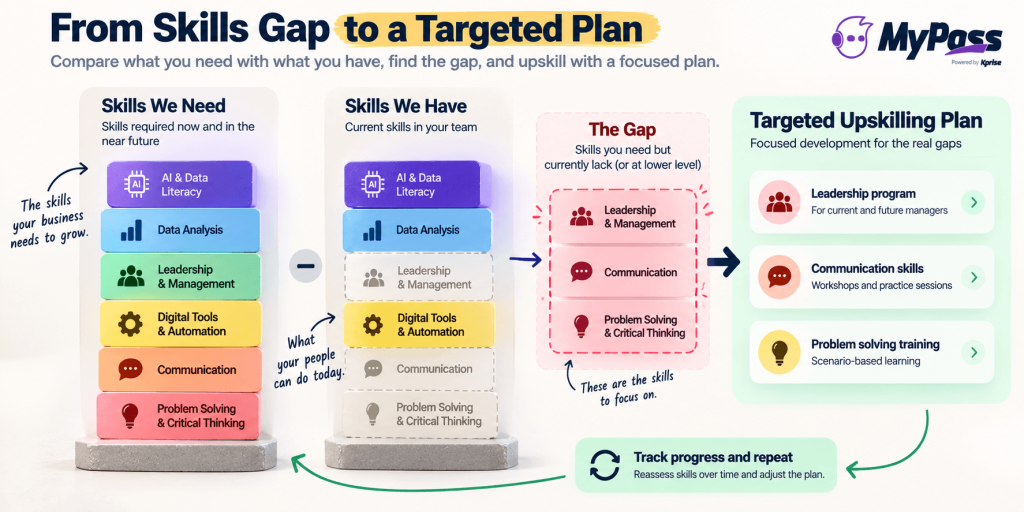
Once you know the skills you need, the next step is to see where you actually stand, which skills you already have and where the gaps are. This is a skills gap analysis, and it turns upskilling from guesswork into something precise. You're comparing 'skills we need' against 'skills we have' to find exactly who needs to develop what.
- Map needed skills against current skills, by role, team or individual.
- Spot the gaps: where needed skills aren't yet present.
- Prioritise: which gaps matter most to the business, and which are most urgent.
- Target development at the real gaps, rather than training everyone in everything.
Deliver Training People Will Actually Use
A perfect upskilling plan fails if the training doesn't fit into people's real lives. Employees are busy doing their jobs; upskilling has to work around that, not compete with it. This is where a lot of well-intentioned programs stall, they design great content and then deliver it in a way that's too rigid, too time-consuming, or too hard to access, and participation quietly dies.
The fix is flexible, accessible delivery. Self-paced training lets people learn when they can fit it in. Mobile access reaches people who aren't at a desk. Bite-sized modules fit into gaps rather than demanding a cleared afternoon. Clear learning paths show people the route from where they are to where they're going, which keeps them motivated. The content matters, but how you deliver it often decides whether upskilling actually happens or just exists on paper. Make it easy to do, and people do it.
| The best upskilling plan dies if the training is hard to fit into a working day. Flexible, self-paced, mobile delivery isn't a luxury, it's what decides whether people actually upskill or just intend to. |
How MyPass LMS Helps You Upskill at Scale
MyPass LMS supports the delivery and tracking that turn an upskilling plan into real skill growth. You build targeted development as structured learning paths, so people have a clear route from their current skills to the ones they need, and deliver it self-paced and mobile so training fits around real work rather than competing with it.
Role-based assignment aims training at the right people, an AI course builder lets you create the skill-specific content you need quickly, and reporting shows who's progressing and where gaps remain, so you can see whether upskilling is actually working and adjust. That turns upskilling from a hopeful initiative into a tracked, improving program. And with flat pricing and unlimited registered users, upskilling your entire workforce, not just a chosen few, doesn't add per-seat cost, which matters because the people most in need of new skills are often the ones development usually skips.
| Start narrow: pick the one or two skills your business most needs, find who has the gap, and build a focused path for them. A targeted win beats a broad program that trains everyone in everything and moves nothing. |
The bottom line
Upskilling your existing employees is now one of the most practical ways to close a widening skills gap, cheaper than hiring, better for retention, and the way to keep your people current. Do it well by starting with the skills the business actually needs, finding the real gaps, targeting development at them, delivering training people will genuinely use, and tracking progress so you can adjust.
Targeted beats blanket every time. See how learning paths, role-based assignment and progress tracking support upskilling in MyPass LMS features, read about reskilling vs upskilling, or start a free trial.
Frequently asked questions
How do you upskill employees?
Start by identifying the skills your business actually needs now and soon, tied to where it's heading. Then assess where the gaps are by comparing needed skills against the skills you have, to find who needs what. Build targeted development for those gaps rather than blanket training, deliver it in a flexible, accessible way people will actually use (often self-paced and mobile), and track skill growth so you can adjust. The key is being targeted, aiming training at real gaps, not training everyone in everything.
What is the difference between upskilling and reskilling?
Upskilling means helping employees build new skills to do their current role better or handle its evolving demands, deepening and extending what they do. Reskilling means training employees in substantially new skills to move into a different role, often because their old role is changing or disappearing. Both matter as the skills businesses need shift, but the goal differs: upskilling advances people within their path, while reskilling redirects them to a new one. Many organizations do both as part of workforce planning.
Why is upskilling important?
Because the skills businesses need are changing faster than ever, and the gap between skills companies have and skills they need keeps widening. Upskilling your existing workforce is usually cheaper than hiring scarce, expensive talent, keeps your people current instead of falling behind, and is one of the strongest drivers of retention, people stay where they're growing. It also makes an organization more adaptable. For most companies, upskilling has shifted from a nice-to-have to a practical necessity for staying competitive.
How do you identify which skills to upskill?
Don't start with training, start with the skills the business actually needs, tied to where it's heading (new technology, a strategy shift, changing roles). Then run a skills gap analysis: compare the skills you need against the skills you currently have, by role, team or individual, to find exactly where the gaps are. Prioritise the gaps that matter most and are most urgent. This turns upskilling from training people in whatever's on offer into targeting development at what will genuinely move the business forward.