
| A learning culture is an environment where growing, sharing knowledge and improving is part of how work happens, not an occasional event. You build it by making learning visible from leadership down, giving people time and permission to learn, connecting it to careers, and recognising it, not just by buying more courses. |
What a Learning Culture Actually Is
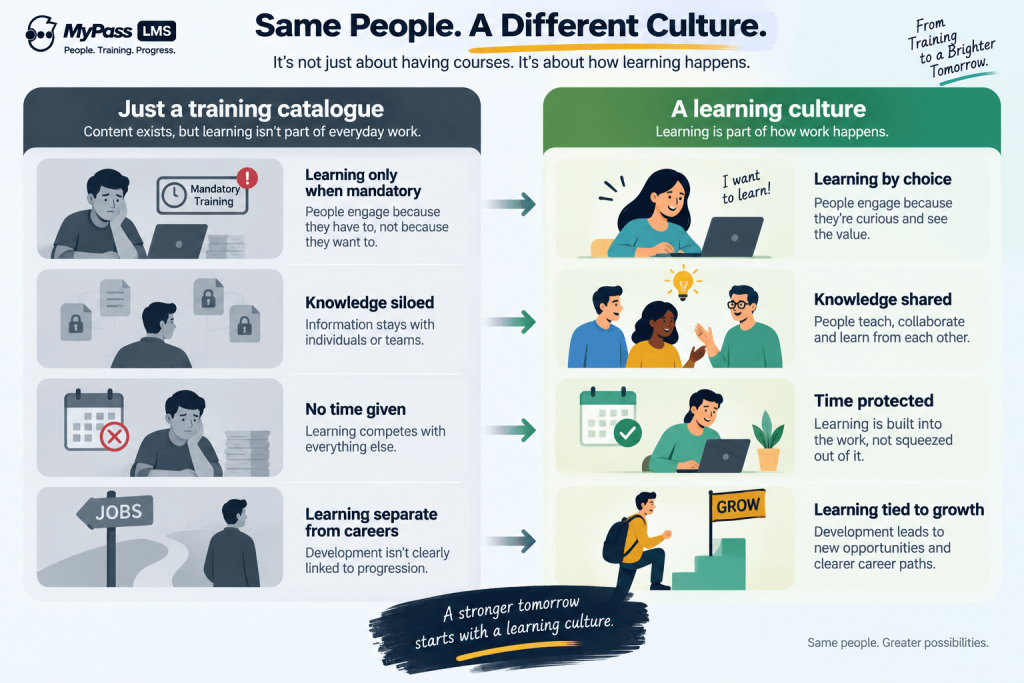
A learning culture is an organization where continuous learning, sharing knowledge, and improving are woven into daily work, not bolted on as occasional training. It is the difference between a company that has courses and a company where learning is simply how people operate. Buying an LMS and filling it with content does not create a learning culture; how people behave around learning does.
The distinction matters because culture, not catalogue, is what produces results. Organizations with strong learning cultures adapt faster, retain people better, and innovate more, because their people keep growing. But culture is harder to build than a course library, which is why so many organizations have the second and not the first.
| The test of a learning culture: does learning happen when nobody is required to do it? A full course catalogue that only gets used when training is mandatory is a training program, not a learning culture. |
The Signals of a Real Learning Culture
You can recognise a genuine learning culture by how people behave, not by how much content exists. These signals separate real culture from a well-stocked catalogue.
- Leaders learn visibly: senior people openly develop, share what they are learning, and talk about it.
- Time is protected: people are given real time and permission to learn, not told to fit it around everything else.
- Knowledge is shared: people teach each other; expertise flows rather than staying siloed.
- Curiosity is safe: asking questions and admitting gaps is encouraged, not penalised.
- Learning connects to growth: development visibly links to advancement and new opportunities.
- Improvement is normal: mistakes become lessons rather than blame.
Why Most Attempts Fail
Most learning-culture initiatives stall for predictable reasons, and knowing them helps you avoid the traps.
- Tools without behaviour: buying an LMS and assuming culture follows. It does not.
- No time given: telling people to learn while leaving them no room to do it signals that it is not really valued.
- Leaders exempt: if leadership does not visibly learn, nobody believes it matters.
- No connection to careers: learning that leads nowhere is quickly deprioritised.
- Learning that interrupts work: if development always means stepping away from the job, it competes with work and loses.
| The most common failure is buying the platform and stopping there. Technology enables a learning culture but never creates one. The behaviours, especially leaders modelling learning and time being protected, are what make it real. |
How to Build One, Step by Step
Building a learning culture is a change effort, not a purchase. It works best as deliberate, reinforcing moves rather than a single announcement.
- Start at the top: get leaders visibly learning and talking about it, because culture follows what leaders do.
- Give time and permission: protect real time for learning so it is not squeezed out by work.
- Connect learning to careers: make development map to advancement, so growing here is worthwhile.
- Enable knowledge sharing: create ways for people to teach each other and surface expertise.
- Bring learning into the work: use microlearning and learning in the flow of work so growth does not always mean stepping away.
- Recognise and reward it: celebrate learning and applying new skills, so the behaviour is reinforced.
None of these is about buying more content. They are about signals, time, connection and recognition, the things that tell people learning genuinely matters here.
Where the Platform Fits
Technology does not create a learning culture, but the right platform removes friction and makes the behaviours easier to sustain. If learning is hard to access or disconnected from work and careers, culture stalls no matter how good the intentions.
MyPass LMS supports the practical side: learning paths that connect development to roles and advancement, microlearning and mobile access that bring learning into the flow of work, and analytics that show whether people are actually engaging, not just enrolled. Flat pricing with unlimited registered users matters here too, because a learning culture is organization-wide by definition, and a per-seat model quietly discourages opening learning to everyone.
| Use the platform to reduce friction, not to declare victory. The LMS should make learning easy to reach and clearly tied to growth. The culture comes from how leaders behave and how time is treated around it. |
The bottom line
A learning culture is not a course catalogue; it is an environment where growing and sharing knowledge is simply how work happens. It is built through behaviour, not purchase: leaders learning visibly, time and permission to learn, a clear link between learning and careers, knowledge sharing, and recognition. Technology helps by removing friction, but never substitutes for the culture itself.
Start with leadership and protected time, then use the platform to make learning easy and connected. See how learning paths, microlearning and analytics support a learning culture in MyPass LMS features, or start a free trial.
Frequently asked questions
What is a learning culture?
A learning culture is an organization where continuous learning, knowledge sharing and improvement are part of daily work rather than occasional events. It is the difference between a company that has courses and one where learning is simply how people operate. It shows up in behaviour, leaders learning openly, time protected for it, knowledge shared, not in the size of a content library.
How do you build a learning culture at work?
Build it through behaviour, not purchases. Start with leaders learning visibly, give people real time and permission to learn, connect learning to career advancement, enable knowledge sharing, bring learning into the flow of work so it does not always mean stepping away, and recognise and reward learning. Buying an LMS helps remove friction but does not by itself create the culture.
Why do learning culture initiatives fail?
They usually fail because organizations buy a platform and assume culture follows, give people no real time to learn, exempt leaders from modelling it, or fail to connect learning to careers so it gets deprioritised. Learning that always interrupts work also loses to work. Culture comes from signals, time and leadership behaviour, not from technology alone.
What is the difference between a learning culture and training?
Training is specific, often mandatory activity: courses assigned and completed. A learning culture is the broader environment in which people choose to keep growing and sharing knowledge as a normal part of work. You can have plenty of training and no learning culture. A real learning culture shows up when learning happens even when nobody is required to do it.