| AI agents (agentic AI) are AI that can take actions to complete tasks, not just answer questions like a chatbot. In HR and L&D, they're starting to handle onboarding steps, answer employee queries, and assign and track training. The key difference from older AI is that agents do things on your behalf, within limits you set, rather than just responding. |
Chatbots Answer; Agents Act
'AI agents' and 'agentic AI' are suddenly everywhere, and like a lot of AI language, the terms are thrown around faster than they're explained. So here's the plain version. You already know AI chatbots: you ask a question, they answer. An AI agent goes a step further, it can actually take actions to get something done, not just talk about it. The difference between answering and doing is the whole point.
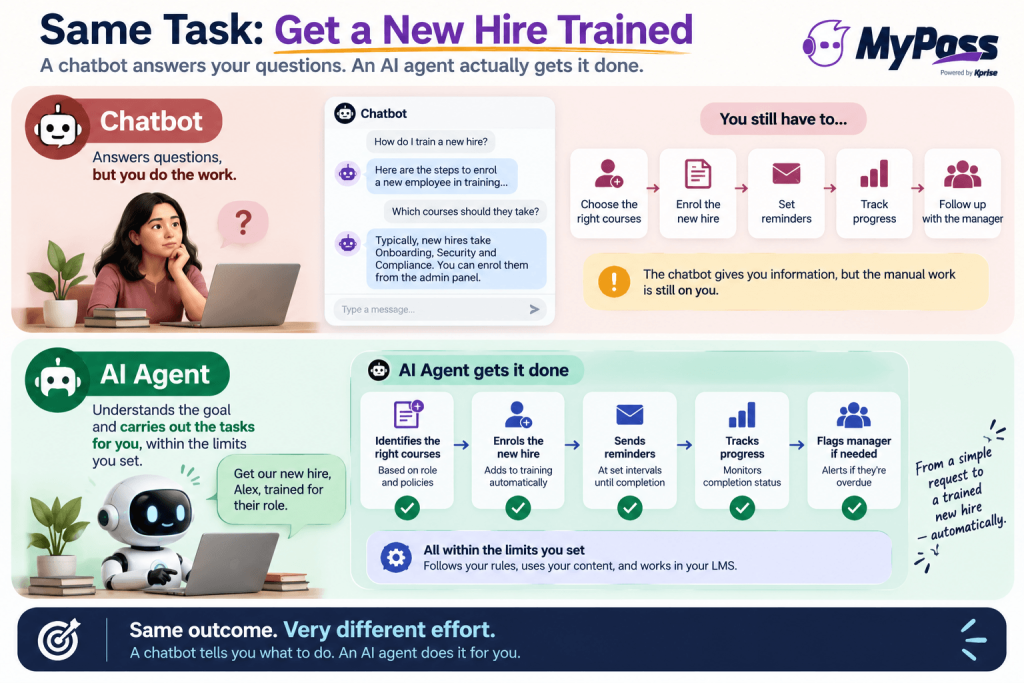
A chatbot might tell an employee how to enrol in a training course. An agent could actually enrol them, assign the right modules for their role, send the reminders, and flag their manager if they fall behind, carrying out the task rather than just describing it. That shift, from AI that responds to AI that acts on your behalf within limits you set, is what makes agents a genuinely new capability, and why HR and L&D are paying attention.
| The one-line difference: a chatbot answers your question, an agent does the task. Older AI tells you how to enrol someone in training; an AI agent actually enrols them, assigns the modules and chases completion. |
What AI Agents Are Starting to Do in HR and L&D
This is an emerging area, so it's worth being honest: much of it is early, and the hype runs ahead of reality. But real, practical use cases are taking shape, especially for the repetitive, rules-based work that eats HR and L&D time.
- Onboarding: walking a new hire through steps, assigning their training, and nudging them along.
- Answering employee questions: handling the routine 'how do I...' queries that flood HR.
- Assigning and tracking training: giving the right people the right courses and chasing completions.
- Surfacing issues: flagging who's overdue, where completion is lagging, or who needs support.
- Routine admin: the enrolments, reminders and updates that are rules-based and repetitive.
Why This Matters for Training Specifically
For L&D, the appeal of AI agents is straightforward: a huge amount of training administration is exactly the kind of repetitive, rules-based work agents are suited to. Assigning the right courses to the right people, sending reminders, chasing non-completers, keeping records up to date, these are necessary but low-value tasks that currently eat L&D time or get done inconsistently by overstretched managers. An agent that reliably handles them frees people for the work only humans can do: designing good training, coaching, and judging whether it's working.
It's worth being measured, though. The genuinely useful near-term agent use cases in L&D are about automating the admin and logistics around training, not replacing the teaching or the human judgment at its heart. An agent can make sure the right person is assigned the right course and actually completes it; it can't decide what that person most needs to learn or mentor them through a tough skill. The value is real, but it's in the plumbing, not the teaching.
The Honest Take: Promising, Still Early
It would be easy to either dismiss AI agents as hype or oversell them as revolutionary, and neither is accurate. The honest position is that agentic AI is promising and genuinely new, but still early, especially in HR and L&D specifically. A lot of what's marketed as 'AI agents' today is closer to advanced automation, and the fully autonomous versions come with real questions about oversight, accuracy and trust, you want to know exactly what an agent is empowered to do, and keep a human accountable for it.
So the sensible stance for an L&D leader is interested but grounded: understand what agents are (AI that acts, not just answers), watch the practical use cases mature, and adopt them where they reliably save time on real administrative work, while keeping humans in charge of the decisions that matter. The teams that benefit will be the ones who use agents to remove drudgery, not the ones who hand over judgment to software that isn't ready for it.
| Be interested but grounded. AI agents are genuinely new and will help with training admin, but much marketed as 'agents' is really advanced automation. Adopt them for drudgery, keep humans accountable for decisions. |
Where MyPass LMS Fits
Whatever the pace of the agent hype, the foundation that makes this kind of automation useful is already practical today, and it's what MyPass LMS provides. The platform automates the rules-based training work that agents are meant to take over: assigning the right training by role, sending reminders, reassigning recurring courses on schedule, and tracking completion, so the repetitive logistics are handled without manual effort or a leap of faith into unproven autonomy.
It also brings AI where it's genuinely proven, generating courses quickly, translating content, surfacing insights from training data, rather than as a speculative agent layer. As agentic capabilities mature across the industry, having your training already structured, assigned and tracked in one automated system is exactly the foundation that lets you adopt them sensibly. And with flat pricing and unlimited registered users, automating training across everyone doesn't add per-seat cost.
| You don't have to wait for AI agents to get the core benefit. Automating training assignment, reminders and tracking today captures most of the practical value people hope agents will deliver, reliably and now. |
The bottom line
AI agents (agentic AI) are AI that takes actions to complete tasks, not just chatbots that answer questions. In HR and L&D they're starting to handle onboarding steps, routine queries, and assigning and tracking training, the repetitive, rules-based work that eats time. The value is real but currently in the admin and logistics around training, not in replacing teaching or human judgment, and much of it is still early.
Be interested but grounded: adopt agents for drudgery, keep humans accountable for decisions. Meanwhile, the automation foundation is practical today, see how assignment, reminders and tracking work in MyPass LMS features, or read about what an agentic AI LMS is. Want to try it? Start a free trial.
Frequently asked questions
What are AI agents in HR?
AI agents (agentic AI) are AI that can take actions to complete tasks, rather than just answering questions like a chatbot. In HR, that means handling things like walking a new hire through onboarding steps, answering routine employee queries, assigning and tracking training, and flagging issues such as overdue completions, carrying out the work within limits you set, not just describing it. The key shift from older AI is from responding to acting on your behalf. It's an emerging area, with real use cases still taking shape.
What is the difference between an AI agent and a chatbot?
A chatbot answers questions, an AI agent does tasks. A chatbot might tell an employee how to enrol in a course; an agent could actually enrol them, assign the right modules, send reminders, and flag their manager if they fall behind. The difference is between responding and acting: chatbots provide information, while agents carry out multi-step actions on your behalf within set limits. That ability to actually do things, not just talk about them, is what makes agents a genuinely new capability.
How are AI agents used in L&D?
The practical near-term uses are about automating training administration: assigning the right courses to the right people, sending reminders, chasing non-completers, keeping records current, and surfacing who's overdue or struggling. These are the repetitive, rules-based tasks agents suit. Importantly, the value is in the logistics around training, not in replacing the teaching or human judgment at its core, an agent can ensure someone is assigned and completes the right course, but it can't decide what they most need to learn or coach them through it.
Are AI agents in HR ready to use?
They're promising but still early, especially in HR and L&D. Much of what's marketed as 'AI agents' today is closer to advanced automation, and fully autonomous versions raise real questions about oversight, accuracy and trust. The sensible stance is interested but grounded: understand what agents are, adopt them where they reliably save time on genuine administrative work, and keep a human accountable for decisions that matter. Notably, the automation foundation, assigning, reminding and tracking training, is practical and valuable today, without waiting for agents to mature.