MyPass LMS includes AI translation that turns a single course into versions across more than 120 languages, removing the traditional cost and delay of localising training. It works best when a fluent reviewer checks the output before release, particularly for compliance, safety or legal content where a mistranslation carries real consequences.
The reason most training is only in one language
Ask why a multinational organization trains its whole workforce in English, and the honest answer is almost never that it is the right thing to do. It is that translation has traditionally been expensive and slow. Each additional language meant a vendor, a quote, a turnaround time, and a fresh round of the same work every time the source course changed.
The result is predictable. Frontline staff who are not fluent receive safety and compliance training in a second or third language, complete it, and understand less of it than the completion record suggests. The record says trained. The reality is patchier.
How AI translation changes the arithmetic
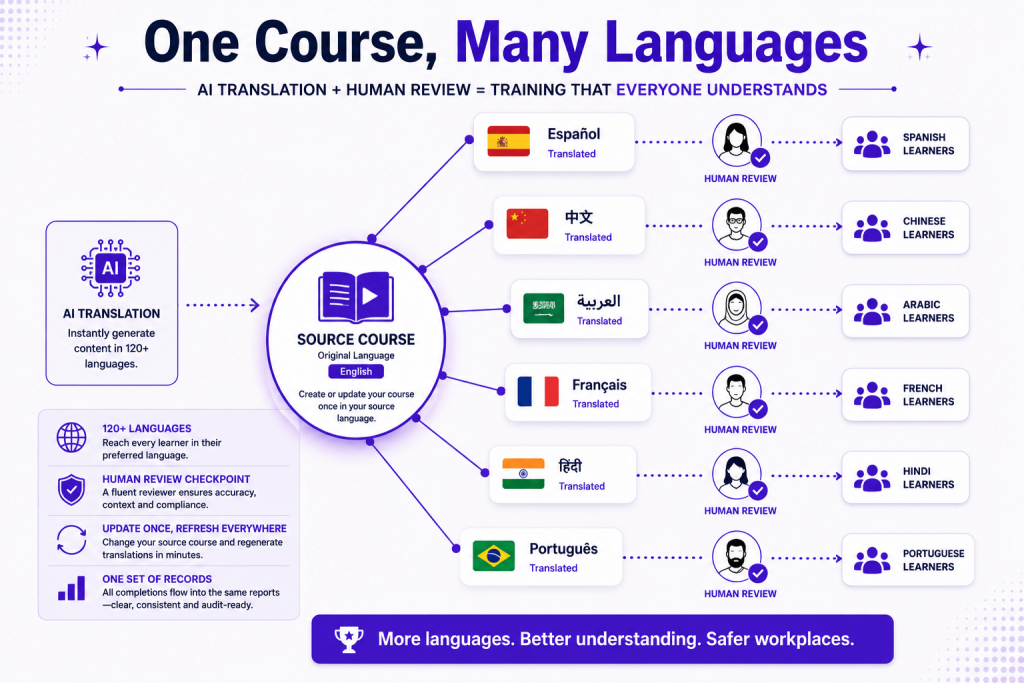
- Build the course once in your source language.
- Generate translated versions across more than 120 languages inside the platform, without exporting to a translation vendor.
- Have a fluent reviewer check the output, particularly terminology specific to your industry or organization.
- Publish, with each learner seeing the version appropriate to them, and all completions flowing into the same records.
The change is not simply cost. It is that updating the source course no longer triggers a translation project. When a policy changes, you regenerate rather than re-commission.
Where AI translation is strong, and where it is not
Being straight about this matters, because the failure mode is quiet. A poor translation does not throw an error; it just teaches the wrong thing.
Strong for: general workplace training, process and product instruction, onboarding material, and content where meaning is carried by plain description rather than nuance. Also strong for reaching people you were previously not reaching at all, which is usually a large improvement on the status quo.
Needs a human reviewer for:
- Compliance, safety and legal content, where a mistranslated instruction has consequences beyond comprehension.
- Industry-specific terminology, where a technically correct general translation may not match the term practitioners actually use.
- Regulatory content that must reflect a specific jurisdiction's wording rather than a generic rendering.
- Idiom, humour and culturally specific examples, which often need adapting rather than translating.
| The workable rule: AI translation should remove the cost of producing a first version in every language, not remove the person who checks it. Reviewing a generated translation takes a fraction of the time of commissioning one from scratch, which is where the real saving sits. |
Why doing this inside the LMS matters
Translating course content outside your platform leaves you managing a set of parallel files, each version drifting from the others as updates land. In practice organizations end up with a current English course and several increasingly outdated translations, which is arguably worse than not translating at all, because the records still say everyone was trained.
Because translation happens inside MyPass LMS, the language versions stay tied to the source course, and completions in any language feed the same compliance tracking and reporting as everything else. One report covers your whole workforce rather than the English-speaking part of it.
This matters most for organizations with distributed frontline populations: manufacturing sites, healthcare systems, retail networks and associations with international membership, where the people most exposed to safety and compliance risk are often the least likely to be fluent in the head office language.
The bottom line
AI translation removes the cost and delay that kept most training monolingual, letting one source course reach a workforce across more than 120 languages. Treat it as a way to produce a strong first version in every language rather than a way to eliminate review, keep a fluent checker on anything compliance, safety or legally significant, and keep the versions inside the platform so they cannot drift apart from the source. Done that way, it turns training everyone properly from a budget question into an operational one.
See AI capabilities in MyPass LMS, explore the platform features, or start a free trial.
Frequently asked questions
How many languages does MyPass LMS support for AI translation?
More than 120. A course built once in a source language can be generated into versions across those languages inside the platform, without exporting content to an external translation vendor.
Is AI translation accurate enough for compliance training?
It produces a strong first version, but compliance, safety and legal content should always be checked by a fluent reviewer before release. A mistranslated instruction in that context carries consequences beyond simple comprehension.
Do I need to retranslate when I update a course?
No. Because translation happens inside the platform and language versions stay tied to the source course, updating the source lets you regenerate translations rather than commissioning a fresh translation project each time.
What content types need the most human review after AI translation?
Compliance, safety and legal content; industry-specific terminology where practitioners use particular terms; jurisdiction-specific regulatory wording; and idiom, humour or culturally specific examples, which usually need adapting rather than translating.
Do completions in different languages show in one report?
Yes. Because the language versions live inside MyPass LMS and stay linked to the source course, completions in any language feed the same tracking and reporting, so one report covers the entire workforce.