
AI Coaching for Managers in 2027: What Works, What Backfires and How to Pilot It
On this page 13 sections
- What Is AI Coaching?
- Why Is AI Coaching for Managers Trending in 2027?
- Does AI Coaching Actually Work?
- AI Coach vs Human Coach: Which Should Your Managers Use?
- What Are the Risks of AI Coaching?
- How Do You Choose an AI Coaching Tool?
- How Do You Run a 90-Day AI Coaching Pilot?
- How Do You Measure AI Coaching?
- Where Does an LMS Fit With AI Coaching?
- Where This Comes From
- The bottom line
- Frequently asked questions
- Sources
AI coaching uses a conversational AI tool to help people set goals, practice hard conversations and reflect between sessions. For managers, it works best for frequent, low-stakes practice and follow-through. It works poorly for sensitive people issues, which still need a human coach. Most organizations get the best results by blending the two.
What Is AI Coaching?
AI coaching is coaching delivered by an AI tool instead of, or alongside, a human coach. The manager types or talks to it, and it asks questions, offers frameworks, plays out practice scenarios and checks in on goals. It's available any time, is usually cheaper to scale than human coaching, and can reach every manager rather than only senior leaders.
Most AI coaching tools do some mix of four things.
| Type | What it does | Example use for a manager |
| Reflective coach | Asks coaching-style questions to help someone think a problem through | Working out why a team keeps missing deadlines |
| Roleplay simulator | Plays the other person in a practice conversation, then gives feedback | Rehearsing a difficult performance conversation before having it |
| Goal and habit nudges | Sets goals with the user and checks in on progress | Following through on a commitment to hold weekly one-to-ones |
| Feedback on real work | Reviews something the manager wrote or said and suggests improvements | Tightening the wording of a written review before it's sent |
These are different from AI tutors that teach course content. A coach helps someone apply what they already know to their own situation. We cover the wider difference in training vs coaching vs mentoring.
Why Is AI Coaching for Managers Trending in 2027?
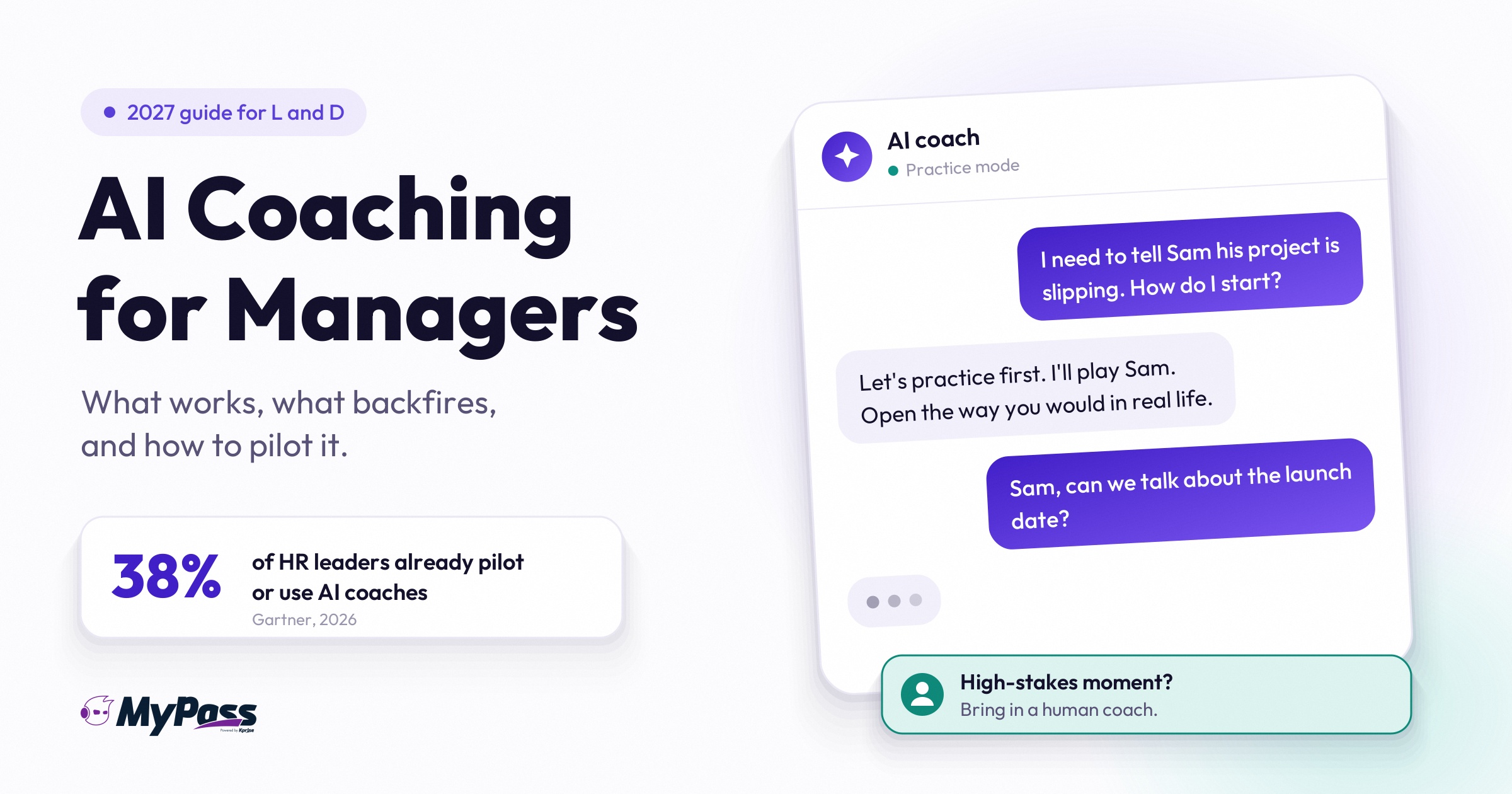
Managers are stretched thin, human coaching is expensive to scale, and AI tools have become good enough at conversation to fill some of the gap. Gartner lists AI coaching for managers as one of its four L and D trends for 2027, and more than a third of HR leaders are already piloting or using AI coaches.
- Managers are overwhelmed. Close to 8 in 10 CHROs surveyed by Gartner said managers are overwhelmed by their responsibilities.
- Adoption has started. 38 percent of HR leaders told Gartner they're piloting or using AI coaches for leadership development.
- Gartner expects it to scale fast. It predicts that by 2028, 40 percent of employees will be first trained and coached by AI when they enter a new role, up from under 5 percent today.
- Managers aren't ready to use AI well. In an October 2025 release, Gartner said only 8 percent of HR leaders believe their managers have the skills to use AI effectively.
That last point matters. The people being coached by AI are often the same people who haven't been taught how to question AI outputs, so rolling out a coach without that training adds risk.
Key point
Gartner's own advice is to implement AI coaching for managers carefully. Its research found some employees felt uneasy about AI coaching and said they want human connection, and it warns that poorly vetted vendors can damage trust.
Does AI Coaching Actually Work?
For narrow goals, the best evidence so far says yes. A 2022 study in PLoS ONE ran two 10-month randomized trials and found an AI chatbot coach was about as effective as human coaches at helping people reach their goals. The evidence for complex, emotional or relationship-heavy coaching is much thinner.
Here's what that study did and didn't show.
- What it tested. Researchers at Stellenbosch Business School and partners ran two equivalent randomized trials over 10 months. One group got six sessions with human coaches. The other used a text-based chatbot coach built on goal-setting theory, with a control group in each trial.
- What it found. Both coached groups reached their goals significantly more than their control groups, and the AI coach performed about as well as the human coaches.
- What it didn't test. It measured goal attainment only. It didn't test the things human coaches are often hired for, like working through conflict, identity changes in a new leadership role, or a crisis.
The practical reading is that AI is a good fit for the structured, repetitive parts of coaching, such as setting a goal, practicing and following up. It shouldn't be treated as a replacement for the parts that rely on trust, judgment and reading a person.
AI Coach vs Human Coach: Which Should Your Managers Use?
Use AI for frequent, low-stakes practice and follow-through, and use a human coach for sensitive, high-stakes or emotional situations. Many organizations now blend the two, with AI handling everyday practice and a human stepping in at the moments that carry real risk to people or to trust.
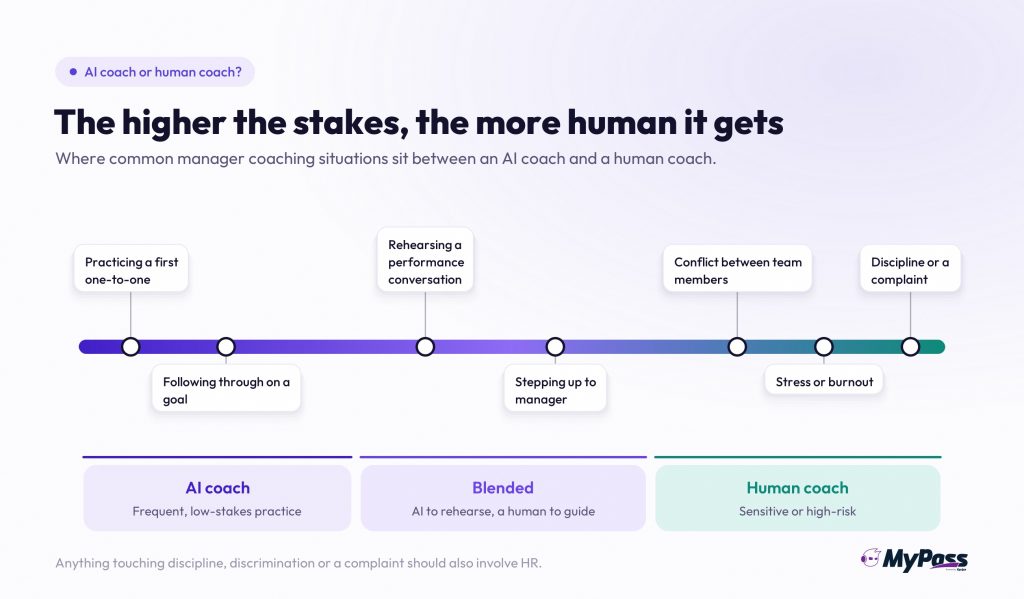
| Situation | Best fit | Why |
| Practicing a first one-to-one or a feedback conversation | AI coach | Safe, unlimited practice with instant feedback |
| Following through on a goal or a new habit | AI coach | Regular nudges and check-ins at very low cost |
| Preparing for a difficult performance conversation | Blended | AI for rehearsal, a human or HR partner for the plan and legal risk |
| Stepping up from team member to manager | Blended | AI for daily questions, a human for the identity shift and confidence |
| Conflict between team members | Human | Needs context, judgment and often HR involvement |
| Stress, burnout or personal issues | Human | Needs empathy and the right referral, not a chatbot |
| Anything touching discipline, discrimination or a complaint | Human, with HR | Legal and ethical risk is too high for an unsupervised tool |
If you run a manager training program, AI coaching works best as the practice layer between sessions, not as a replacement for the program.
What Are the Risks of AI Coaching?
The main risks are privacy, bias, over-reliance and losing human contact. Managers tell coaches things they wouldn't put in an email, so where that data goes matters. In the EU, some features are banned outright, and tools that evaluate performance face strict rules from December 2027.
- Confidential conversations. Coaching chats can include details about team members, health or pay. Know who can read transcripts, how long they're kept and whether the vendor uses them to train its models.
- Bias. An AI coach can give different advice depending on how someone writes, or repeat stereotypes about leadership style. Test it with varied scenarios before rollout.
- Skill atrophy. Gartner warns that leaning on AI for coaching could weaken managers' own skills. If the AI always drafts the feedback, the manager never learns to.
- Less learning from people. Gartner also notes that AI-first onboarding means fewer chances to learn from experienced peers. That's the same knowledge loss problem in a new form.
- Over-trust. AI can sound confident and still be wrong. Managers need to treat its advice as a starting point to check, not an answer.
EU rules to check if you operate in Europe.
- Emotion recognition at work is banned. Article 5(1)(f) of the EU AI Act prohibits AI that infers employees' emotions from biometric data, which can include voice and facial analysis, except for medical or safety reasons. The Commission's guidelines say inferring emotions from written text isn't covered, so ask any vendor exactly how its tool reads tone.
- Performance evaluation is high-risk. AI used to monitor or evaluate workers' performance and behavior is high-risk under Annex III of the Act. After the AI Omnibus, those obligations apply from 2 December 2027. A coach that only supports the manager is different from one that scores them for HR, so be clear which you're buying.
Key point
This section is general information, not legal advice. Check your specific tool and use with your legal or privacy team. Our guide to AI governance for L and D covers how to set up that review.
How Do You Choose an AI Coaching Tool?
Choose on data handling, evidence and escalation before features. Ask vendors who can see conversations, whether data trains their models, how the tool hands sensitive topics to a human, and what independent evidence shows it works. A tool that can't answer those questions clearly isn't ready for your managers.
Take these questions into every demo.
1. Who can read a manager's conversations? The answer should be the manager, and nobody else by default. Reporting to HR should be aggregated and anonymous.
2. Is our data used to train your models? Get the answer in the contract, not just the sales deck.
3. Does it infer emotions from voice or video? If yes and you operate in the EU, that's a red flag under the AI Act.
4. What happens when a manager raises something serious? Look for clear escalation to a human coach, HR or support resources.
5. Can it use our own leadership model? Generic advice is less useful than coaching tied to the behaviors you actually expect from managers.
6. What evidence do you have? Ask for independent studies or customer data on behavior change, not just usage numbers.
7. Does it follow recognized standards? The International Coaching Federation published AI coaching standards in January 2025. Ask whether the vendor aligns with them.
How Do You Run a 90-Day AI Coaching Pilot?
Run it in three phases: set it up with a small group of willing managers, run it for about two months with a clear goal, then decide based on behavior change rather than log-ins. A pilot of this size tells you whether the tool helps your managers before you spend money rolling it out to everyone.
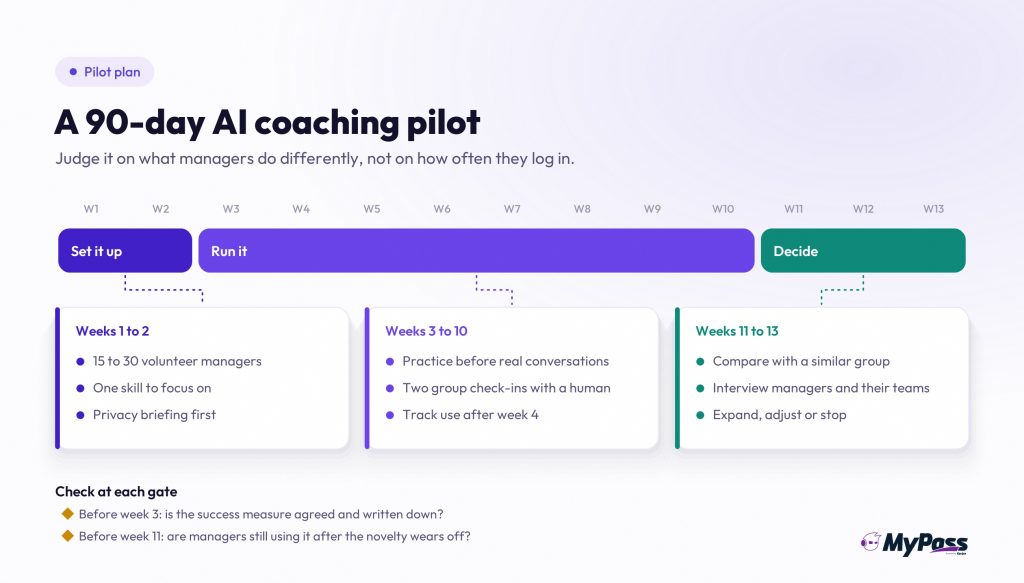
1. Weeks 1 to 2: Set it up. Pick 15 to 30 volunteer managers, ideally a mix of new and experienced. Choose one skill to focus on, such as giving feedback. Brief them on privacy, what the tool is for and when to go to a human instead.
2. Weeks 3 to 10: Run it. Ask managers to use the coach before real conversations, not just in spare time. Hold two short group check-ins with a human facilitator to share what's working.
3. Weeks 11 to 13: Decide. Compare results with a similar group that didn't use the tool. Interview a few managers and some of their team members. Then expand, adjust or stop.
Key point
Set your success measure before the pilot starts. If you decide afterwards, it's too easy to call any result a success.
How Do You Measure AI Coaching?
Measure it by changes in what managers do and how their teams experience them, not by how many times they log in. Look at whether managers hold the conversations they practiced, whether their teams notice a difference, and whether goals get met, using aggregated data that doesn't turn coaching into surveillance.
- Behavior. Did managers hold the conversations they practiced? A short self-report before and after works well here.
- Team experience. Ask direct reports two or three pulse questions about feedback and support, before and after the pilot.
- Goal attainment. The same measure the PLoS ONE study used: did people reach the goals they set?
- Sustained use. Use after week four says more than use in week one, when novelty drives log-ins.
- Trust. Ask managers directly whether they felt safe using it. If they didn't, the other numbers won't hold up.
Our guide on how to measure training effectiveness covers how to set up before-and-after comparisons like this.
Where Does an LMS Fit With AI Coaching?
An AI coach handles the conversation. An LMS holds the structure around it: the manager program, the skills content, the live sessions with human coaches, and the record of who completed what. Used together, AI gives managers practice between sessions and the LMS keeps the whole program organized and measurable.
MyPass LMS isn't an AI coach. It's where the manager development program around the coach lives, using these features.
- Build the manager curriculum fast. The MyPass LMS AI course builder drafts courses from a prompt or a document, so your feedback model or management handbook becomes training quickly.
- Sequence the program. Learning paths take new managers from basics like one-to-ones to harder topics like performance conversations, in order.
- Run the human sessions. Instructor-led session management and QR code attendance track cohort workshops and group coaching alongside online courses.
- Keep a human in the loop on assessments. AI-assisted grading always comes with instructor override, the same principle that should apply to any AI coaching.
- Include every manager. Unlimited registered users on every plan means you don't pay per manager to give the whole management layer access.
Where This Comes From
The Gartner material comes from HR Dive's report on Gartner's L and D trends for 2027, published 3 November 2026, Gartner's own posts on its 2028 prediction, and Gartner's October 2025 release on managers' AI skills.
The evidence on AI coaching comes from Terblanche and colleagues, 'Comparing artificial intelligence and human coaching goal attainment efficacy', PLoS ONE, 2022.
The EU rules come from the AI Act, Article 5(1)(f) and Annex III, with the Future of Privacy Forum's analysis of the Commission's guidelines. The December 2027 date comes from the AI Omnibus, in force since 27 July 2026, as summarized by White and Case.
The coaching standards are the International Coaching Federation's AI Coaching Standards, published January 2025.
MyPass LMS features come from our own product documentation.
The bottom line
AI coaching is moving from experiment to standard practice, and the evidence supports using it for what it does well: frequent, structured practice and follow-through that most managers never get from a human coach.
The organizations that get it right won't be the ones that replace human coaching. They'll be the ones that are clear about where AI fits, protect what managers share with it, and keep people involved where trust and judgment matter.
Start small. Pick one skill, run a 90-day pilot with volunteer managers, and measure what changes for their teams. That one pilot will tell you more than any vendor demo.
Frequently asked questions
Can AI replace human coaches for managers?
Not fully. Evidence shows AI can match human coaches on narrow goal attainment, but sensitive, emotional and high-stakes situations still need a human.
What is AI roleplay training?
An AI plays the other person in a practice conversation, such as an employee receiving feedback, then gives the manager feedback on how it went.
Is AI coaching legal in the EU?
Generally yes, but AI that infers emotions from biometric data like voice is banned at work, and AI that evaluates performance faces high-risk rules from 2 December 2027.
How much does AI coaching cost?
Vendors price it differently and many don't publish prices, so get quotes based on your real manager headcount and compare them with your current coaching spend.
Sources
- Gartner, via HR Dive, '4 trends to expect in L and D in 2027', 3 November 2026. AI coaching for managers is trend 3: close to 8 in 10 CHROs say managers are overwhelmed, 38 percent of HR leaders are piloting or using AI coaches for leadership development, and Gartner predicts 40 percent of employees will be first trained and coached by AI in a new role by 2028.
- Gartner on X, prediction that by 2028, 40 percent of employees will be trained and coached by AI when entering new roles, up from less than 5 percent, with fewer chances to learn from experienced peers.
- Gartner press release, 8 October 2025: only 8 percent of HR leaders believe their managers have the skills to use AI effectively.
- Terblanche, Molyn, De Haan and Nilsson, 'Comparing artificial intelligence and human coaching goal attainment efficacy', PLoS ONE, 2022, 17(6): e0270255. Two 10-month randomized controlled trials.
- EU AI Act (Regulation (EU) 2024/1689), Article 5(1)(f), emotion recognition in the workplace, and Annex III point 4, employment. Future of Privacy Forum analysis of the Commission's guidelines.
- White and Case, 'EU AI Omnibus enters into force, amending the AI Act'. In force 27 July 2026, with Annex III high-risk obligations moved to 2 December 2027.
- International Coaching Federation, AI Coaching Standards, January 2025.
- MyPass LMS features: the Kprise product brief.
Keep reading
L&D strategy
Manager Training: Why It Matters and How to Build It
AI in learning
AI Governance for L&D: Closing the Gap
AI in learning