Best LMS for Healthcare in 2026
On this page 7 sections
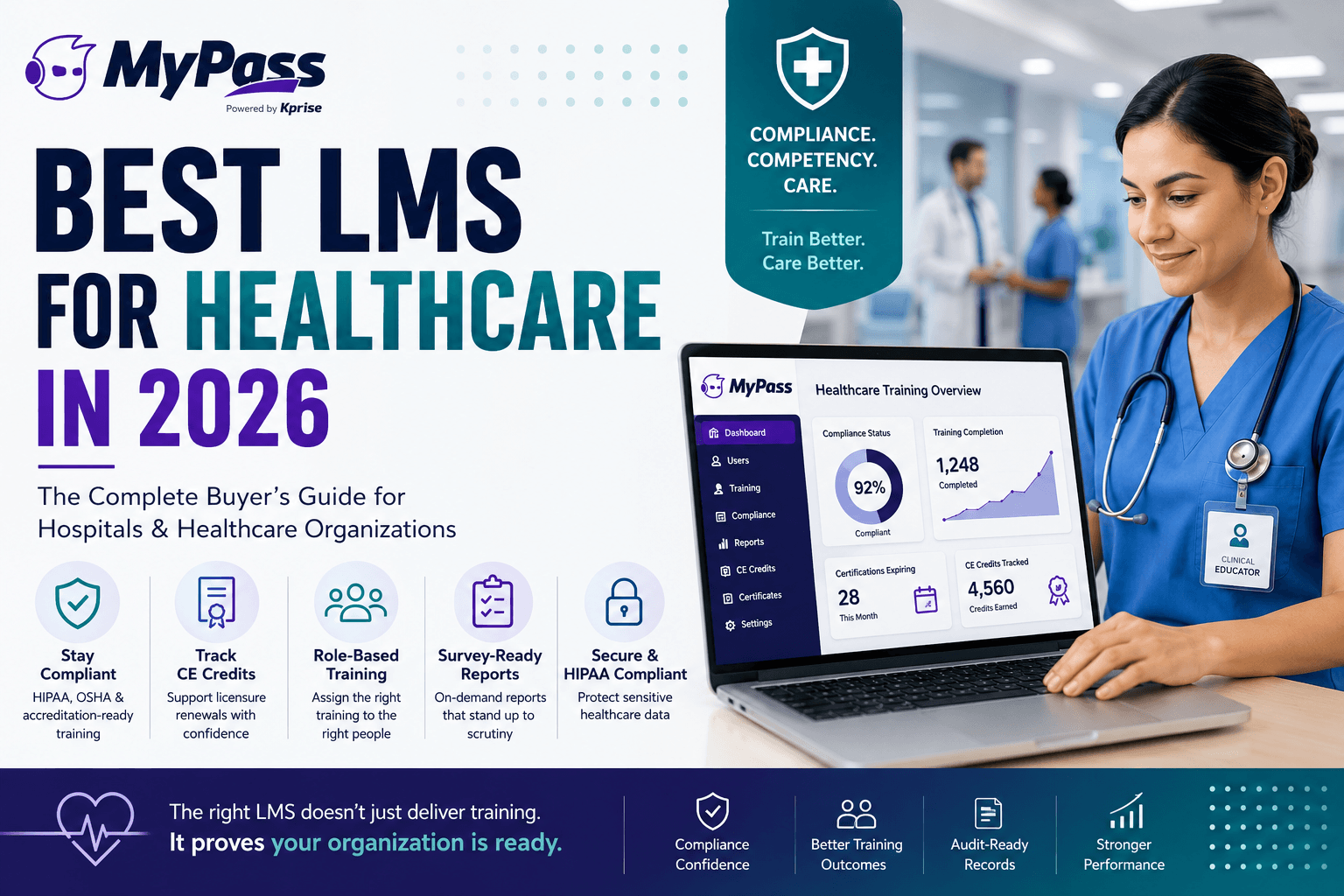
The best LMS for healthcare handles three things most platforms treat as extras: recurring annual training cycles such as HIPAA and OSHA bloodborne pathogens, continuing education credit tracking tied to licensure, and documentation that survives an unannounced survey. Role, department and state-based assignment matters more than course volume, because requirements differ by clinician and jurisdiction.
Healthcare training is a renewal problem, not a delivery problem
Most industries buy an LMS to deliver training. Healthcare organizations buy one to survive the renewal cycle. Every clinical and administrative staff member carries a set of mandatory requirements that expire, and the requirements differ by role, department, and often state. A nurse in a California ICU carries a different obligation set from a billing clerk in the same building.
So the question is not which platform has the nicest course player. It is which platform can hold a complex, expiring, role-specific requirement matrix and prove, on demand, that every person met their obligations inside the required window.
Key point
→ This article is general guidance rather than legal or regulatory advice. Requirements vary by organization type, accreditation body and state, so confirm your specific obligations with qualified counsel or your compliance officer.
The requirements your LMS actually has to carry
A quick picture of what makes healthcare different. [Requirements reflect general 2026 practice; confirm specifics for your organization.]
- HIPAA training. Required on hire and when policies materially change. Annual refresh is the widely accepted industry standard, and accreditation bodies generally expect it. Gaps longer than twelve months are the kind regulators notice.
- OSHA Bloodborne Pathogens, 29 CFR 1910.1030. Initial training before any task with exposure risk, then at least annually for anyone with reasonably anticipated occupational exposure. It must be provided free, during working hours, in language the workforce understands.
- CMS Conditions of Participation. Cover staff competency among other areas, enforced through unannounced surveys, with participation in Medicare and Medicaid at stake for serious non-compliance.
- Joint Commission standards. Mandatory for accredited hospitals, with competency evidence expected at survey.
- Continuing education for licensure. Clinicians accumulate CE credits against state and board requirements, for example a state nursing board requiring a set number of credits per renewal period.
- Workplace violence prevention. An area of sharpening regulatory focus in healthcare settings specifically.
Every one of those is recurring, and most are role-specific. That combination is what breaks general-purpose platforms.
What to prioritise when comparing platforms
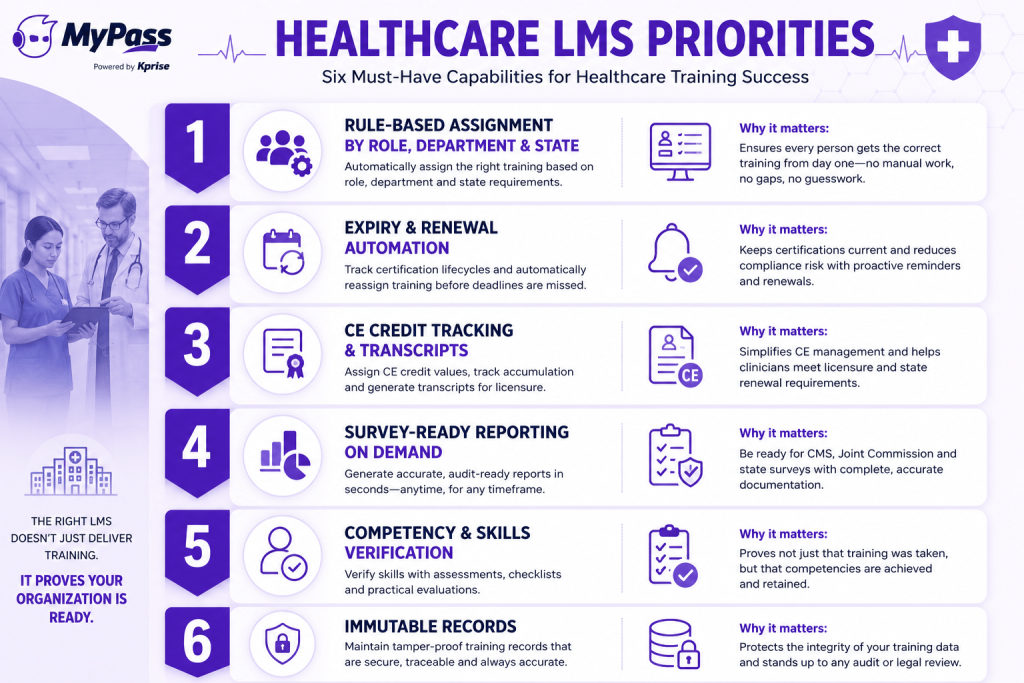
- Rule-based assignment. You should be able to define a rule once, such as role equals Registered Nurse and department equals ICU and state equals California, and have every new hire flow into the right requirement set automatically. Manual assignment does not scale in an environment with constant turnover.
- Expiry and renewal automation. The platform must track the full certification lifecycle, from earned to valid to expiring to expired to renewed, and reassign before a lapse rather than reporting it afterwards.
- CE credit tracking. Assign credit values per course, track accumulation per clinician against their requirement, and generate transcripts on demand for licence renewal.
- Survey-ready reporting. Surveys are frequently unannounced. Producing a filtered completion record in minutes, not days, is the practical test.
- Immutable records. Completion evidence needs dated, tamper-evident storage, since the entire value of the record is that it cannot have been adjusted after the fact.
- Competency verification. Some requirements need skills checks and observation, not just a quiz score, so look for assessment depth beyond multiple choice.
How the main options compare
An honest look at where each type of platform fits. [Positioning reflects general 2026 market observation; confirm current capability directly with vendors.]
- EthosCE. Purpose-built for healthcare education and CME/CE, and genuinely strong if continuing medical education is the core of what you run. Narrower if you also need broad workforce compliance across non-clinical staff.
- Docebo and Absorb LMS. Capable enterprise platforms with solid compliance features and analytics, well suited to large health systems with procurement capacity. Both are quote-based, and advanced reporting or analytics often sit in higher tiers or as add-ons, so confirm what is included before comparing prices.
- Moodle. Free to self-host with deep customization, and used successfully in healthcare education. It expects real technical capacity, since you own hosting, security patching and upgrades, which is a heavier commitment in an environment with strict data handling obligations.
- MyPass LMS. Compliance tracking, role and location based automatic assignment, certification and renewal management, and audit-ready reporting are included on every plan rather than sold as upgrades, with unlimited registered users so training every staff member does not raise the bill.
Key point
→ A demand worth making of every vendor on your shortlist: ask them to produce, live in the demo, a completion record for one named person, one named course, on one named date. If it takes more than a minute, the reporting is not built for survey conditions.
Where MyPass LMS fits, and where it does not
MyPass LMS suits healthcare organizations that need broad workforce compliance across clinical and non-clinical staff, with automatic assignment, renewal tracking and audit-ready records included rather than tiered. Unlimited registered users matters here specifically because healthcare organizations often train large populations including per-diem, float-pool, temporary and contract staff, and per-seat pricing penalises exactly the thorough coverage regulators expect. It also runs on FedRAMP-authorized AWS infrastructure, which matters to organizations with strict hosting requirements.
Where it is not the obvious choice: if your programme is overwhelmingly accredited CME with complex provider-level accreditation workflows, a purpose-built CME platform may fit that specific job more closely. And if you need deeply customised clinical simulation integrations, evaluate that requirement carefully with any vendor rather than assuming.
For most healthcare organizations, the deciding factors are whether compliance features are included or tiered and whether the platform can produce documentation on demand.
The bottom line
The best LMS for healthcare is the one that carries a complex, expiring, role-specific requirement matrix without manual effort, and proves compliance on demand when a surveyor arrives unannounced. Prioritise rule-based assignment, renewal automation, CE credit tracking and immutable, instantly retrievable records over course catalogue size. Then test every shortlisted vendor by asking them to produce one named person's completion record live in the demo.
MyPass LMS includes role and location based assignment, renewal tracking, certification management and one-click audit reporting on every plan, with unlimited registered users. See the healthcare solution, explore the compliance course library, or start a free trial.
Frequently Asked Questions
What is the best LMS for healthcare?
The best healthcare LMS handles recurring compliance cycles, role and state-specific assignment, CE credit tracking and survey-ready documentation. EthosCE suits CME-focused programmes, Docebo and Absorb suit large enterprises with procurement capacity, Moodle suits technically capable teams, and MyPass LMS includes compliance features on every plan.
Does a healthcare LMS need to be HIPAA compliant?
The platform must support your HIPAA obligations, including secure handling of any protected information, appropriate access controls, and reliable training records. Confirm the vendor's security posture, hosting arrangements and willingness to enter a business associate agreement where applicable.
How often is healthcare compliance training required?
It varies by requirement. OSHA bloodborne pathogens training is required initially and at least annually for staff with anticipated exposure. HIPAA training is required on hire and on material policy changes, with annual refresh the widely accepted standard. CE requirements follow licensure renewal periods.
What should a healthcare LMS track besides course completion?
Certification lifecycle status from earned through expiring to renewed, CE credit accumulation against each clinician's licensure requirement, role and department and state-specific requirement sets, competency verification beyond quiz scores, and dated tamper-evident records for surveys.
How do I evaluate an LMS for survey readiness?
Ask the vendor to produce, live during the demo, a completion record for one named individual, one named course and one specific date. If that takes more than about a minute, the reporting will not hold up under unannounced survey conditions.
Keep reading
Choosing an LMS
Best LMS for Government and Public Sector Organizations
Choosing an LMS
Best LMS for Logistics and Transportation: A Buyer's Guide
Choosing an LMS
Best LMS for Hospitality: Hotels, Restaurants and Beyond

Choosing an LMS