
| Real employee engagement comes from everyday experience, not perks: give people meaningful work and a clear sense of purpose, invest in their growth, recognise good work, ensure good management, and genuinely listen and act on feedback. Engaged employees care about their work and put in discretionary effort. The strategies that work address why people care, not surface rewards. |
Engagement Isn't Ping-Pong Tables
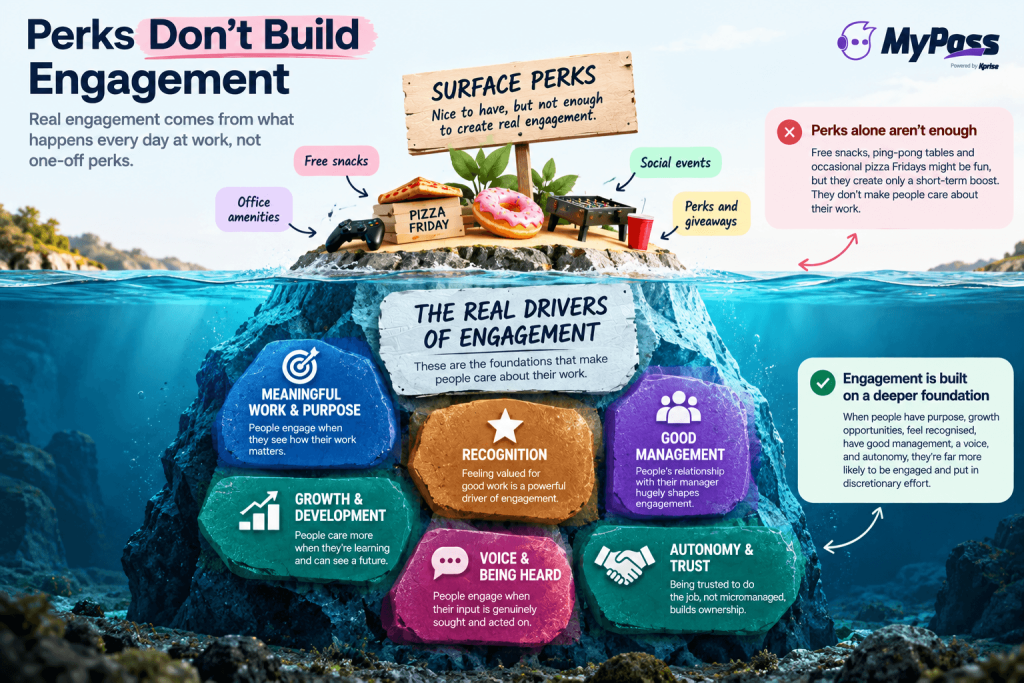
Let's clear this up first, because it causes so much wasted effort: employee engagement is not about perks. Free snacks, ping-pong tables, the occasional pizza Friday, none of these create engagement, and companies that treat them as the strategy wonder why nothing changes. Engagement is something deeper and more durable: it's whether people actually care about their work and the organization, enough to put in effort beyond the bare minimum.
That distinction matters because it changes what you work on. Perks are a surface-level transaction; engagement comes from the everyday experience of the job, whether the work feels meaningful, whether people are growing, whether they're treated well and heard. The strategies that genuinely move engagement all address those deeper drivers, not the office amenities. If your engagement efforts so far have been perks and haven't worked, this is why, and what to do instead.
| If your engagement strategy is snacks and socials, that's why it isn't working. Perks are nice but they don't make people care about their work. Engagement comes from the everyday experience of the job, not the amenities around it. |
The Strategies That Genuinely Move Engagement
Engagement has a handful of real drivers. Work on these and engagement rises; ignore them and no perk compensates.
- Meaningful work and purpose: people engage when they see how their work matters.
- Growth and development: people care more when they're learning and can see a future.
- Recognition: feeling valued for good work is a powerful, underused engagement driver.
- Good management: people's relationship with their manager hugely shapes engagement.
- Voice and being heard: people engage when their input is genuinely sought and acted on.
- Autonomy and trust: being trusted to do the job, not micromanaged, builds ownership.
Growth Is a Driver You Control
Among the engagement drivers, one is both powerful and unusually within your direct control: giving people the chance to grow. People are far more engaged when they're learning, developing and can see a path forward. Stagnation is one of the quickest routes to disengagement, when work stops teaching people anything and there's no visible future, caring about it becomes hard. A job that keeps growing you is a job you stay engaged with.
What makes development such a practical engagement lever is that, unlike some of the softer cultural factors, you can actually do something concrete about it. You can offer real training, create clear development paths, support people in building new skills, and open up progression. Investing visibly in people's growth signals that the organization is invested in them, and that's a powerful reason to be engaged rather than just present. It also compounds with the other drivers, growth gives work more meaning and makes people feel valued.
Measure It, and Actually Act
You can't improve engagement you don't understand, so measuring it matters, through surveys, conversations and watching the signals (turnover, absenteeism, discretionary effort). But here's the trap that undermines most engagement efforts: measuring without acting. Running an engagement survey and then doing nothing visible with the results is worse than not asking, because you've now signalled that people's input doesn't matter, which actively damages engagement.
So the rule is simple: only ask if you're prepared to act, and when you do act, close the loop visibly so people see that their voice led to something. This is itself one of the strongest engagement moves, genuinely listening and responding tells people they're heard, which is a core driver. Engagement isn't a once-a-year survey; it's an ongoing practice of understanding how people feel and doing something about it. The acting is the part that counts.
| Never run an engagement survey you won't act on. Asking and then ignoring the answers tells people their input doesn't matter, which damages engagement more than never asking. Only measure if you'll close the loop. |
How MyPass LMS Supports Engagement
The engagement lever an LMS most directly supports is the big, controllable one: growth and development. MyPass LMS lets you give people genuine, visible development, structured learning paths that build skills, training that opens up new opportunities, and support for progression, which is one of the strongest and most practical ways to keep people engaged rather than stagnating.
It also helps with recognition (certificates and visible achievement for completed learning and earned credentials) and supports manager development, since the quality of management is a top engagement driver. Reporting shows who's engaging with development, giving you a real signal to act on. None of this replaces the wider cultural work engagement needs, but it addresses one of the most powerful drivers directly and measurably. And with flat pricing and unlimited registered users, extending development, and its engagement benefit, to everyone doesn't add per-seat cost.
| Start with the growth lever, because it's powerful and you control it. Giving people a real, visible way to develop addresses several engagement drivers at once, purpose, growth and feeling valued, more concretely than most culture initiatives. |
The bottom line
Employee engagement isn't built on perks, it comes from the everyday experience of the job: meaningful work and purpose, growth and development, recognition, good management, having a voice, and being trusted. Work on those real drivers and engagement rises; rely on snacks and socials and it won't. And measuring engagement only helps if you actually act on what you learn.
Growth is the driver that's both powerful and most within your control. See how structured development supports engagement in MyPass LMS features, read about building a learning culture, or start a free trial.
Frequently asked questions
What are the best employee engagement strategies?
The strategies that genuinely work address the real drivers of engagement, not perks: give people meaningful work and a clear sense of purpose, invest in their growth and development, recognise good work, ensure good management, give people a genuine voice and act on it, and extend autonomy and trust. No single one is enough, engagement comes from the everyday experience of the job across these drivers. Perks like snacks and socials don't create engagement, which is why perk-based efforts usually disappoint.
How do you improve employee engagement?
Work on the everyday experience of the job rather than surface perks. Make work meaningful and connect it to purpose, invest visibly in people's growth, recognise good work, develop good managers, genuinely listen and act on feedback, and trust people to do their jobs. Measure engagement through surveys, conversations and signals like turnover, but crucially act on what you find, measuring without acting damages engagement. Growth and development is one of the most powerful and controllable levers to start with.
Do perks improve employee engagement?
Not really. Free snacks, ping-pong tables and pizza Fridays are pleasant but they don't create genuine engagement, which is about whether people actually care about their work enough to put in extra effort. Engagement comes from deeper drivers: meaningful work, growth, recognition, good management, being heard, and trust. Companies that treat perks as their engagement strategy usually find nothing changes. Perks aren't harmful, they're just a surface-level transaction, not a substitute for addressing why people do or don't care about their work.
Does training improve employee engagement?
Yes, growth and development is one of the strongest and most controllable engagement drivers. People are far more engaged when they're learning and can see a path forward; stagnation, when work stops teaching anything and there's no visible future, is a quick route to disengagement. Offering real training, clear development paths and support for progression signals that the organization is invested in people, which is a powerful reason to be engaged. It also reinforces other drivers by making work more meaningful and helping people feel valued.