Most organizations run training through a patchwork of separate tools: a course authoring tool, a video host, a quiz platform, a proctoring service, an ecommerce plugin, a compliance tracker, a certificate generator and an AMS or HR integration layer. MyPass combines all eight into one connected LMS, so course creation, delivery, assessment, proctoring, ecommerce, compliance tracking, certification and integrations run through a single platform with one login, one bill and one source of truth for training data.
The eight-tool problem nobody budgeted for
Ask most L&D or operations leaders how many tools their training program actually depends on, and the honest answer is usually more than they expected. A course authoring tool for building content. A separate video platform for hosting it. A quiz or assessment tool. A proctoring service for exams. An ecommerce plugin if you sell any courses. A compliance tracker to prove training happened. A certificate generator. And some kind of integration layer to connect it all to your AMS or HR system.
Each tool made sense on its own when someone bought it. Together, they create a specific kind of pain: separate logins, separate bills, data that does not talk to itself, and an integration project every time one vendor changes its API. We built MyPass because we kept meeting organizations stuck exactly there.
The eight tools MyPass LMS replaces
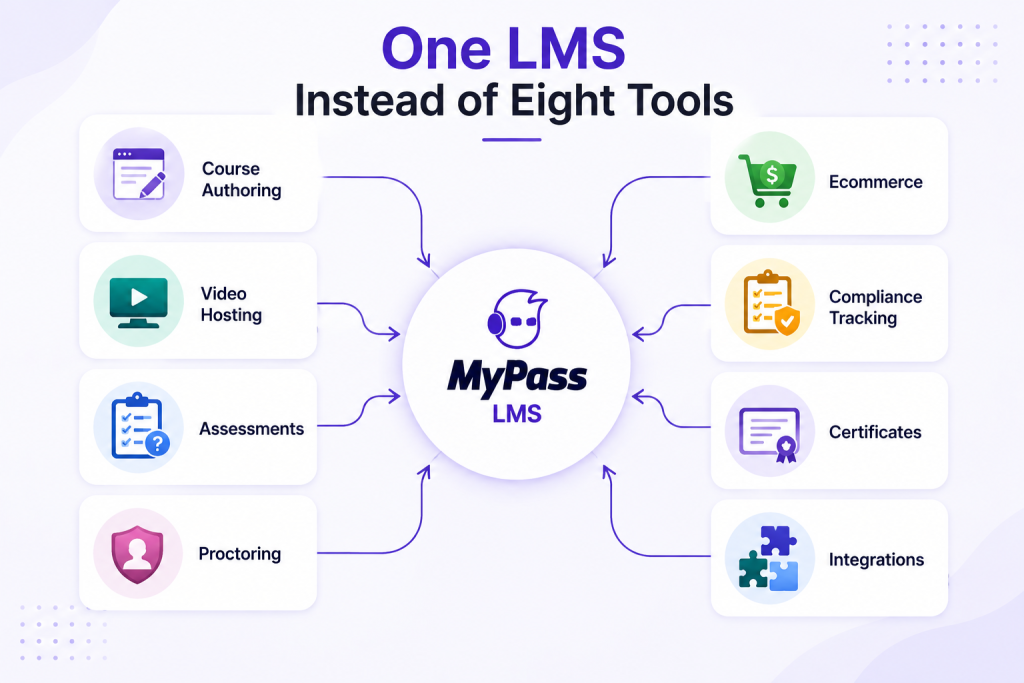
- Course authoring tool. MyPass includes a built in AI course builder , so you create courses inside the platform instead of exporting from a separate authoring tool.
- Video and content hosting. Upload and stream course video natively, with no separate hosting subscription.
- Assessment and quiz software. Quizzes, exams and knowledge checks are built into every course.
- Exam proctoring service. AI-powered proctoring runs inside MyPass LMS across three tiers, replacing a standalone proctoring vendor.
- Ecommerce plugin. Sell courses directly, with member versus non-member pricing and bundles, without bolting on a separate storefront.
- Compliance tracking software. Automatic assignment, completion tracking and an immutable audit trail are native, not a third-party add-on.
- Certificate and badge generator. Issue certificates and digital badges automatically on completion.
- Integration layer. Native connections to 8 AMS platforms and HR systems, so member or employee data flows in without custom middleware.
Why consolidation is not just about saving money
The obvious pitch for an all-in-one platform is cost. Eight subscriptions cost more than one, and that is true. But the bigger problem with a fragmented stack is not the invoice total. It is what happens between the tools.
- Data fragmentation. Completion data lives in one tool, certificates in another, and compliance records in a third. Producing a single audit-ready report means stitching together exports by hand.
- Integration fragility. Every tool-to-tool connection is a point of failure. When one vendor changes an API, something breaks, and it is rarely obvious which tool is at fault.
- Inconsistent learner experience. Learners log into one place to watch a video, another to take a quiz, and a third to get certified. Each handoff is a chance to lose them.
- Slower administration. Every new hire, course or compliance requirement means updating settings in multiple systems instead of one.
| → The real cost of a fragmented stack is not the subscription total. It is the hours spent reconciling data between tools that were never designed to talk to each other, and the risk of a compliance gap nobody notices until an audit. |
What one connected platform actually changes
When course creation, delivery, assessment, proctoring, ecommerce, compliance and certification all run through MyPass, three things change immediately. One login for learners and admins, so there is no handoff between systems. One source of truth for training data, so a completion record, a certificate and a compliance report are all pulling from the same event, not three separate exports. And one bill, at a flat rate with unlimited registered users, instead of eight invoices that each scale with usage in their own way.
This is not about MyPass doing everything a specialist tool does at its absolute best. It is about most organizations not needing eight best-in-class point solutions. They need one platform that does all eight jobs well enough, connected, so the whole program actually works together.
The bottom line
Most training programs run on a patchwork of tools that were each reasonable purchases on their own and painful together. MyPass replaces course authoring, video hosting, assessments, proctoring, ecommerce, compliance tracking, certification and integrations with one connected platform, one login, and one bill. The savings are real, but the bigger win is a single source of truth for training data instead of eight systems that do not talk to each other.
See every feature included in MyPass , compare the all-in-one approach against point solutions, or start a free trial and consolidate your stack.
Frequently Asked Questions
What tools does MyPass replace?
MyPass combines course authoring, video hosting, assessments, exam proctoring, ecommerce, compliance tracking, certificate generation and AMS or HR integrations into one platform, replacing the typical patchwork of separate tools most organizations run training through.
Is an all-in-one LMS better than separate best-in-class tools?
For most organizations, yes, because the value of consolidation is not just cost. It removes data fragmentation, integration fragility between tools, and the inconsistent learner experience that comes from logging into multiple systems for one training program.
Does MyPass include exam proctoring?
Yes. MyPass includes AI-powered exam proctoring across three tiers built into the platform, so you do not need a separate proctoring vendor for certification or high-stakes assessments.
Can I sell courses directly through MyPass?
Yes. MyPass includes native course ecommerce with member versus non-member pricing and bundles, so you can sell courses without adding a separate ecommerce plugin.
How does consolidating training tools save money?
Beyond avoiding multiple subscriptions, consolidation removes the time spent reconciling data across systems, reduces integration failures between vendors, and lets one flat-rate LMS plan with unlimited users replace several tools that each scale their own pricing with usage.