| Companies use AI in employee training mainly to build courses faster, personalize learning to each person, translate content into many languages, automate admin like reminders and reporting, and surface insights from training data. The biggest real win is speed of content creation. AI doesn't replace good training design or human coaching, it removes the slow, manual work around them. |
Cut Through the AI Hype First
Every L&D tool now claims to be 'AI-powered,' and it's hard to tell what actually helps from what's just a marketing sticker. So let's be practical. AI genuinely changes some parts of training a lot, and barely touches others. Knowing the difference saves you from both missing real gains and wasting money on hype.
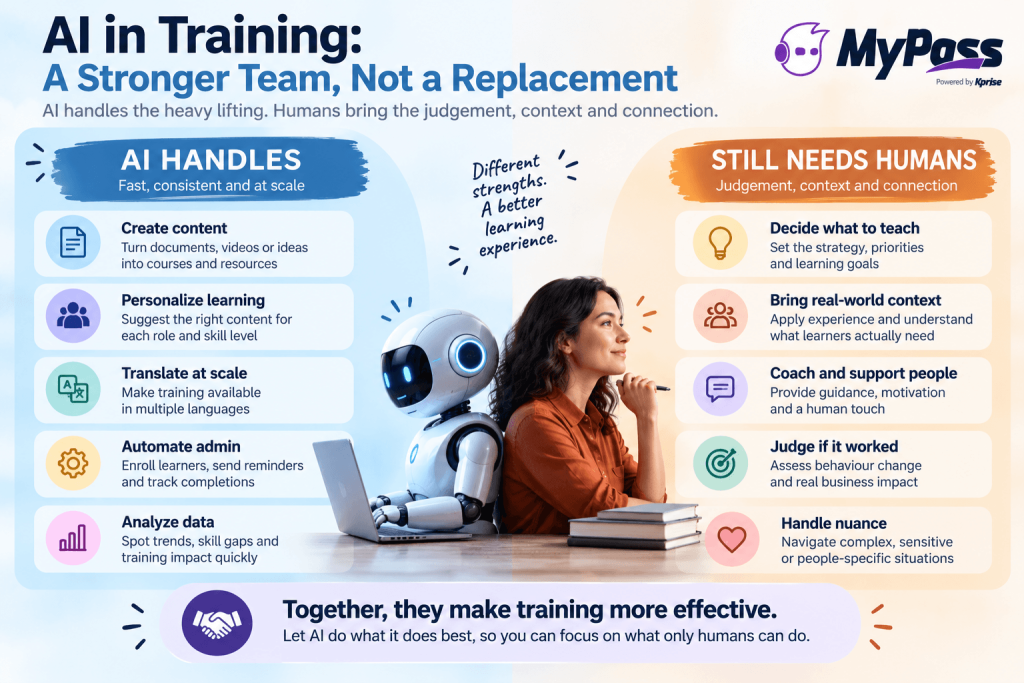
Here's the honest summary up front: AI is brilliant at the slow, manual, repetitive parts of training, building content, personalizing, translating, chasing completions, crunching data, and it's no substitute for the human parts, deciding what to teach, coaching people, and judging whether training worked. Used for the first set, it's a genuine step change. Expected to replace the second, it disappoints. This article walks through where it actually earns its place.
| The useful question isn't 'should we use AI in training?' It's 'which parts of training is AI actually good at?' The answer: the slow, manual work around training, not the human judgment at its core. |
Where AI Genuinely Helps in Training
A handful of AI applications in L&D are real and valuable right now, not someday. These are the ones worth paying attention to.
- Creating content faster: AI can draft courses, quizzes and outlines in a fraction of the usual time.
- Personalizing learning: tailoring what each person sees to their role, level and gaps.
- Translating training: making the same course available in many languages, quickly and cheaply.
- Automating admin: reminders, enrolments and reporting that used to eat hours of manual work.
- Surfacing insights: spotting patterns in training data a human would never find by hand.
The Biggest Win: Content Creation Speed
If you do only one thing with AI in training, use it to create content faster, because that's where the time savings are most dramatic and immediate. Building a course the traditional way, writing the content, drafting quiz questions, structuring modules, is slow, often the main bottleneck in getting training out the door. AI collapses that. What took days can take hours: a first draft of a course, a set of assessment questions, an outline to build on.
This matters more than it sounds. When creating training is fast and cheap, you create more of it, and you update it more often, so your training stays current instead of ageing because nobody has time to revise it. The human still shapes, checks and improves what AI drafts, that's essential, but starting from an AI draft instead of a blank page changes how much training you can realistically produce. For most teams, this is the single most valuable use of AI in L&D today.
Personalization and Translation at Scale
Two other AI uses are quietly transformative because they do things that were previously impractical at scale. The first is personalization. Ideally, everyone gets training matched to their role, their level and their specific gaps, but doing that manually for a whole workforce is impossible. AI makes tailoring what each person sees realistic, so a new hire and a veteran, or someone strong in one area and weak in another, don't sit through identical generic courses.
The second is translation. For any organization with people who speak different languages, training in only one language leaves people behind. Translating courses the old way is slow and expensive, so it often just doesn't happen. AI translation makes delivering the same training in many languages fast and affordable, which for a global or multilingual workforce isn't a nice-to-have, it's the difference between everyone being trained and only some being trained. Both of these turn 'in theory we should' into 'we actually can.'
| AI's quieter superpower is making things that were impractical at scale, true personalization and multi-language training, suddenly realistic. Those weren't impossible before AI, just too slow and costly to actually do. |
How MyPass LMS Puts AI to Work
MyPass LMS builds the genuinely useful AI applications into the platform, rather than bolting on AI as a buzzword. An AI course builder lets you generate courses in minutes instead of days, attacking the content-creation bottleneck directly, and AI translation delivers training in 120+ languages so a multilingual workforce isn't left out.
On the administrative side, automation handles the reminders, enrolments and reporting that otherwise eat your time, and analytics surface where learners struggle so you can act on patterns rather than guesswork. The point throughout is to use AI for the slow, manual work so your people spend their time on the parts that need human judgment, deciding what to teach and whether it's working. And with flat pricing and unlimited registered users, scaling AI-assisted training across everyone doesn't add per-seat cost.
| Start where the payoff is biggest and the risk is lowest: use AI to draft your next course instead of starting from scratch. You'll feel the time saving immediately, and you stay in control by reviewing and improving the draft. |
The bottom line
AI in employee training is real where it attacks the slow, manual work, creating content faster (the biggest win), personalizing learning, translating at scale, automating admin, and surfacing insights, and overhyped where it's expected to replace human judgment, coaching and design. Use it for the first and keep humans firmly in charge of the second, and it's a genuine step change rather than a gimmick.
Start with content creation, where the payoff is immediate. See how an AI course builder, AI translation and automation work in MyPass LMS features, read about the AI course builder, or start a free trial.
Frequently asked questions
How is AI used in employee training?
Mainly in five ways: creating course content faster (drafting courses, quizzes and outlines in a fraction of the usual time), personalizing learning to each person's role and gaps, translating training into many languages quickly and cheaply, automating admin like reminders and reporting, and surfacing insights from training data. The biggest practical win is content-creation speed. AI handles the slow, manual work around training; it doesn't replace deciding what to teach, coaching people, or judging whether training worked.
Can AI replace trainers and L&D teams?
No. AI is excellent at the manual, repetitive parts of training, building content, personalizing, translating, chasing completions, analysing data, but it doesn't replace the human core: deciding what actually needs teaching, coaching and developing people, handling nuance, and judging whether training changed behaviour. The realistic picture is AI as a powerful assistant that removes the slow work so L&D teams spend their time on the high-value human judgment, not as a replacement for them.
What is the best use of AI in L&D right now?
Creating content faster. Building a course traditionally, writing content, drafting assessments, structuring modules, is slow and often the main bottleneck in getting training out. AI can turn days of work into hours by producing strong first drafts you then shape and improve. This matters because when training is fast and cheap to create, you make more of it and keep it current instead of letting it age. For most teams, content-creation speed is the single most valuable AI application today.
Is AI in training just hype?
Partly, there's a lot of 'AI-powered' marketing on tools where AI barely helps. But several applications are genuinely valuable now: fast content creation, personalization at scale, affordable multi-language translation, automated admin, and data insights. The way to cut through the hype is to ask which specific parts of training AI actually improves (the slow, manual ones) versus where it's oversold (replacing human judgment and coaching). Used for the former, it's real; expected to do the latter, it disappoints.