
Learning and Development Strategy for 2027: The Complete Guide to Building One Leaders Fund
On this page 16 sections
- What Is a Learning and Development Strategy?
- Why Do You Need a Learning and Development Strategy in 2027?
- What Frameworks Can You Use to Build an L and D Strategy?
- What Does L and D Maturity Look Like?
- How Do You Build a Learning and Development Strategy Step by Step?
- What Should a Learning and Development Strategy Document Include?
- What Should Be on Your 2027 L and D Priority List?
- Why Do L and D Strategies Fail?
- How Do You Measure a Learning and Development Strategy?
- How Do You Budget and Defend an L and D Strategy?
- How Should AI Shape Your 2027 L and D Strategy?
- How Can an LMS Support Your Learning and Development Strategy?
- Where This Comes From
- The bottom line
- Frequently asked questions
- Sources
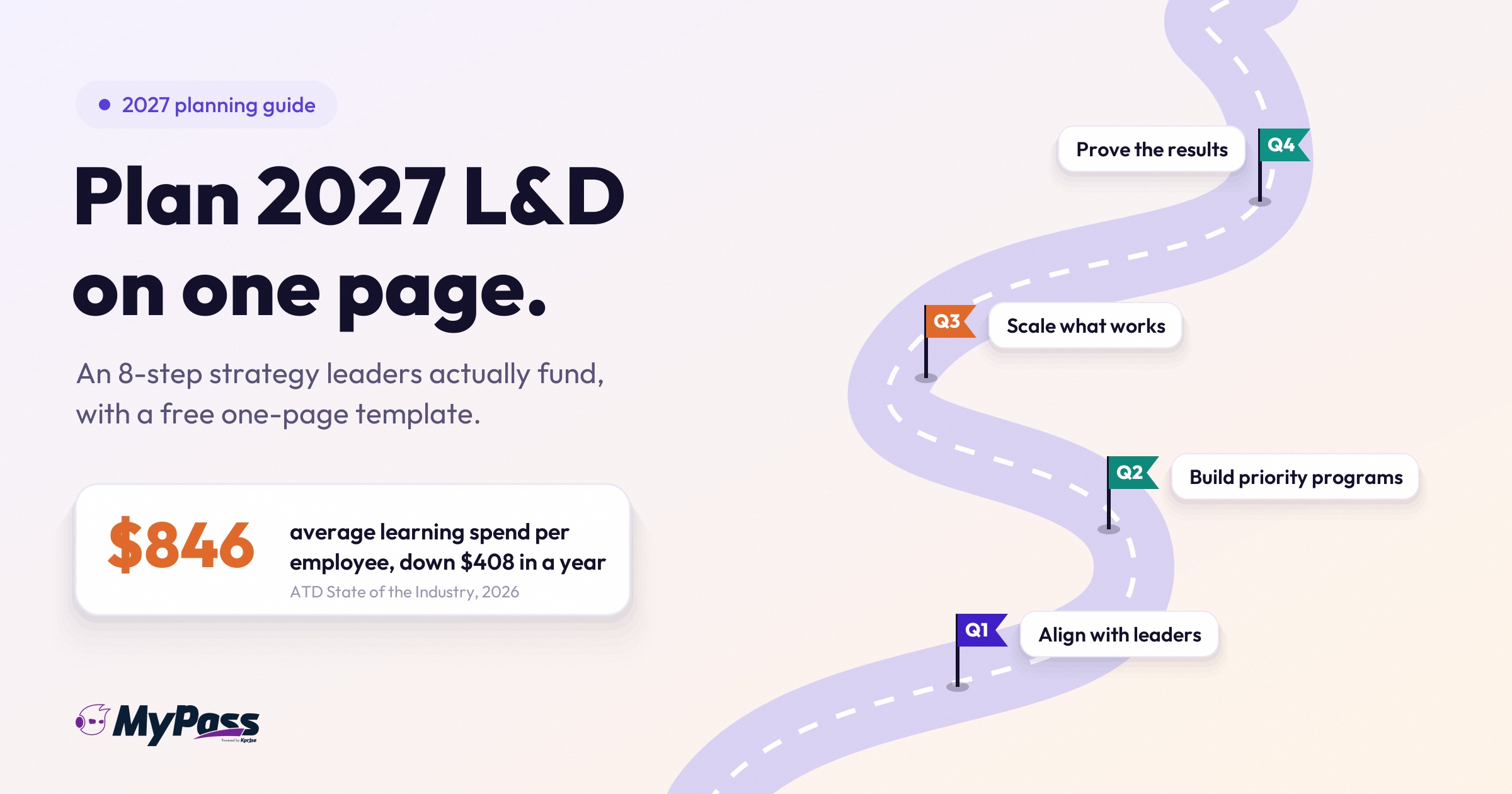
A learning and development strategy is a short, business-owned plan that names the few capabilities your organization needs, who needs them, how you'll build them and how you'll prove it worked. For 2027, build it like an investment case: tie it to business results, agree measures up front, and fund it from a budget that's likely flat.
What Is a Learning and Development Strategy?
A learning and development strategy is the plan that decides what your learning function will focus on, for whom and why. It links business goals to the capabilities people need, then to the programs that build them and the measures that prove they worked. Good ones are short, co-owned with business leaders and reviewed at least once a year.
Think of it as an investment case rather than a training catalog. A catalog lists what's available. A strategy explains which few capabilities the business is paying to build, what result each should produce, and what you won't spend money on.
People often mix up strategy, plan and calendar. They work at three different levels.
| L and D strategy | L and D plan | Training calendar | |
| Answers | What matters most, and why | What we'll deliver, and when | Which session runs on which date |
| Time frame | One to three years, reviewed yearly | One year, by quarter | Weeks and months |
| Main audience | Executives and business leaders | L and D team and managers | Learners and facilitators |
| Example | Build frontline leadership to cut first-year turnover | Launch a new manager program in Q2 for 120 supervisors | New manager cohort 3, 14 to 16 April |
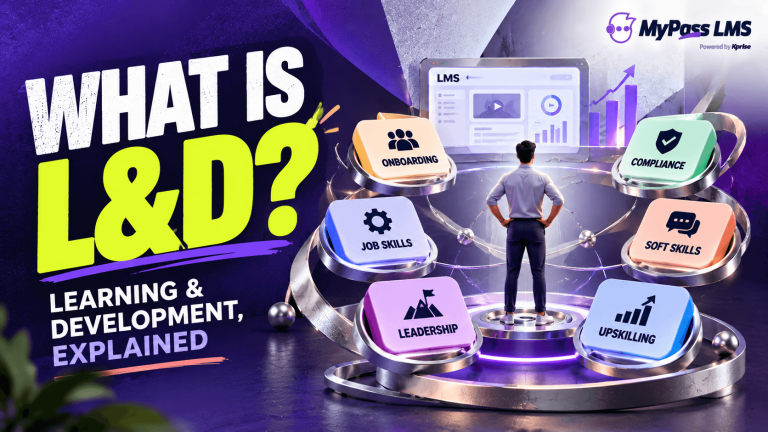
If you're new to the field, start with what learning and development is.
Why Do You Need a Learning and Development Strategy in 2027?
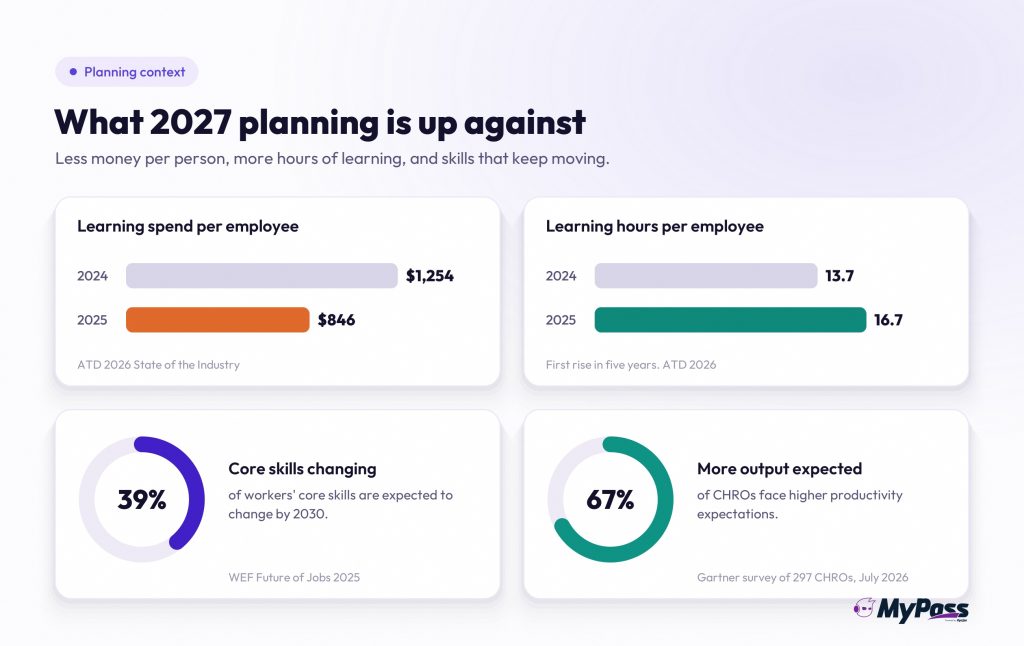
Because L and D is being asked to reskill people faster with less money and fewer staff. Spend per employee fell sharply in ATD's latest data, most leaders expect flat or lower budgets, and employers expect almost 4 in 10 core skills to change by 2030. Without a clear strategy, a learning team gets judged on cost and cut first.
Budgets per person are falling
- Spend per employee dropped. ATD's 2026 State of the Industry report (340 organizations, 2025 data) found average direct learning spend fell to $846 per employee, down $408 from 2024. Learning hours rose to 16.7, the first increase in five years.
- The outlook has cooled. The share of ATD respondents expecting more resources fell from 48 percent to 28 percent, and the share expecting cuts rose from 8 percent to 25 percent.
- Benchmarks disagree, so quote them carefully. Training magazine's 2025 report found US spend rose 4.9 percent to $102.8 billion, or $874 per learner. It measures per learner across a weighted universe, while ATD measures per employee in a sample. Treat 2025 as roughly $800 to $900 per head, and always name the source.
- Size changes everything. Training magazine puts spend per learner at $1,091 in small companies, $782 in midsize and $468 in large ones. Compare yourself with organizations your size.
Demand for new skills is rising
- Skills are shifting fast. The World Economic Forum's Future of Jobs Report 2025 expects 39 percent of workers' core skills to change by 2030, and 59 of every 100 workers to need training.
- Jobs need more skills each year. Gartner estimates the skills required per job are rising by about 5 percent a year.
- Leaders want more output. In Gartner's July 2026 survey of 297 CHROs, 67 percent said they face higher productivity expectations. Gartner's advice for 2027 is to focus on fewer, differentiated skills.
- Skills training is the top priority. In SHRM's 2026 survey of 223 L and D executives, more than 1 in 3 named skills training as their number one priority.
Teams are stretched
ATD's median talent development team is six people. In small and midsize businesses, each L and D person supports about 224 employees on average. In Training magazine's survey, 41 percent named lack of resources or staff as their biggest challenge. A strategy is how a small team decides where its limited hours go.
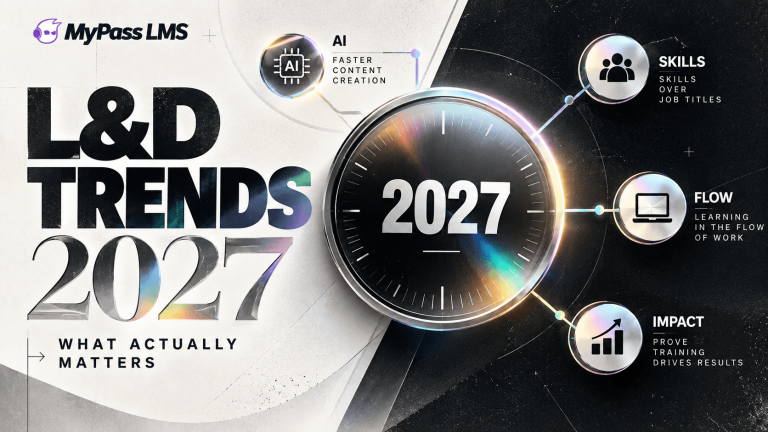
We track the wider picture in learning and development trends.
What Frameworks Can You Use to Build an L and D Strategy?
The most useful are McKinsey's nine-part ACADEMIES checklist, Josh Bersin's capability academy model, Gartner's principles for learning in the AI era and CIPD's evidence-informed approach. They use different names but agree on the essentials: start from business strategy, share ownership with leaders, embed learning in work and measure business results.
McKinsey ACADEMIES: the most complete checklist
Published in 2019 and still the most cited checklist, McKinsey's framework names nine components of a successful L and D strategy.
| Component | What it means in practice |
| Alignment | The strategy follows business strategy and is reassessed every year |
| Co-ownership | Business leaders and HR own capability building together |
| Assessment | Capability gaps are measured and given a value |
| Design | Continuous learning journeys, not stand-alone courses |
| Execution | Pilot first, then scale what works |
| Measurement | Business, learning and operational measures |
| Integration | Linked to hiring, onboarding, performance and succession |
| Enabling informal learning | Support learning that happens through work and people |
| Systems | Technology that fits the wider talent setup |
Bersin capability academies: who owns the learning
A capability academy is built around a business capability, not a course catalog, and is led by a business leader rather than L and D. Bersin's published examples include Capital One's CIO-led Digital Academy and PepsiCo's CFO-sponsored Finance Academy. His 2025 model adds a lean central L and D team that sets standards and tools, functional teams that own their own content, and employees who share knowledge directly.
Gartner's principles for the AI era
Gartner's 2024 learning manifesto sets out five priorities: business outcomes over knowledge gained, growth mindset over current skill set, skills-based agility over role-based stability, embedded learning over off-the-job training, and community learning over individual learning. Gartner also found that support from a network of employee, manager, L and D, talent team and subject experts nearly doubles the effect on skills readiness compared with one-to-one support.
CIPD's evidence-informed approach
CIPD adds the learning science: set clear business goals, keep cognitive load manageable, support transfer of learning to the job, focus on outcomes rather than inputs, and co-create with stakeholders. Deloitte's 2025 guidance adds experience-based development such as short internal gigs, stepping-stone roles and pairing new people with experts.
Is the 70-20-10 model evidence-based?
Not really. The 70-20-10 idea, that 70 percent of learning comes from experience, 20 percent from others and 10 percent from formal training, came from successful executives recalling their careers. One of its originators reportedly later called it folklore. The only empirical test found, a study of 84 managers, found about 16 percent from experience, 44 percent from others and 30 percent from formal training.
Key point
Use 70-20-10 as a direction, not a ratio. It's a good reminder to design stretch assignments, coaching and manager involvement alongside courses. Don't use it to split a budget, and don't call it research-proven.
What Does L and D Maturity Look Like?
Mature L and D functions are defined by integration, not catalog size. They connect learning to business goals and talent systems, build it into daily work, use skills and career paths, and measure outcomes. Josh Bersin's 2026 research describes four maturity levels and finds only about 5 percent of organizations at the top.
| Level | Name | What it looks like |
| 1 | Static Training | Courses and compliance, delivered on request. Success means completions |
| 2 | Scaled Learning | A broad catalog and an LMS at scale. Still mostly separate from the business |
| 3 | Integrated Development | Learning tied to roles, skills and careers, with business owners |
| 4 | Dynamic Enablement | Learning built into work, adapting as business needs change |
Bersin's 2026 research covered more than 800 organizations in 60 countries. It puts about a third of companies at Level 1 and 46 percent at Level 2. Organizations at Level 4 reported being six times more likely to meet financial targets and 16 times more likely to adapt to change.
Key point
Read those multipliers with care. They're self-reported correlations, not proof that maturity causes the results, and they come from a firm that also sells an AI learning platform. The direction is still useful: integration and business ownership matter more than adding courses.
The gaps are telling. In Bersin's 2025 data, only 15 percent of organizations had L and D systems well integrated with other corporate systems, and only 12 percent offered career pathways.
How Do You Build a Learning and Development Strategy Step by Step?
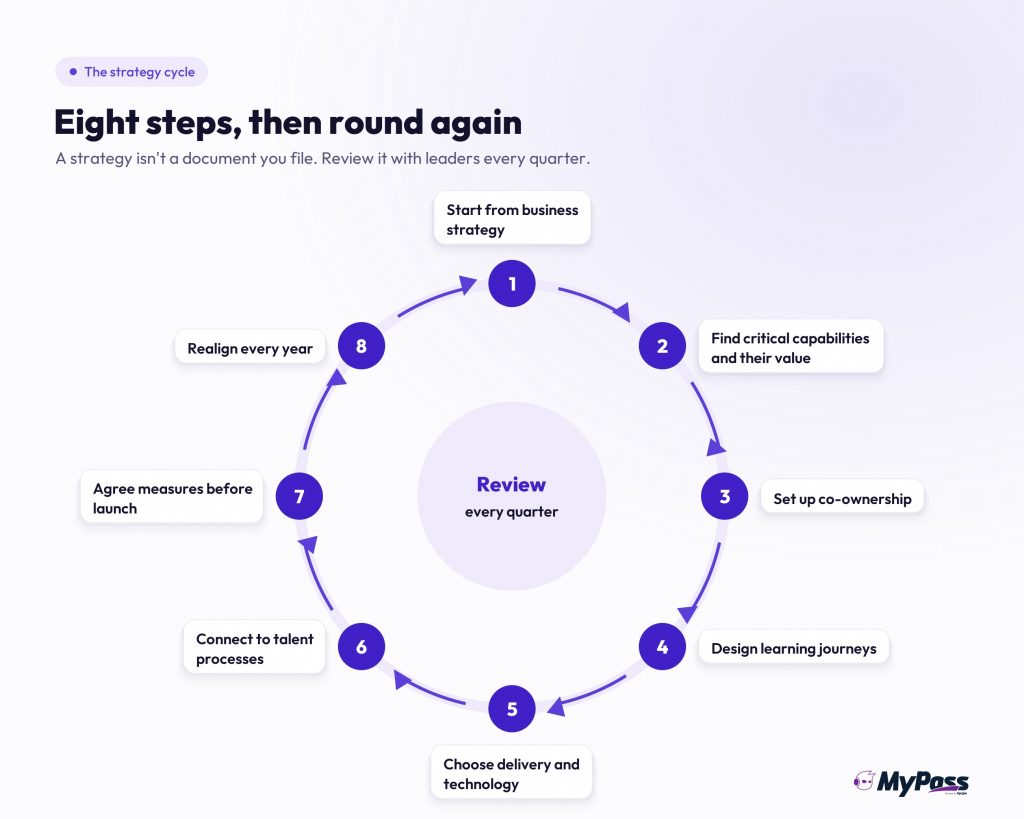
Follow eight steps: start from business strategy, find the critical capabilities and their value, set up co-ownership with leaders, design learning journeys, choose delivery and technology, connect to talent processes, agree measures before launch, and review every year. This sequence combines what McKinsey, Bersin, Gartner and CIPD recommend.
Step 1: Start from business strategy
Talk to five to ten senior leaders before you write anything. Ask what results they need next year, what's getting in the way and which roles matter most. Write down three to five business outcomes in their words, such as cutting first-year turnover in stores or speeding up product launches.
- Output: a short list of business outcomes, each with a named executive sponsor.
Step 2: Find the critical capabilities and their value
For each outcome, name the few capabilities that would move it. Then estimate the gap and what closing it is worth, even roughly. Gartner's 2027 advice is to focus on fewer, differentiated skills. A competency framework makes these specific, but build only the part you need for this problem.
- Output: three to five priority capabilities, each linked to an outcome and a rough value.
Step 3: Set up co-ownership
Give each priority a business owner and an L and D owner. The business owner provides access, subject experts and time for practice. The L and D owner designs, delivers and measures. This is the single biggest difference between strategies that get funded and ones that don't.
- Output: a named pair of owners for every priority.
Step 4: Design learning journeys, not one-off courses
For each priority, plan a journey that mixes formal learning, practice on the job, coaching and peer learning over weeks, not a single event. Decide how you'll support transfer, meaning how people will apply what they learned at work, because that's where most programs fail.
- Output: a journey outline per priority, with a transfer plan.
Step 5: Choose delivery and technology
Pick the delivery mix for each audience, such as online, live virtual, classroom or on the job, and the platforms you'll use. Pilot with one audience before you scale, as McKinsey recommends.
- Output: a delivery plan and a pilot for each priority.
Step 6: Connect to talent processes
Link the strategy to hiring, onboarding, performance reviews, internal moves and succession. Skills built in one place should show up in the others, otherwise people learn and then nothing changes for them.
- Output: the touchpoints with each talent process, and who owns them.
Step 7: Agree measures before you launch
For each priority, agree one or two business results with the sponsor, plus a leading measure that shows whether behavior is changing. McKinsey suggests starting with two or three measures in the first 90 days.
- Output: an agreed measure set per priority, with a baseline.
Step 8: Review every quarter and realign every year
Review progress with sponsors each quarter, and refresh the strategy at least once a year or when business priorities change. Drop what isn't working and move the budget.
- Output: a review calendar, and a yearly refresh date.
What Should a Learning and Development Strategy Document Include?
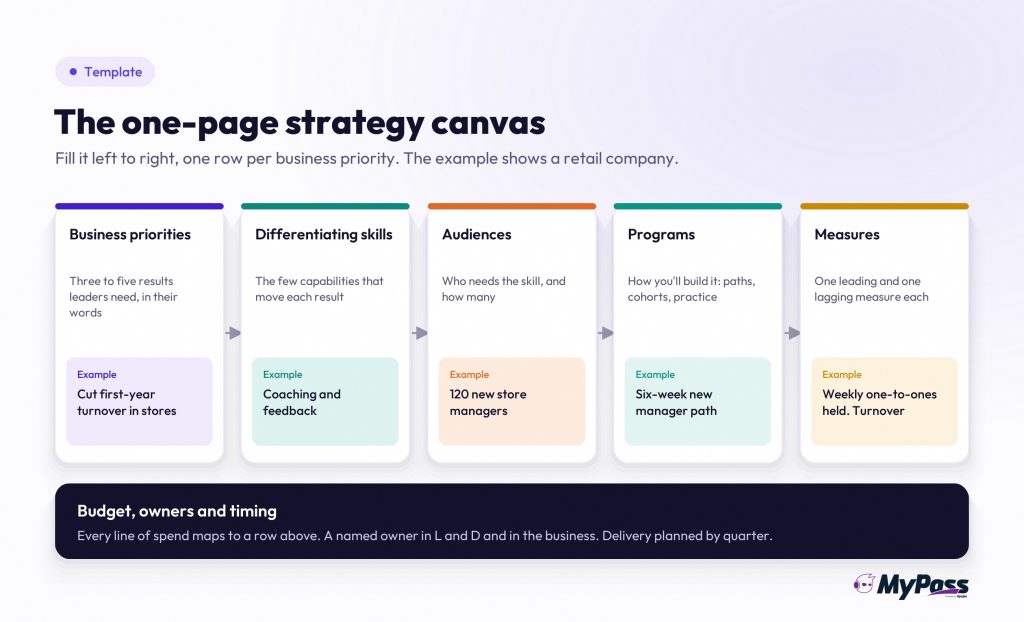
Include the business context, priority capabilities and their value, target audiences, learning approach, governance and funding, operating model, technology, links to talent processes, measures, a roadmap with pilots, and a review schedule. Then summarize it on one page for leaders, with one row per business priority.
No official body publishes a mandatory template, but the frameworks support these sections for the full document.
1. Business context. The strategy and pressures the business faces next year.
2. Priority capabilities and value at stake. The few skills that matter and what closing each gap is worth.
3. Priority audiences. Who needs each capability, and how many people.
4. Learning approach. The mix of formal learning, on-the-job practice and coaching, plus how you'll support transfer.
5. Governance and funding. Who decides, who pays and how trade-offs are made.
6. Operating model and roles. What the central team does, what business teams own and how subject experts contribute.
7. Technology and data. The platforms you'll use and the data you'll report.
8. Talent process links. How the strategy connects to hiring, performance, mobility and succession.
9. Measurement. Business, learning and operational measures, agreed with sponsors.
10. Roadmap. Pilots, launches and milestones by quarter.
11. Review schedule. Quarterly check-ins and a yearly refresh.
The one-page summary template
Leaders rarely read a 20-page document. Give them one page with one row per priority. Copy this table into a document or spreadsheet. The first two rows are examples.
| Business priority | Capability | Audience | Program | Measures | Owners | When |
| Cut first-year turnover in stores | Coaching and feedback | 120 new store managers | Six-week new manager path with monthly cohort sessions | Leading: weekly one-to-ones held. Result: first-year turnover | Head of Retail Ops and L and D lead | Q1 to Q2 |
| Keep expertise as senior engineers retire | Knowledge transfer and mentoring | Senior engineers and successors | Shadowing plan plus captured SOP courses | Leading: tasks signed off. Result: escalations to retirees | Engineering Director and L and D lead | Q1 to Q4 |
Key point
If a row doesn't start with a business priority a leader would recognize, it doesn't belong on the page. Move it to the plan, or drop it.
What Should Be on Your 2027 L and D Priority List?
That depends on your business outcomes, but research points to six strong candidates for 2027: a repeatable reskilling process, manager capability, knowledge transfer, AI skills with critical thinking, AI literacy for EU compliance, and replacing the early-career learning that automation is removing. Test each against your own priorities.
- A repeatable reskilling process. Gartner's 2027 L and D trends call for a repeatable process rather than a series of disconnected programs.
- Manager capability. Gartner's CHRO priorities include redesigning the leader role, and only 8 percent of HR leaders believe their managers have the skills to use AI effectively.
- Knowledge transfer. Gartner warns organizations are losing critical knowledge faster than they're transferring it.
- AI skills and critical thinking. Gartner flags cognitive surrender, relying on AI instead of thinking critically, as a 2027 risk to train against.
- AI literacy if you operate in the EU. Article 4 of the EU AI Act has required AI literacy measures since 2 February 2025, with national enforcement from 2 August 2026.
- Early-career development. Gartner found AI is reducing some entry-level hiring at nearly a quarter of organizations, and McKinsey recommends redesigning early-career paths as automation takes over routine tasks.
Why Do L and D Strategies Fail?
They usually fail for predictable reasons: weak alignment with the business, no evidence of impact, poor transfer to the job, being seen as a cost center, gaps in the L and D team's own skills, low priority from leaders, and talent structures that can't keep up. No reliable overall failure rate exists, but each cause is well documented.
1. Weak alignment. Only 33 percent of L and D leaders say their strategy aligns with business strategy (Bersin, 2025), and only 26 percent of companies believe they're building the skills their strategy needs (Bersin, 2026).
2. No evidence of impact. CIPD found almost half of L and D teams have no systematic approach to evaluation, and fewer than 1 in 10 strongly agree they make evidence-informed decisions.
3. Poor transfer to the job. Only 46 percent have a process to support learning transfer (CIPD). If managers don't reinforce new skills, they fade.
4. Seen as a cost center. When L and D reports courses and hours rather than outcomes, leaders judge it on cost. In a year when a quarter expect cuts, cost centers get cut.
5. L and D skill gaps. Only 10 percent of organizations say their L and D team is proficient with generative AI (Bersin, 2025).
6. Low priority from business leaders. CIPD lists it alongside lack of capacity and lack of insight into what works.
7. Structures that lag. 48 percent of HR leaders say skills demand is changing faster than their structures can support (Gartner, 2025).
Key point
Avoid the myth that 90 percent of training is forgotten within a week. It's a loose paraphrase of 19th-century research on memorizing nonsense syllables, and skeptical executives know it. The case for practice and reinforcement stands without it.
How Do You Measure a Learning and Development Strategy?
Agree a small set of business results with sponsors before launch, track whether people can apply what they learned, and save full ROI studies for your most expensive or strategic programs. Completions and satisfaction belong on an operational dashboard, not in your impact report. Fewer than a quarter of organizations measure against business goals at all.
The three main measurement models
| Model | What it adds | Best used for |
| Kirkpatrick and New World Kirkpatrick | Four levels: reaction, learning, behavior, results. The newer version plans from the business result backward | Agreeing expectations with sponsors up front |
| Phillips ROI Methodology | A fifth level, ROI, plus isolating the program's effect from other causes | Your most expensive or strategic programs |
| Thalheimer's LTEM | Eight tiers that separate knowledge from real task competence and transfer | Checking whether people can actually do the job |
How deep to evaluate each program
You don't need ROI for everything. ROI Institute suggests evaluating reaction for 90 to 100 percent of programs, learning for 60 to 80 percent, application on the job for 30 to 50 percent, business impact for 10 to 20 percent, and full ROI for only 5 to 10 percent.
Leading, lagging and activity measures
| Type | What it tells you | Examples |
| Activity | Whether the program ran | Enrollments, completions, attendance, satisfaction |
| Leading | Whether behavior is changing | Practice completed, skills assessed, tasks signed off, manager observations |
| Lagging | Whether the business result moved | Turnover, time to proficiency, error rates, sales, internal moves, audit findings |
McKinsey's 2026 guidance is to measure outcomes, not activity, starting with time to proficiency, internal redeployment and productivity or customer gains. A useful test for every initiative is whether it helps the business make money, save money or reduce risk. Our guide on how to calculate training ROI shows how to put a value on results.
How Do You Budget and Defend an L and D Strategy?
Tie every line of spend to a strategic priority, make the trade-offs visible, and say clearly what you won't fund. There's no reliable formula for setting an L and D budget, so your best defense is a short list of priorities that leaders co-own, with results agreed in advance.
- Know where the money goes. ATD's data shows the average budget split is 66 percent internal services, 23 percent external services and 11 percent tuition reimbursement.
- Make trade-offs visible. Gartner advises showing leaders what each choice costs and regularly tying spend to core business priorities.
- Prioritize core skills. Gartner reports that strengthening core skills has roughly five times the impact on talent readiness compared with focusing only on new skills.
- Use the efficiency story honestly. ATD's data shows spend per employee falling while learning hours rose, which supports a doing-more-with-less message, provided you can show results held.
- Test AI savings, don't bank them. Claims of 40 to 50 percent L and D cost cuts from AI come from vendors. Pilot first, then budget on what you measure.
- Watch per-seat costs. Tools that charge for every registered learner get expensive as audiences grow, especially for occasional learners like contractors or seasonal staff.
For making the case to leaders, see how to get training budget.
How Should AI Shape Your 2027 L and D Strategy?
Use AI to speed up content production, support practice and coaching, and personalize learning, but govern it. Adoption is wide but shallow: 37 percent of US organizations use AI in learning, yet it accounts for only 2 percent of training hours. Plan for real risks such as over-reliance, bias and weaker manager skills.
Where AI helps most
- Faster content production. The most common use of AI in L and D today. It shortens the long build cycle for new courses.
- AI coaching and practice. 38 percent of HR leaders are piloting or using AI coaches for leadership development (Gartner). Treat Gartner's prediction that 40 percent of employees will first be coached by AI in a new role by 2028 as a forecast, not a fact.
- Learning in the flow of work. Short, targeted support tied to current priorities, as McKinsey recommends.
- Skills data. AI can estimate people's skills from their work history, but that's modeling, not measurement. Check estimates with managers or assessments.
The risks to plan for
- Cognitive surrender. Gartner's term for relying on AI instead of thinking critically. Gartner suggests hallucination hunt exercises and an untrusted-until-validated mindset.
- Weaker manager skills. If AI does all the coaching, managers may lose their own coaching ability.
- Bias and data risk. Vet vendors carefully and decide what data the tools can see.
- Unclear accountability. Only 24 percent of leadership teams agree on who is accountable for AI agents (Gartner, 2026).
The EU AI Act sets a minimum
If you operate in the EU, Article 4 of the AI Act requires AI literacy measures for staff who use AI systems. The European Commission says no certificate is required, but relying only on instructions for use is generally not enough. The 2026 AI Omnibus kept the duty and put the focus on documenting training. Stricter high-risk rules for some employment uses apply from 2 December 2027, so check with your legal team if AI-driven assessments or skills data feed into employment decisions. This isn't legal advice.
How Can an LMS Support Your Learning and Development Strategy?
An LMS turns the strategy into delivery and data. It hosts each priority program, sequences it for each audience, records who completed and passed what, and produces the reports you'll take back to sponsors each quarter. The right platform also keeps costs predictable as your audience grows.
Here's how MyPass LMS supports each step of the strategy.
| Strategy step | How MyPass LMS helps |
| Design learning journeys | Learning paths with sequencing give each audience its own route through a program |
| Build content quickly | The AI course builder drafts courses from a prompt or document, and built-in SCORM authoring lets your team edit them |
| Run blended programs | Instructor-led session management and QR code attendance track live sessions alongside online courses |
| Measure leading indicators | Assessments, AI-assisted grading with instructor override, and certificates with expiry and renewal tracking |
| Report to sponsors | Training analytics and dynamic reporting by team, plus one-click audit reports for compliance |
| Reach global teams | AI translation into more than 120 languages |
| Keep costs predictable | Unlimited registered users on every plan, so adding learners doesn't add seat fees |
Where This Comes From
Spend, hours, budget outlook, budget split, team size and AI adoption figures come from ATD's 2026 State of the Industry report (2025 data) and Training magazine's 2025 Training Industry Report.
Priorities and trends come from Gartner's 6 October 2026 CHRO priorities release, HR Dive's 3 November 2026 report on Gartner's L and D trends for 2027, Gartner releases from 2024 and 2025, SHRM's 2026 survey of L and D executives, LinkedIn's 2025 Workplace Learning Report and the World Economic Forum's Future of Jobs Report 2025.
Frameworks come from McKinsey (2019 and 2026), The Josh Bersin Company (2021 to 2026), Gartner and CIPD's Learning at Work 2023. Bersin's maturity multipliers are self-reported correlations, and Bersin sells an AI learning platform.
The 70-20-10 evidence comes from ATD's review and a University of Twente article from April 2026. Measurement models come from Kirkpatrick, Phillips and ROI Institute, and Thalheimer's LTEM.
EU AI Act guidance comes from the European Commission's AI literacy Q and A and Lewis Silkin's July 2026 summary of the AI Omnibus.
MyPass LMS features come from our own product documentation.
The bottom line
A learning and development strategy for 2027 isn't a longer list of courses. It's an investment case: a few capabilities the business is paying to build, co-owned by the leaders who need them, and judged on results agreed before anything launches.
The evidence behind it is clear in places and thin in others. Alignment, transfer and measurement are where most strategies fall down. The 70-20-10 ratio, maturity multipliers and AI savings claims need careful handling, because skeptical executives will spot them.
Start with the conversations this week. Ask five leaders what results they need next year, and write the first row of your one-page strategy from their answers.
Frequently asked questions
What are the key components of a learning and development strategy?
Business priorities, the capabilities that support them, target audiences, learning journeys, owners, measures, budget, a roadmap and a review schedule.
What is the 70-20-10 model?
An idea that 70 percent of learning comes from experience, 20 percent from others and 10 percent from courses. It isn't research-proven, so use it as a direction, not a budget split.
How do you measure the success of an L and D strategy?
Agree business results with sponsors before launch, track behavior change on priority programs, and use full ROI studies only for your most strategic programs.
How often should you update an L and D strategy?
Review progress with sponsors every quarter and refresh the strategy at least once a year, or sooner if business priorities change.
Sources
- ATD, 2026 State of the Industry report (2025 data, 340 organizations), ATD blog of May 2026 and the SOIR 2026 white paper: $846 per employee (down $408), 16.7 learning hours, budget outlook 28 percent up and 25 percent down, budget split 66/23/11, median team of 6, 224 employees per TD staff member in SMBs, AI embedded in learning at 17 percent of SMBs to 42 percent of extra-large organizations, fewer than a quarter measure against organizational goals.
- Training magazine, 2025 Training Industry Report (November 2025): $102.8 billion US spend, up 4.9 percent; $874 per learner; $1,091 small, $782 midsize, $468 large; 40 hours per learner; 41 percent increased and 16 percent decreased budgets; 37 percent use AI in learning; AI 2 percent of training hours; 41 percent cite lack of resources.
- Gartner, CHROs' top priorities for 2027, press release 6 October 2026; Gartner L and D trends for 2027 via HR Dive, 3 November 2026; Gartner press releases of 29 October 2024 (learning manifesto), 11 March 2025 (skills gaps at scale), 8 October 2025 (managers and AI); Gartner article on L and D strategies.
- World Economic Forum, Future of Jobs Report 2025.
- McKinsey, 'The essential components of a successful L and D strategy' (2019, ACADEMIES framework) and 'Reimagine learning and development for the AI age' (2026).
- The Josh Bersin Company: 'It's Time for an L and D Revolution' (2025), 'Definitive Guide to Corporate Learning' executive summary (2026), capability academy article (2021), skills-based organization article (2023). Bersin sells an AI learning platform; maturity multipliers are self-reported correlations.
- CIPD, Learning at Work 2023 executive summary.
- ATD, '70-20-10: Where is the evidence?' and University of Twente, 'Rethinking the 70-20-10 rule', April 2026.
- LinkedIn Workplace Learning Report 2025 (latest edition found).
- SHRM, 2026 L and D executives' priorities (223 L and D executives).
- Kirkpatrick, New World Kirkpatrick (via TrainingZone), Phillips ROI Methodology (Training Industry and ROI Institute), Thalheimer's LTEM (via Thiagi, 2019).
- European Commission, AI literacy questions and answers (Article 4 of the EU AI Act); Lewis Silkin on the AI Omnibus final approval, July 2026.
- Mastercard newsroom, 2025, and Deloitte Human Capital Trends 2025 (Medtronic). Company-reported results.
- MyPass LMS features: the Kprise product brief.
Keep reading
L&D strategy
What Is Learning and Development (L&D)?
AI in learning