
Critical Thinking Training in the AI Era: How to Stop Cognitive Surrender at Work
On this page 12 sections
- What Is Cognitive Surrender?
- Why Is Critical Thinking Training Urgent in 2027?
- What Does the Research Show About AI and Critical Thinking?
- What Should Critical Thinking Training Cover Now?
- What Is a Hallucination Hunt and How Do You Run One?
- How Do You Build Critical Thinking Into Everyday AI Use?
- How Do You Measure Critical Thinking Skills?
- How Can an LMS Support Critical Thinking Training?
- Where This Comes From
- The bottom line
- Frequently asked questions
- Sources
Critical thinking training for the AI era teaches employees to question, check and improve AI outputs instead of accepting them. It targets cognitive surrender, where people adopt an AI answer with little scrutiny. The most effective approach combines short practice exercises such as hallucination hunts with simple verification habits matched to how risky the work is.
What Is Cognitive Surrender?
Cognitive surrender is when someone accepts an AI's answer with little or no scrutiny, even over their own instinct or reasoning. Wharton researchers Steven Shaw and Gideon Nave coined the term in 2026. Gartner describes it as relying on outside sources such as AI instead of thinking independently.
It isn't the same as using AI. Handing a task to a tool on purpose, while staying in charge of the result, is normal and useful. Researchers call that cognitive offloading. Surrender is what happens when the checking step quietly disappears.
| Healthy offloading | Cognitive surrender | |
| Who decides | You decide what to hand off and why | The tool's answer becomes the decision |
| What happens to the output | Checked against what you know or a source | Accepted because it sounds right |
| Confidence | Matches how much you've verified | Higher than the checking justifies |
| Example | Using AI to draft an email, then editing it for accuracy and tone | Sending an AI summary of a contract to a client without reading the contract |
The goal of training isn't to stop people using AI. It's to keep them in the decision.
Why Is Critical Thinking Training Urgent in 2027?
Because AI use is now routine and the evidence shows people often trust it too much. Gartner lists combating cognitive surrender as one of its four L and D trends for 2027, employers already rank analytical thinking as a core skill, and costly real-world mistakes from unchecked AI output keep making headlines.
- Gartner has made it an L and D priority. Its 2027 trends say training needs to combat cognitive surrender. Gartner's Rebecca Burton put it simply: "We actively should be fighting against this."
- Employers already value the skill. In the World Economic Forum's Future of Jobs Report 2025, seven in 10 companies said analytical thinking is a core skill, the top core skill for the third edition running.
- Unchecked AI has real costs. In 2023 a US federal judge fined two lawyers and their firm $5,000 after they filed a brief citing court cases ChatGPT had invented. In 2025 Deloitte agreed to partially refund the Australian government after a report it delivered was found to contain references to non-existent papers and a made-up quote from a court judgment.
Key point
None of these were failures of the technology alone. In each case, a person had the chance to check the output and didn't. That's the gap training can close.
What Does the Research Show About AI and Critical Thinking?
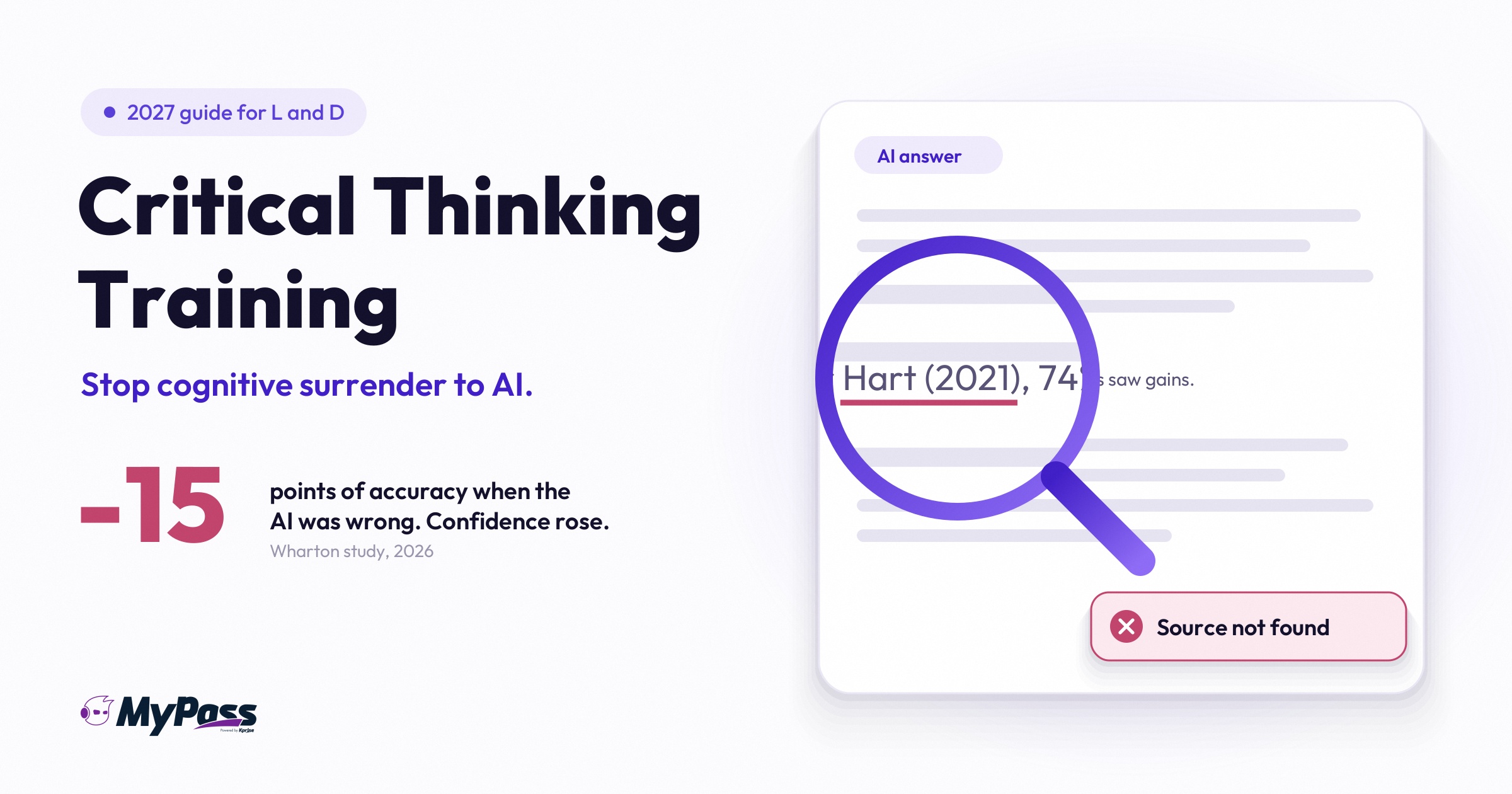
Studies so far point the same way: people who lean on AI more, or trust it more, tend to check less. A 2026 Wharton experiment found accuracy dropped when the AI was wrong while confidence still rose. The findings are early, and some are correlational, so treat them as a warning sign rather than final proof.
| Study | Who | Key finding | Caveat |
| Shaw and Nave, Wharton, 2026 | 1,372 participants, three experiments, 9,593 reasoning questions | Compared with no AI, accuracy rose about 25 points when the AI was right and fell about 15 points when it was wrong. Confidence rose even after errors | Preprint, not yet peer reviewed. Lab puzzles, not real jobs |
| Lee and colleagues, Microsoft Research and Carnegie Mellon, CHI 2025 | 319 knowledge workers, 936 real examples | Higher confidence in AI was associated with less critical thinking. Higher self-confidence went with more | Self-reported survey |
| Gerlich, Societies, 2025 | 666 survey participants and 50 interviews | Heavier AI use was linked to lower critical thinking scores, mostly explained by cognitive offloading. Younger participants relied on AI more | Correlational. It can't show AI caused the lower scores |
Two details from the Wharton study matter for training. First, people who trusted AI more surrendered more. Second, adding time pressure, rewards and feedback changed overall performance but didn't remove the pattern. Telling people to be careful isn't enough. They need practice and habits.
The Microsoft and Carnegie Mellon study adds a useful point. With AI, critical thinking shifts from producing work to checking it, combining it and taking responsibility for it. That's the skill set training should now focus on.
What Should Critical Thinking Training Cover Now?
It should cover the skills people need to check AI work: questioning claims, tracing sources, spotting false premises and missing caveats, and knowing when not to use AI at all. Gartner highlights three common AI flaws to train against: fabricated or misattributed citations, missing caveats, and answers built on a false premise.
- Claim checking. Breaking an AI answer into individual claims and asking which ones matter and which ones can be verified.
- Source tracing. Opening the cited source and confirming it exists and actually says what the AI claims. Fabricated and misattributed citations are among the most common AI errors.
- Spotting false premises. Noticing when the question itself was wrong. AI tools often answer a flawed question confidently instead of challenging it.
- Finding missing caveats. Asking what's been left out, such as exceptions, dates, regional differences or conditions.
- Calibrated confidence. Matching how sure you are to how much you've checked. The Wharton finding that confidence rose after errors is exactly what this skill counters.
- Knowing when not to use AI. Some decisions need your own reasoning first, then AI as a second opinion.
These sit alongside the broader skills in our guide to soft skills training, but they need their own practice because the failure mode is new.
What Is a Hallucination Hunt and How Do You Run One?
A hallucination hunt is an exercise where learners check an AI-generated answer against primary sources that weren't produced by AI, and find the errors. Gartner recommends it as a practical way to build an 'untrusted until validated' habit. It works best with real work examples and errors you've planted deliberately.
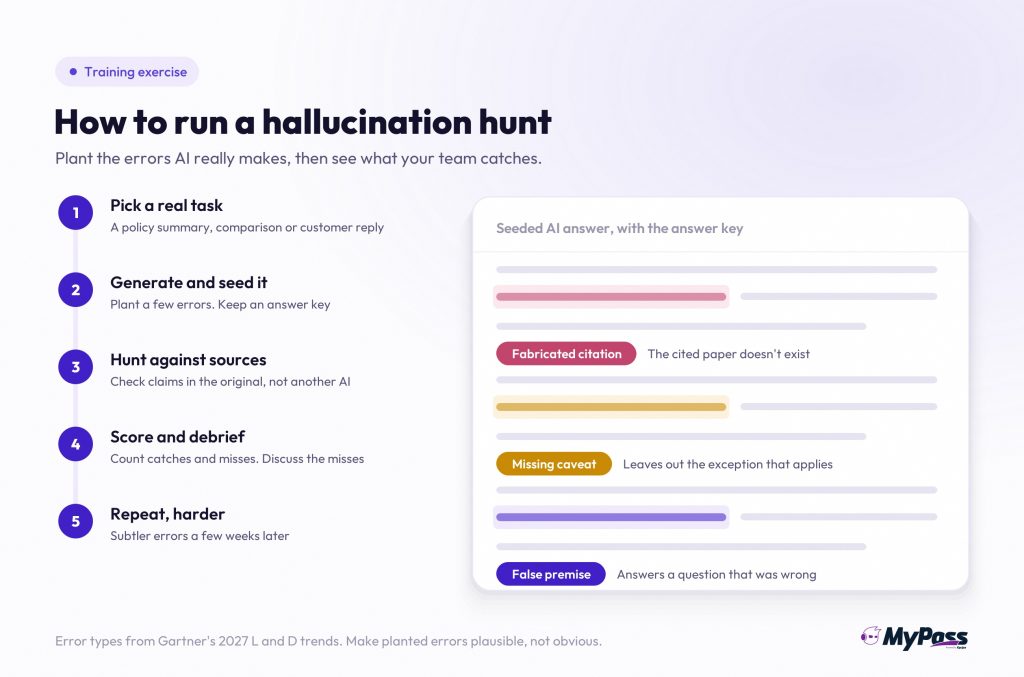
1. Pick a real task. Use something from the team's actual work, such as a policy summary, a product comparison or a customer reply.
2. Generate and seed the answer. Have AI produce the output, then plant a few errors of the kinds Gartner flags: a fake or misattributed citation, a missing caveat and a false premise. Keep a private answer key.
3. Hunt against primary sources. Learners check each claim against the original policy, data or document, not against another AI tool.
4. Score and debrief. Count which errors were caught and which were missed, and talk through why. The misses teach the most.
5. Repeat with harder examples. Run it again a few weeks later with subtler errors, so the habit sticks instead of fading after one workshop.
Key point
Make the errors realistic. If they're obvious, people learn to spot obvious errors. The ones that matter in real work are the plausible ones.
How Do You Build Critical Thinking Into Everyday AI Use?
Turn the training into habits people use every day: think first, then ask the AI; ask it for counterarguments and sources; and match how much you check to how much is at stake. A simple verification checklist tied to risk levels makes 'untrusted until validated' practical rather than exhausting.
Checking everything equally isn't realistic. Matching the effort to the stakes is.
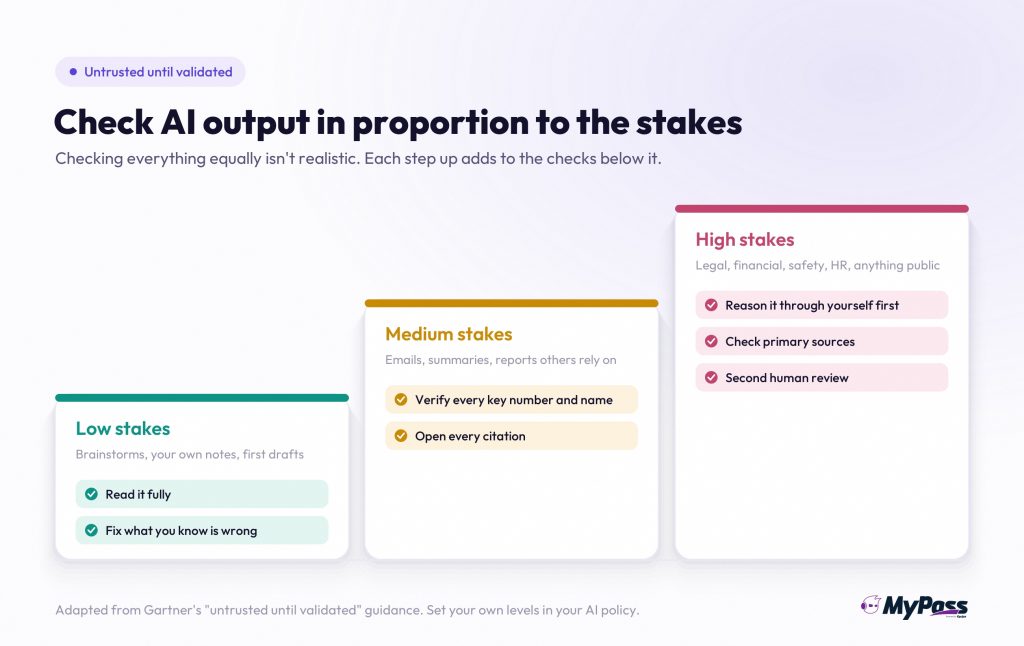
| Stakes | Examples | Minimum check |
| Low | Brainstorming, internal first drafts, meeting notes for yourself | Read it fully and fix anything you know is wrong |
| Medium | Anything a colleague or customer will rely on, such as emails, summaries and reports | Verify every number, name and claim that matters against the source. Open every citation |
| High | Legal, financial, safety, medical, HR decisions or anything public | Do your own reasoning first. Verify against primary sources. Get a second human review before it goes out |
- Think first, then ask. Write your own short answer before prompting. Comparing the two is a built-in check.
- Ask for the other side. Prompt the AI for counterarguments, risks and what it might be missing.
- Demand sources, then open them. A citation isn't evidence until you've seen it.
- Flag uncertainty. Encourage people to say "I haven't verified this yet" when sharing AI output.
Your AI policy should say the same thing as your training. Our guide to AI governance for L and D covers how to set those rules.
How Do You Measure Critical Thinking Skills?
Measure what people catch, not what they say. Use hallucination hunts as before-and-after tests, track how many seeded errors each group finds, and use scenario-based assessments where the right answer requires rejecting a plausible AI output. Self-ratings alone tell you little, because overconfidence is part of the problem.
- Error detection rate. The share of planted errors learners catch, measured before training and again a few weeks after.
- Scenario assessments. Questions that show an AI answer and ask what's wrong with it, or whether it's safe to use.
- Confidence calibration. Ask learners how sure they are, then compare that with how often they're right. Good training should close the gap.
- Real-work signals. Fewer AI-related errors found in reviews, audits or customer complaints over time.
For the wider set of measures, see our guide to training metrics and KPIs.
How Can an LMS Support Critical Thinking Training?
An LMS lets you deliver the practice at scale, test the skill properly and track improvement over time. Workshops build the habit. The LMS keeps it going with repeat exercises, scenario assessments and reporting, so critical thinking becomes part of ongoing training rather than a one-off session.
Here's how MyPass LMS supports it.
- Build hallucination hunts as assessments. Built-in authoring and assessments let you show an AI answer with planted errors and ask learners to find them. See built-in authoring and assessments.
- Practice the habit when you build content. The MyPass LMS AI course builder drafts courses from a prompt or document, and the training team reviews them before publishing. That's the same 'untrusted until validated' habit you're teaching.
- Keep a human in the loop on grading. AI-assisted grading comes with instructor override, so a person can review open answers about why an output is wrong.
- Space the practice out. Learning paths sequence repeat exercises over weeks, which helps the habit last longer than a single workshop.
- Run the live workshops. Instructor-led session management and QR code attendance track in-person hallucination hunts alongside online modules.
- Track progress. Training analytics and dynamic reporting show error detection rates by team over time.
For the broader picture, see our guide to AI in employee training.
Where This Comes From
The Gartner material comes from HR Dive's report on Gartner's L and D trends for 2027, published 3 November 2026, quoting Gartner's Rebecca Burton.
The Wharton findings come from Shaw and Nave's 2026 preprint 'Thinking, Fast, Slow, and Artificial', which had not completed peer review at the time of writing.
The other studies are Lee and colleagues at Microsoft Research and Carnegie Mellon (CHI 2025) and Gerlich (Societies, 2025). The skills figure comes from the World Economic Forum's Future of Jobs Report 2025.
The real-world examples come from the Mata v. Avianca sanctions order of 22 June 2023 and Fortune's report of 7 October 2025 on Deloitte Australia.
MyPass LMS features come from our own product documentation.
The bottom line
AI tools aren't going away, and they shouldn't. The risk isn't that people use AI. It's that they stop checking it, and research suggests confidence can rise exactly when accuracy falls.
Critical thinking training for 2027 is practical: teach people to spot the errors AI really makes, give them habits that match checking to stakes, and test the skill with real exercises rather than self-ratings.
Start with one hallucination hunt using your own team's work. What people miss will tell you exactly what to train next.
Frequently asked questions
What is cognitive surrender?
Accepting an AI's answer with little or no scrutiny, even over your own reasoning. Wharton researchers coined the term in 2026.
Is cognitive offloading bad?
Not by itself. Handing a task to a tool on purpose and checking the result is healthy. It becomes a problem when the checking stops.
What is a hallucination hunt?
A training exercise where learners check an AI answer against primary, non-AI sources to find fabricated citations, missing caveats and false premises.
How long should critical thinking training take?
A first workshop can take an hour or two. The habit builds through repeat exercises spaced over several weeks, not a single session.
Sources
- Gartner, via HR Dive, '4 trends to expect in L and D in 2027', 3 November 2026. Trend 4: training needs to combat cognitive surrender. Hallucination hunt exercises and the 'untrusted until validated' mindset, from Gartner's Rebecca Burton.
- Shaw and Nave, 'Thinking, Fast, Slow, and Artificial: How AI is Reshaping Human Reasoning and the Rise of Cognitive Surrender', Wharton School preprint on SSRN, 2026. Three preregistered experiments, 1,372 participants, 9,593 trials.
- Lee, Sarkar, Tankelevitch and others, 'The Impact of Generative AI on Critical Thinking', CHI 2025, Microsoft Research and Carnegie Mellon University. Survey of 319 knowledge workers sharing 936 examples.
- Gerlich, 'AI Tools in Society: Impacts on Cognitive Offloading and the Future of Critical Thinking', Societies, January 2025. 666 survey participants and 50 interviews. Correlational.
- World Economic Forum, Future of Jobs Report 2025, skills outlook. Seven in 10 companies consider analytical thinking a core skill.
- Mata v. Avianca, US District Court for the Southern District of New York, sanctions order of 22 June 2023, as reported by LawSites.
- Fortune, 7 October 2025, on Deloitte Australia's partial refund for a government report containing AI-generated errors.
- MyPass LMS features: the Kprise product brief.
Keep reading

Choosing an LMS
Critical LMS Implementation Mistakes to Avoid
AI in learning
AI Governance for L&D: Closing the Gap
AI in learning